




Policy
What Work Does Generative AI Do?
Essays SEP 8, 2026
By: Alexander Bick, Adam Blandin, David Deming, Tyler Schumacher
AI, Tech & Energy
Labor, Wages & Worker Power

This is a weekly post we publish on Fridays with links to articles that touch on economic inequality and growth. The first section is a round-up of what Equitable Growth has published this week and the second is work we’re highlighting from elsewhere. We won’t be the first to share these articles, but we hope by taking a look back at the whole week, we can put them in context.
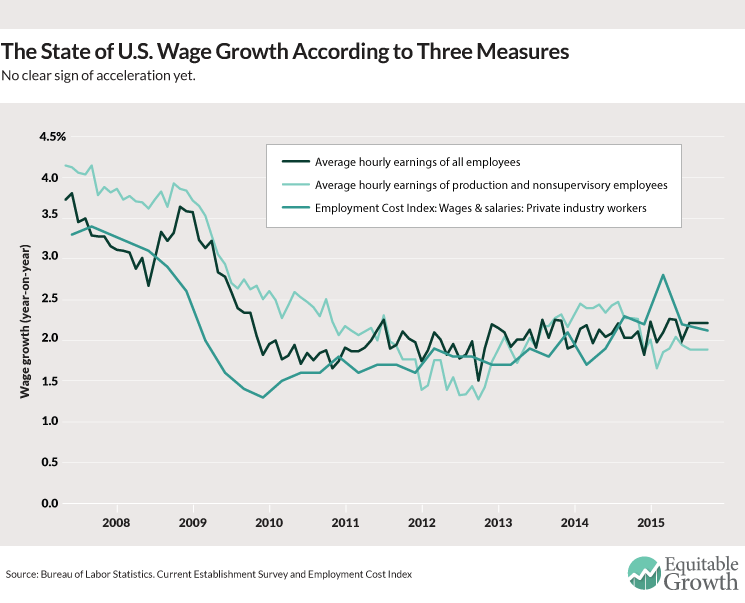
Last week, we got fresh data on U.S. wage and compensation growth for the third quarter of 2015, which showed no pick-up in wage growth. And while wage growth seemed to pick up in today’s employment situation report for October, there’s still no conclusive evidence of accelerating wage growth.
One of the major concerns about the post-Great Recession labor market has been that the millions of workers out of a job for 27 weeks or longer would be locked out of future jobs. But a new study used fake resumes to show that length of unemployment isn’t a detriment (for some workers) for getting called for an interview.
A new report by economists Anne Case and recent Nobel Prize winner Angus Deaton shows an alarming increase in mortality among middle-age whites in the United States. The reasons for this increase aren’t definitively known, but economic insecurity seems like a likely culprit.
Looking back at the efforts to rein in budget deficits so soon after the Great Recession shows the many problems with that approach. In fact, it may have hurt the potential growth of gross domestic product. And that has important implications for our conversations about secular stagnation.
Following this morning’s jobs report, Ben Zipperer takes a look at the stagnation of the employment rate for prime-age workers and links that to the new report from Case and Deaton.
Jeff Guo looks at research as to why women are sometimes hesitant to compete against men, and comes away with a new argument for hiring quotas. This form of affirmative action can increase the number of qualified women who apply for a job. [wonkblog (opens in a new tab)]
When accelerating wage growth shows up, will the acceleration be gradual or quick? Adam Ozimek looks at the relationship between unemployment and the Employment Cost Index among U.S. metro areas and finds that the acceleration will likely be smooth and steady. [moody’s (opens in a new tab)]
When talking about how economic instability abroad threatens the U.S. economy, economists often mention that the United States is a relatively closed economy. But that might not be the case anymore, and that has important implications for when the Federal Reserve raises interest rates, according to Menzie Chinn. [econbrowser (opens in a new tab)]
A new Pew Research Center survey shows the amount of stress that working parents experience. Claire Cain Miller discusses how, while both parents working is increasingly becoming the norm, “public policy, workplace structure and mores have not seemed to adjust.” [the upshot (opens in a new tab)]
Household debt growth has remained tepid, at least compared to last decade, but who is this new credit flowing to? Four economists from the Federal Reserve Bank of New York find that most household debt is flowing more to higher-income households, with the major exception of student debt. [liberty street economics (opens in a new tab)]
Essays SEP 8, 2026
By: Alexander Bick, Adam Blandin, David Deming, Tyler Schumacher

Essays SEP 2, 2026
By: Megan Rivera

Essays AUG 31, 2026
By: Christopher Bangert-Drowns
Get updates on our latest research, event announcements, and policy insights delivered straight to your inbox. Stay connected with the leading voices on equitable growth.


