



Policy
What Work Does Generative AI Do?
Essays SEP 8, 2026
By: Alexander Bick, Adam Blandin, David Deming, Tyler Schumacher
AI, Tech & Energy
Labor, Wages & Worker Power

This is a weekly post we publish on Fridays with links to articles that touch on economic inequality and growth. The first section is a round-up of what Equitable Growth has published this week and the second is work we’re highlighting from elsewhere. We won’t be the first to share these articles, but we hope by taking a look back at the whole week, we can put them in context.
The rate at which minimum-wage workers move to higher-paying jobs has declined quite a bit in recent years. This new analysis is important for debates about the proper level of the minimum wage, but it’s also a reminder of the larger problems in the U.S. labor market.
Princeton University economist Angus Deaton won this year’s Nobel Prize in economics. His noted work looks at how understanding the micro data, and not ignoring inequality, can help us better understand the larger macroeconomic phenomena of the world.
While short-term interest rates in the United States have been at zero for almost seven years, long-term rates have been on the decline for several decades now. The interplay between lower long-term rates and extremely low short-term rates has important ramifications for monetary policy.
Federal Reserve Board governors aren’t known for airing their disagreements with Fed chairs in public. Governor Lael Brainard gave a speech this week, however, saying interest rates might not be hiked this year—contrary to recent statements by Fed Chair Janet Yellen and Vice Chair Stanley Fischer. University of Oregon economist Tim Duy explains the importance of Governor Brainard doing this. [fed watch (opens in a new tab)]
Is the “gig economy” all hype or an actually important trend in the labor market? It’s hard to tell with the existing data we have for the United States. But the Department of Labor and other parts of the federal government are starting to rectify this problem, Lydia DePillis reports. [wonkblog (opens in a new tab)]
One of the many ideas for decreasing health care spending in the United States has been to increase people’s exposure to prices. A new paper shows that this has reduced spending, but not the wasteful kind. Sarah Kliff writes about how this could prompt a rethink of how to reduce health care costs. [vox (opens in a new tab)]
Even though it was passed more than 80 years ago and repealed more than 15 years ago, the Glass-Steagall Act continues to come up in conversations about regulation of the finance industry. Should reinstating a divide between commercial and investment banks be central for regulating finance? Mike Konczal says no. [rortybomb (opens in a new tab)]
Analysts of the global oil market have long had key assumptions about the economics of the commodity stuck in their brains. But perhaps those assumptions are no longer the case. Martin Sandbu discusses a new paper that details how much the oil market has changed. [free lunch (opens in a new tab)]
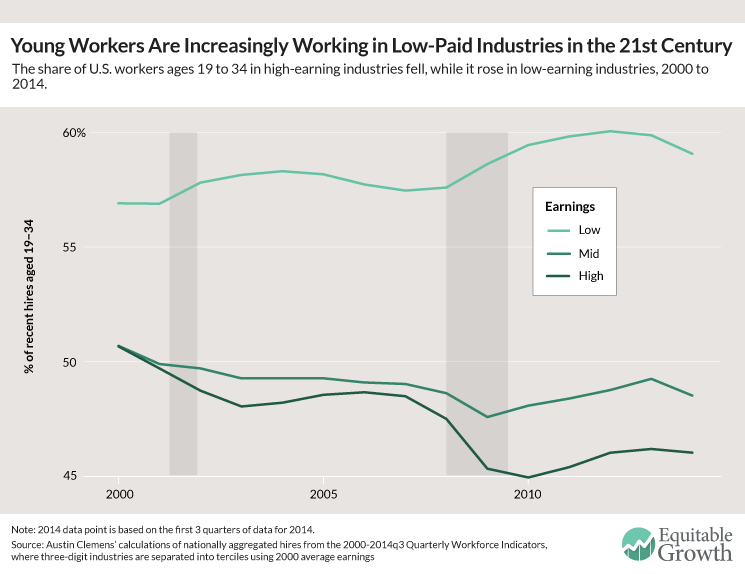
Figure from “The pernicious effects of growing student debt on the economic security of young workers” by Kavya Vaghul
Essays SEP 8, 2026
By: Alexander Bick, Adam Blandin, David Deming, Tyler Schumacher

Essays SEP 2, 2026
By: Megan Rivera

Essays AUG 31, 2026
By: Christopher Bangert-Drowns
Get updates on our latest research, event announcements, and policy insights delivered straight to your inbox. Stay connected with the leading voices on equitable growth.


