



Policy
What Work Does Generative AI Do?
Essays SEP 8, 2026
By: Alexander Bick, Adam Blandin, David Deming, Tyler Schumacher
AI, Tech & Energy
Labor, Wages & Worker Power

This is a weekly post we publish on Fridays with links to articles that touch on economic inequality and growth. The first section is a round-up of what Equitable Growth has published this week and the second is work we’re highlighting from elsewhere. We won’t be the first to share these articles, but we hope by taking a look back at the whole week, we can put them in context.
Talk about taxing business and most people will think of the corporate income tax. Most U.S. business income, however, is now earned by pass-through businesses like partnerships. This income is more unequally distributed, less taxed, and harder to track in the data than traditional corporate income.
In the wake of the housing bubble’s burst and the resulting Great Recession, economists and the general public have become more skeptical about the merits of private debt—and for good reason. New research by economists Atif Mian and Emil Verner of Princeton University and Amir Sufi of the University of Chicago shows how high levels of private debt affects economic growth and stability.
Economists continue to debate how much of the U.S. productivity gains have gone to the owners of capital instead of wage earners in recent years. That’s an important debate, but what if the resulting decline in the labor share of income itself affects the rate of measured productivity gains?
The job ladder, or the movement of workers to higher-paying jobs over the course of their career, has long been an important source of wages for workers. But it seems to have broken down since the Great Recession. In fact, as Marshall Steinbaum and Austin Clemens show, the ladder has been broken for the entire 21st century.
Today’s data from the U.S. Bureau of Labor Statistics show that the labor market is far from fully recovered. While the unemployment rate is close to 5 percent, the employment rate for workers 25 to 54 years old is still quite weak. Ben Zipperer shows how historically lackluster the labor market recovery has been by the latter metric.
Economics has become increasingly empirical and has gone through what some people call a “credibility revolution.” But there is still some reason to be concerned about taking this triumphalism too far, as economics isn’t exactly a lab science. Noah Smith discusses some of the tensions of “theory vs. data.” [noahpinion (opens in a new tab)]
The rise of “sharing economy” companies like Uber and Airbnb has raised concerns about the future of the labor market and the relationship between employer and employees. Steve Randy Waldman suggests that changing the requirements for 1099 status might be an interesting way to address the potential problem. [interfluidity (opens in a new tab)]
Policymakers are considering repealing the “Cadillac tax”—a tax on expensive health insurance plans that was part of the Affordable Care Act. Catherine Rampell argues that the tax, by urging companies to find more affordable insurance plans, might actually help boost cash wages for workers. [wa post (opens in a new tab)]
The United Kingdom, like the United States, has experienced a slowdown in productivity growth in recent years. This slowdown is almost always interpreted as a problem with the supply side of the economy, but Jeremy Smith argues the U.K. slowdown is mainly about demand. [prime economics (opens in a new tab)]
MIT economist Amy Finkelstein has done pioneering research on insurance markets and health economics and won the John Bates Clark Medal, given to the leading American economist under 40, in 2012. Douglas Clement interviews her about her research. [minneapolis fed (opens in a new tab)]
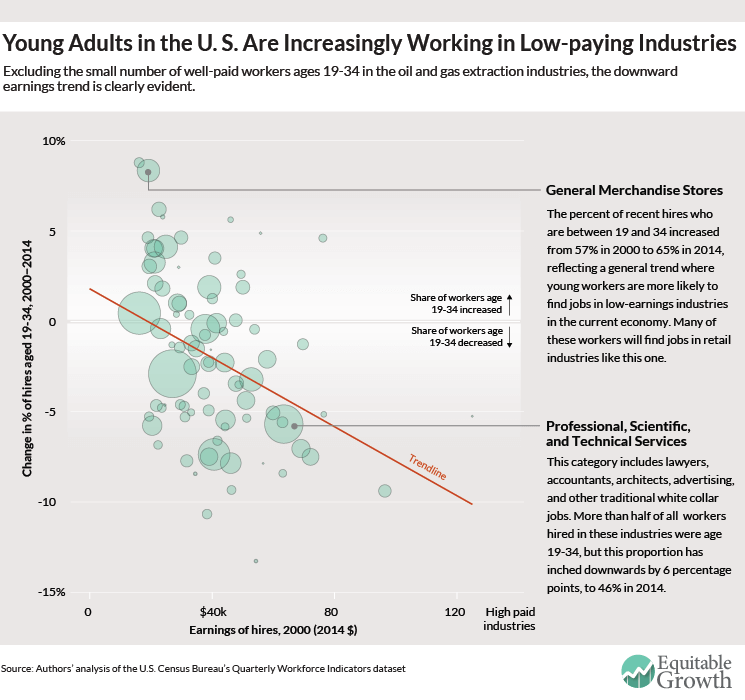
Figure from “What happened to the job ladder in the 21st century?” by Marshall Steinbaum and Austin Clemens.
Essays SEP 8, 2026
By: Alexander Bick, Adam Blandin, David Deming, Tyler Schumacher

Essays SEP 2, 2026
By: Megan Rivera

Essays AUG 31, 2026
By: Christopher Bangert-Drowns
Get updates on our latest research, event announcements, and policy insights delivered straight to your inbox. Stay connected with the leading voices on equitable growth.


