




Policy
What Work Does Generative AI Do?
Essays SEP 8, 2026
By: Alexander Bick, Adam Blandin, David Deming, Tyler Schumacher
AI, Tech & Energy
Labor, Wages & Worker Power
 Browse All Resources
JAN 14, 2021
By: Susan Helper

This essay is part of Boosting Wages for U.S. Workers in the New Economy (opens in a new tab), a compilation of 10 essays from leading economic thinkers who explore alternative policies for boosting wages and living standards, rooted in different structures that contribute to stagnant and unequal wages. The authors in the new book demonstrate that efforts to improve workers’ access to good jobs do not need to be limited to traditional labor policy. Policies relating to macroeconomics, to social services, and to market concentration also have direct relevance to wage levels and inequality, and can be useful tools for addressing them.
To read more about Boosting Wages for U.S. Workers in the New Economy 20 and download the full collection of essays, click here.
The two vignettes that open my essay illustrate the serious job-quality issues faced by U.S. workers and small businesses due to supply chain challenges. These challenges are due to the current structure of supply chains that reduce the bargaining power of workers and small businesses alike.
“After paying about $1,500 for home office equipment: a computer, two headsets, and a phone line dedicated to Arise; after paying Arise to run a check on her background; after passing Arise’s voice-assessment test and signing Arise’s nondisclosure form; after paying for and passing Arise’s introductory training, to which she devoted 3 days, unpaid; after paying for and passing a certification course to provide customer service for Arise client AT&T, to which she devoted 44 unpaid days; after then being informed she had to get more training yet—an additional 10 days, for which she was told she would be paid but wasn’t; and then, after finally getting a chance to sign up for hours and do work for which she would be paid (except for her time spent waiting for technical support, or researching customer issues, or huddling with supervisors), Tami Pendergraft spent 3 weeks fielding telephone calls from AT&T customers, after which she received a single paycheck. For $96.12.”212
The owner of a small rubber manufacturing plant in Cleveland explained to me (prior to the coronavirus recession) the consequences of his current low-wage policy. He paid his workers about $12 per hour, resulting in frequent absenteeism, the inability to fire inattentive workers because of lack of replacements, and late fees owed to his customers. Yet even with generous assumptions about the impact of higher wages on his workers’ efficiency, he makes a convincing case that raising wages by itself wouldn’t pay off. To fill his last 10 positions, he explained, he would need to raise wages for all 60 workers, including those who haven’t complained about pay so far. To fix his problems, he believed, he would need to invest in newer, more automated equipment, and pay enough (more than $20 per hour) to attract workers who could and would tend several machines. But such equipment costs millions of dollars, and if he takes out large loans to buy this equipment quickly, then it might lead to the loss of his house. He also would have to redesign many of his products to be compatible with the new equipment. He doubts that his customers would pay more, even if quality and delivery improve. And he’s locked in competition with other low-wage manufacturers, many of them abroad; his current operations are optimized for the purchasing environment he faces. He thinks he can probably survive until retirement by slowly shrinking as his equipment wears out.213
Decisions about how firms structure their supply chains matter greatly for working Americans, yet this topic rarely takes a front seat in discussions of policies to address income inequality. The customer service agent, the factory owner, and his workers in the vignettes above suffer significantly because of supply chain dysfunction.
Firms have restructured their supply chains significantly in recent decades. They have outsourced many activities previously done in-house by full-time employees to a complex web of outside firms. These outside suppliers manufacture components and provide services such as logistics, cleaning, and information technology.
Some of this restructuring contributes to innovation. As final products become more complex, it makes sense for large firms to purchase key components from firms that specialize in that technology or process.214 Supply networks based on product specialization do not necessarily reduce wages and could have the opposite effect.
But in other cases, firms outsource so as to offload production onto firms with weak bargaining power. These supplier firms have little ability to compete except by aggressively holding down wages. Aided by rampant worker misclassification, the erosion of workers’ bargaining power, and periods of weak regulatory enforcement, these forces further erode the quality of jobs for these downstream workers. This “fissured (opens in a new tab)”215 or “low-road” model weakens innovation and suppresses wages, contributing to the erosion of U.S. workers’ standard of living.216
This essay explains how the structure of supply chains affects wages—in particular, why current models of outsourcing and offshoring manufacturing and services operations often lead to worse jobs. I propose policies to make supply chains fairer and argue that these better, “high-road” supply chains also serve other social goals, especially innovation. Specifically, I propose:
To the extent that workers are caught in supply chains with cutthroat competition, policies that attempt to upskill individual workers or contractors without changing the incentives of lead firms will not raise their wages. Thus, policies to reform supply chains will make other pro-worker policies more effective.
A supply chain is a network of firms involved in designing, producing inputs for, assembling, and distributing a good or service. (See Figure 1.)
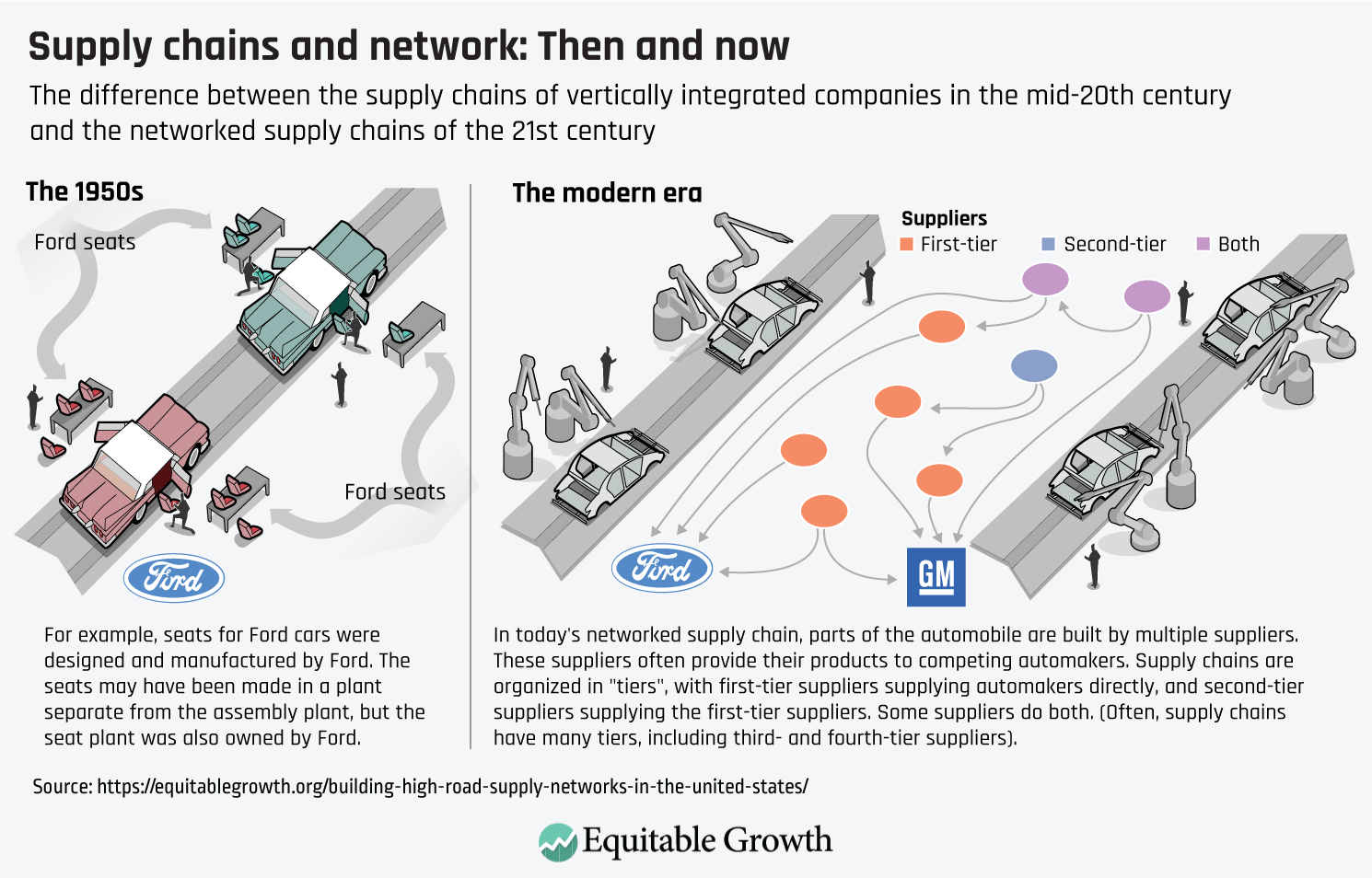
The difference between the supply chain of vertically integrated companies in the mid-20th century and the networked supply chains of the 21st century
Overall, 43 percent of U.S. workers are in supply chain industries, employed either at lead firms or their suppliers.217 Domestic U.S. firms purchase intermediate inputs equal to about 50 percent of their overall output, while intermediate inputs comprise 75 percent of the output of U.S.-based multinationals. Because of deregulation, market failures, and corporate policies, the providers of these intermediate goods are often small, weak firms that compete by cutting corners on existing products and processes, and thus innovate less and pay less.218
The customer service agent in the opening vignette is considered an independent contractor. Even though lead firms (such as AT&T Inc. Or Walt Disney Co.) demand investments and methods of work that are specific to them, these firms bear no legal responsibility under current (inadequate) law to provide her with work hours or to pay for benefits. In a previous decade, she might have been a direct employee of one of these firms, with stable hours and pay that reflected the handsome profits earned by the lead firm. The factory owner in the opening vignette would like to provide defect-free products to his customers and a living wage to his employees, but can’t find a way to fund the transformation required, given the terms of competition imposed by his customers and allowed by current law.
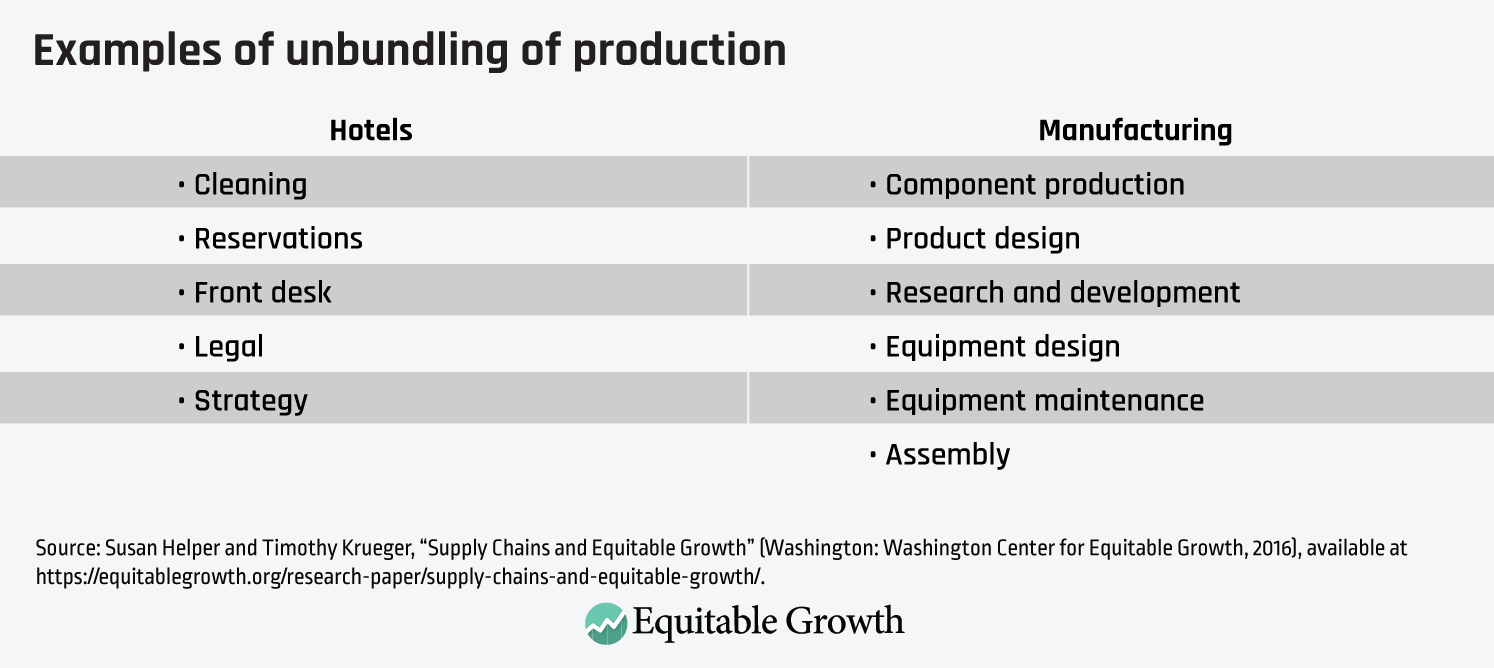
Low-road outsourcing is found (opens in a new tab) in services such as payroll, janitorial work, and security, and now includes “employment activities that could be regarded as core to the company: housekeeping in hotels; cooking in restaurants; loading and unloading in retail distribution centers; even basic legal research in law firms.”219 (See Figure 2.)
Some outsourcing contributes to innovation. As final products have become more complex, it makes sense for large firms to purchase key components from firms that specialize in that technology or process.220 Supply networks based on product specialization do not necessarily reduce wages and could have the opposite effect.
High-road supply chains are possible. Dana Corporation, for example, is a $9 billion supplier of propulsion systems for both conventional and electric vehicles. They have long supplied multiple automakers based on their innovative capabilities. The company provides a complete electric propulsion system, reducing barriers to entry into the electric vehicle market. Many Dana production workers are unionized, earning $16 to $25 per hour, plus benefits.221 These highly skilled workers were able to pivot (opens in a new tab) quickly toward using 3-D printers to make face shields during the coronavirus pandemic.222
The outsourcing of work takes several forms, leading to a variety of types of workers in supply chains, sometimes working side by side. In many U.S. companies today, there are:
These employees may be full time, part time, or temporary (except those in the first category).
These forms of outsourcing of employment, especially as carried out in the United States, typically create undesirable outcomes for most of these workers. Compared to regular employees in lead firms, workers in other forms of employment experience worse outcomes (opens in a new tab) in areas such as wages, benefits, job security, and safety.223
Research by Nathan Wilmers at the Massachusetts Institute of Technology’s Sloan School of Management, for example, finds that firms that sell to a small number of buyers pay lower wages (opens in a new tab) than do similar firms with more customers; this greater dependence on large buyers lowers suppliers’ wages and accounts for 10 percent of wage stagnation in nonfinancial firms since the 1970s.224 It is important to note that most of the workers in Wilmers’ study are full-time, regular workers with all the rights and privileges that comes with that employment. Yet because they work in firms with less market power, they earn less.
Why are outsourced jobs generally worse (opens in a new tab) for most workers?225 Research suggests several reasons:
Rent-sharing. Outsourced workers don’t benefit from norms of fairness that limit wage differentials (opens in a new tab) within firms and encourage rent-sharing.226 It is also easier to fire a supplier than an internal division, due to social ties, complex flows of information, and funds. Thus, wages may creep up at an internal division, leading to cost increases that would lead to an outside firm losing business.
Design for supplier interchangeability. Many lead firms structure their supply chains to make contractors easily replaceable. For instance, U.S. automakers in the past brought product design and complex subassemblies in-house, making it possible to have contractors compete on simple tasks like making a small, pre-designed component. This strategy lowered barriers to entry (opens in a new tab) to being a supplier, meaning that suppliers did not capture many rents.227 This has led to many lead firms in the apparel industry employing long chains of anonymous subcontractors; Walmart Corp., for example, professed to be surprised when goods marked with its label were found in the aftermath of the horrific Rana Plaza fire (opens in a new tab) in Bangladesh.228
Monitoring without accountability. Other lead firms minutely specify the actions to be taken by workers in their supply chains, even those who are not their employees. That is, lead firms can control workers without taking responsibility for paying them benefits. Tight monitoring from lead firms means one of the few profit-making strategies available to subcontractors is to keep wages low.229 In much gig work, contractors have no pricing power; they must accept the price given to them in the app. In addition, workers for Uber Technologies Inc. And Lyft Inc. Are tracked continuously (opens in a new tab) by the two firms using GPS, rating workers based on their speed, harshness of braking, and the efficiency of their routes.230
Low supplier capability. As a result of lead firms’ strategies that maximize their replaceability and control their work methods, subcontractors’ ability to create or capture value is low. Innovation is often not feasible, since it typically requires collaboration and organizational slack. Even though investments might yield productivity improvements, contractors often don’t make them because they lack the capability to do so or would not capture much of the benefit due to fierce competition. As a result, subcontractors often cannot increase pay without risking bankruptcy.231
Weak ecosystems. Not only do U.S. suppliers lack support from lead firms, they are “home alone (opens in a new tab)” in other ways as well.232 The reason: There are few institutions (opens in a new tab) to help with innovation, training, or finance. 233 In contrast, Germany’s Mittelstand (medium-sized firms) are the backbone of the German manufacturing sector (opens in a new tab) due to the help they get from community banks, applied research institutes, training institutions, and unions.234
A different kind of outsourcing is possible: high-road supply networks that benefit firms, workers, and consumers alike.235 Under this model, there is greater collaboration between management and workers, and along the length of the supply chain (opens in a new tab), there is sharing of skills and ideas, new and innovative processes, and, ultimately, better products that can deliver higher profits to firms and higher wages to workers.236
Getting to this better outcome, however, requires overcoming both market and network failures. Understanding the rationale for existing practice is key to designing good policies. Below, I propose policies that aim to directly address each of the reasons that outsourcing increases wage inequality. The first two sets of policy recommendations support workers and firms, respectively, more or less in isolation. The last three sets of recommendations improve job quality by redesigning the structure of supply relationships in which workers and firms are embedded.
The pro-labor policies discussed throughout this book would make it easier for workers to choose unions, raise the minimum wage, and provide universal access to healthcare and retirement savings. These policies would promote high-road supply chains, while discouraging low-road strategies.237
One consequence of the low-road supply chain practices prevalent among many lead firms is that it hinders the development of innovative capabilities among their suppliers. Government can help upgrade these suppliers’ capabilities. For example, it can:
Provide technical assistance, subsidize, and directly engage in efforts to upgrade firms. In manufacturing, for exampe, the Manufacturing Extension Partnership, a state-federal program, has provided technical assistance to small firms since 1989. The program, at its current size, is very effective, with surveys suggesting that $1 of federal investment in the program leads to a $12 increase in economic activity. The Manufacturing Extension Partnership should be expanded significantly and given tools to work with supply chains as a whole, rather than firms one by one.
Develop and diffuse high-road management practices. Management practices within firms are a key determinant (opens in a new tab) of productivity differentials. 238 The management of suppliers (opens in a new tab) by lead firms affects their productivity and innovation.239 Much research (opens in a new tab) documents (opens in a new tab) the ways that firms can utilize high-road policies or good-jobs strategies to tap the knowledge of all their workers to create innovative products and processes.240
High-road firms remain in business while paying higher wages than their competitors because their highly skilled workers help these firms achieve high rates of innovation, quality, and fast response to unexpected situations. The resulting high productivity allows these firms to pay high wages while still making profits that are acceptable to the firms’ owners.
Diffusing new management practices is hard and risky, but these practices deliver social, as well as private, benefits (opens in a new tab).241 That’s why the government should fund the development and implementation of high-road management practice either through a consortium of universities or via a pilot project focused on manufacturing that could be established in the Manufacturing USA network.
Such an institute dedicated to managing a sustainable manufacturing ecosystem could collaborate with the Manufacturing Extension Partnership. The institute could develop and diffuse methods for managing high-road labor practices, establishing collaborative supplier relationships, and developing worker capabilities to participate in discussions of innovation. Such an institute or consortium would be particularly valuable in helping small firms adjust to the worker power policies mentioned above, which would make less effective (and possibly illegal) many of the low-road techniques that firms have used to compete, such as low pay and union avoidance.
Responding to these new rules would require not just changes in labor practices, but also changes in marketing, product development, and information technology to take advantage of the higher-skilled (but also higher-cost) labor entailed by the new policies.242
Two problems with adopting solely the policies above is that firms embedded in low-road supply chains will have trouble finding capital to invest in innovation, and that these policies do little to promote information exchange among firms. Thus, it makes sense to redesign supply chains to allow for this greater investment and interchange.
Simply expanding the Manufacturing Extension Partnership alone is unlikely to lead to dramatic effects on job quality. The program already spends a great deal of time marketing its services, and its average project size is less than $15,000—not nearly enough to make the interlocking changes in product development, information technology, marketing, job design, and labor relations that are needed for a firm to move to the high road.
Making such a transition comes with significant risk. Firms need to invest in new equipment and training, and then live with expensive downtime as kinks are worked out of the new systems. The factory owner in the opening vignette could afford to hire the Manufacturing Extension Partnership to help with small projects, but can’t afford the high-road transformation described above. He’s locked in competition with other low-wage manufacturers (many of which are abroad), his current operations are optimized for the purchasing environment he faces, and he doesn’t think his customers would pay more for higher-quality products or reliable delivery.243
The federal government can promote supply-chain redesign in two main ways:
Encourage lead firms to build high-road supply chains. Low-road outsourcing strategies are costly to lead firms. These strategies slow innovation in auto manufacturing (opens in a new tab), for example.244 And they increase the frequency of infections in hospitals (opens in a new tab).245
In contrast, collaboration (opens in a new tab) among firms along a supply chain can lead to greater productivity and innovation.246 By breaking down the usual silos within and between firms, lead firms can ensure that workers along the supply chain are exposed to ideas and training, to the ultimate benefit of all.
Collaborative relations could offset some of the stratification effects of outsourcing. Suppliers that collaborate with customers may be less interchangeable; workers at such suppliers may be more skilled and able to capture some of the supplier’s rents.247
One reason that firms don’t adopt high-road supply chain strategies is due to the slow diffusion of new management techniques. A new high-road supply chain initiative led by a new management institute or consortium should teach (and further develop) methods to help firms maximize the total value contribution of their suppliers rather than relying on price per-unit alone.248
That’s why the federal government should build on the work (opens in a new tab) of the Obama administration in convening lead firms for a Supply Chain Innovation Initiative, which can drive innovative solutions while complementing a strong regulatory approach.249
Even with greater awareness, lead firms are unlikely to capture all the gains to high-road purchasing policies; the benefits of higher wages, for example, spill over to society as a whole.250 Thus, there remains a significant role for government in promoting high-road supply chains in its capacity both as a purchaser and as a regulator.
Act as a high-road purchaser. The federal government can buy preferentially from companies that use high-road practices. It can require its suppliers to pay prevailing wages, as is required in government-funded construction by the Davis-Bacon Act—a requirement that helps support the apprenticeships and training centers mentioned above. The Obama “Fair Pay and Safe Workplaces” executive order (which has since been overturned) blocked government purchases from companies if they or their suppliers had recent violations of labor laws.
Firms that receive government contracts should pay at least a living wage to their workers and subcontractors. In addition, government should allow prime contractors to count in their bids only 90 percent of the costs of small business subcontractors, as long as the forgiven costs went to investments in wages, training, or equipment. This would enable the government to invest more in contractors who invest more in their people.
The federal government also could offer technical assistance to its own and others’ suppliers by expanding the Manufacturing Extension Partnership (opens in a new tab) and the U.S. Department of Energy’s Industrial Assessment Centers, which helps firms redesign their operation to conserve energy. Combining Buy America requirements with the Manufacturing Extension Partnership has proven effective. The Obama administration’s Department of Transportation enacted rules requiring that any time a federal contractor requested a waiver based on a claim that something can’t be made in America, it was published on a website for potential bidders and relevant stakeholders to see. The department contracted with the Manufacturing Extension Partnership’s supplier scouting service to identify firms that had the capability to fill these procurement needs.251
Government should use its purchasing power to incentivize lead firms to adopt high-road supply chains. Government purchasing policies should include carrots, such as the convening and funding of joint networking, roadmapping, and training efforts.252 But sticks are necessary (opens in a new tab), too, such as the enforcement of existing legal provisions that allow inspectors to confiscate “hot goods” at lead firms made by suppliers in violation of labor laws.253
The government should require firms that wish to exercise detailed control over workers to be accountable for those workers in order to end abuses such as those experienced by the customer service agent in the opening vignette. The new administration should put in place efforts to fight such misclassification of workers as independent contractors and to treat the lead firms that, in practice, direct the work as joint employers.
The new administration also should establish a commission to discover and end hidden incentives for firms to offshore their manufacturing and services operations. The new commission could recommend, for example, that the U.S. Food and Drug Administration should do unannounced inspections of offshore pharmaceutical manufacturing facilities as they already do for U.S.-based facilities.254
Finally, Congress should commission the National Academies of Sciences, Engineering, and Medicine to study the collection of data on supply chains. A potential model (opens in a new tab) is the U.S. Chambers of Commerce’s work with the U.S. Census Bureau to create a standard for learning and employment records that employers can use to keep track of employee information.255 Once this is done, firms can easily opt in to having certain fields within this information automatically uploaded to secure servers at statistical agencies.
Participation in such an effort could be made a condition of receiving government contracts or other government funds greater than a certain threshold, since such data would be needed to determine compliance with proposed requirements for government prime contractors and their subcontractors to provide “good jobs.”
For reasons of both equity and efficiency, workers and small business should not depend solely on lead firms for strategic support. In the United States, the unionized construction sector has developed structures that create good jobs and fast diffusion of new techniques even though the industry remains characterized by small firms and work that is often intermittent.
Training is a way that workers can build their skills and thus potentially increase their wages. Building-trades unions (opens in a new tab)work with signatory employers to provide apprenticeships, continuing-education programs, and portable benefits.256 Other unions have begun similar efforts (opens in a new tab) to create career ladders for workers in the hotel and hospital sectors (opens in a new tab).257 A century ago, the federal government created an innovative farming sector by funding land grant universities, which led not only to the creation of knowledge but also to the creation of durable networks (opens in a new tab) of researchers and practitioners through which such knowledge could quickly spread (opens in a new tab).258
Sectoral partnerships that include employers, unions, and community colleges have shown promise (opens in a new tab) in providing stable, family-supporting jobs.259
This essay applies a supply-chain lens to the problem of income inequality. Some of the solutions proposed are fairly standard, such as various methods of paving the high road while blocking the low road. Others are more novel, including creating an institute to develop and diffuse management practices needed for high-road supply chains, directing the federal government to become a high-road purchaser and convenor of lead firms, and helping firms to collect better data on supply chains.
In closing, I note two key features of these proposals. First, complementary policies are needed to promote high-road supply chains. It is ineffective to simply attempt to enforce minimum wage laws when firms can go bankrupt and easily re-enter the market under a different name. Instead, long-term progress requires working with both suppliers and their buyers, using carrots (technical assistance) and sticks (“hot goods” enforcement) to transform production and purchasing practices toward a more productive model.260
Another example is that network failures (opens in a new tab) make Buy America alone impractical.261 Over the past 20 years, the answer in U.S. manufacturing has often been to turn to China because firms are frequently unaware of suppliers nearby who could meet their needs. The combination of supplier scouting and Buy America discussed above is more powerful than either policy alone in bringing good jobs back.
Second, policies aimed at creating high-road supply chains will make other policies more effective at reducing inequality. Training, for example, may well not lead to increased wages if workers are employed by low-road suppliers. Suppliers may be unable to reorganize to productively use the new skills, and gains from improved performance may instead accrue to a monopsonistic lead firm.
If policies such as those suggested above are enacted, then lead firms are likely to reduce outsourcing for the purpose of maximizing their bargaining power, and move both to bring work back in-house and to engage with high-road suppliers for their unique capabilities.
— Susan Helper is the Carlton professor of economics at the Weatherhead School of Management at Case Western Reserve University, and a visiting scholar at the Massachusetts Institute of Technology. She was formerly chief economist at the U.S. Department of Commerce.
Essays SEP 8, 2026
By: Alexander Bick, Adam Blandin, David Deming, Tyler Schumacher
Working Papers SEP 8, 2026
By: Alexander Bick, Adam Blandin, David Deming, Tyler Schumacher

Essays SEP 2, 2026
By: Megan Rivera
Get updates on our latest research, event announcements, and policy insights delivered straight to your inbox. Stay connected with the leading voices on equitable growth.


