Main Street’s workers, families, and small businesses are now suffering as Wall Street prospers from policies to fight the coronavirus recession
Issue Briefs SEP 17, 2020
By: Amanda Fischer
MAY 11, 2021
By: Amanda Fischer
If you are an analyst following Wall Street, things are looking pretty bright these days. The S&P 500—an index of 500 major publicly traded companies in the United States and a benchmark for gauging the health of the U.S. corporate sector—is up more than 80 percent (opens in a new tab) since its low in March 2020 during the onset of the global pandemic.113 Companies in the index have added $50 trillion worth of value (opens in a new tab) during the course of the lockdowns and recovery, a rally not seen since the post-Great Depression period 90 years ago.114
Meanwhile, how Main Street is faring is a bit more complicated. While the U.S. economy added a healthy 916,000 jobs (opens in a new tab) in March 2021 and the unemployment rate fell to 6 percent, there are still 8.4 million fewer jobs (opens in a new tab) than before the pandemic.115 And job gains during the incipient recovery are driven predominately by the strength of employment for White workers. Black men are still experiencing an unemployment rate of 9.6 percent (opens in a new tab)—almost double that of White men—and Black women actually saw their unemployment rate slightly increase (opens in a new tab) to 8.7 percent in March.116
What’s more, this disparity comes at a time when Black women have already dropped out of the workforce at staggering rates. Their employment-to-population ratio dropped 6 percentage points (opens in a new tab) since just before the pandemic, double the rate of White women’s withdrawal from the workforce.117 Latina women face a similar set of challenges as Black women, with the unemployment rate for Latina women at 7.3 percent and the employment-to-population ratio also still far below pre-pandemic levels.118
By now, many policymakers have heard the story of the so-called K-shaped recovery.119 This describes how the fortunes of those at the top of the U.S. wealth and income ladders can be so disconnected from the experiences of U.S. workers and their families, especially those struggling the most in our economy. Even as U.S. policymakers’ economic response to the coronavirus pandemic was relatively robust, compared to other countries (opens in a new tab),120 the gap between the rich and nonrich in the United States is still among the largest in the world.121
In short, even a strong rescue response can’t make up for decades of disinvestment. So, what policy choices led to the growing divide between the wealthy and the rest of us? How did U.S. policymakers enable these inequitable economic outcomes?
On April 29, a hearing (opens in a new tab) of the U.S. Senate Committee on Banking, Housing and Urban Affairs explored that question, within their remit of banking and financial services: What are the mechanisms by which finance, enabled by public policy, made this the case?122 The hearing delved into the channels through which our financial markets have put the squeeze on U.S. workers, drawing on testimony from Trevon Logan, an Equitable Growth grantee and the Hazel C. Youngberg Trustees distinguished professor of economics at The Ohio State University; Heather McGhee, board chair of the advocacy group Color of Change and author of the new book The Sum of Us: How Racism Costs Everyone and How We Can Prosper Together; and Lisa Donner, executive director of Americans for Financial Reform, an organization focused on strengthening our financial system.123
This issue brief explores their testimony, alongside other evidence-based research and analysis. The brief details how the financialization of the U.S. economy over the past five decades contributed to income and wealth inequality, stifled economic growth, and exacerbated economic disparities by race and ethnicity. It then presents some policy ideas put forth by the witnesses at the hearing, including solutions to short-circuit financialization by investing in physical and care infrastructure, building worker power, ensuring strong regulation of our financial system, and improving fairness in our tax system.
Witnesses at the hearing on April 29 explored how Wall Street harms U.S. workers and their families through the phenomenon known as “financialization.” Financialization refers to the process by which the financial sector—banks, private equity firms, hedge funds, stocks and derivatives exchanges, and other conduits through which money flows between those who have it and those who need it—takes up a larger and larger share of the U.S. economy, fails to allocate capital to its most productive uses, and increasingly results in the hoarding of economic, and thus political, power at the top of the income and wealth ladders.
Financialization also can refer to the increasing participation of nonfinancial businesses in financial activities. General Electric Company, for example, a company most people associate with manufacturing and innovation, earned 43 percent of its profits from financial activities as recently as 2014.124
As explored in the hearing, financialization can create downstream harm for U.S. workers and their families by undermining what Sen. Sherrod Brown (D-OH), chairman of the Senate Banking Committee, calls “the dignity of work.” Sen. Brown borrowed the phrase invoked by Martin Luther King Jr. in defense of striking workers in Memphis, Tennessee, in 1968. The phrase means that all people’s labor is compensated fairly, that employment is free from exploitation and coercion, and that work—whether inside or outside the home—is respected and met with dignity.
Witnesses at the hearing identified the shift to “shareholder capitalism” over the past five decades as a key framework for understanding how financialization has been operationalized. Over the past half-century, corporate leaders, influenced by the free-market economists of the Chicago School (opens in a new tab), shifted the views of the majority of financiers from the need to support jobs and the communities in which they operate to a focus on the maximization of short-term shareholder value.125 In the words of Milton Friedman (opens in a new tab) in 1970, the goal of corporate managers is to “conduct business in accordance with (shareholders’) desires, which generally will be to make as much money as possible while conforming to the basic rules of the society, both those embodied in law and those embodied in ethical custom.”126
The import of Friedman’s statement is that considerations such as worker welfare, the economic health of communities, the environment, and U.S. competitiveness on the world stage were best left to policymakers and civil society leaders, with business leaders’ only obligation being the maximization of profits. This philosophy formed the underpinnings (opens in a new tab) of not just a change in managerial practices but also in business education.127
The problem with this narrowing of focus on the part of corporate leaders is that policymakers—the stewards of public welfare in this ecosystem—failed to keep up, as large businesses and finance entrenched the excesses of shareholder value to harm workers. In fact, as witnesses at the hearing documented, corporate leaders themselves use their outsized economic power to influence the policymaking process in their favor, for example, by eroding the worker protections and financial system regulations established after the Great Depression. This has created feedback loops where enhanced economic power begets more political power, with workers increasingly short-changed.
How does financialization manifest itself throughout the U.S. economy today and, especially, in how policymakers measure the success of the economy?
For one, the share of income accruing to workers continues to decline. The so-called labor share of income represents the percentage of U.S. Gross Domestic Product paid out in the form of wages, salaries, and benefits and can be contrasted with capital’s share of income, which is the money made off of investments or the ownership of things. As economist Dean Baker at the Center for Economic and Policy Research points out (opens in a new tab), if the labor share of income were the same just before the pandemic as it was in 1979, the median worker’s pay would be about 4.2 percent higher than it is now.128
Financialization can decrease the labor share of income in two ways: by increasing the amount of income derived from capital and then by decreasing the amount of income derived from labor. On the first point, while factors such as technological innovation and globalization can drive up the capital share of income, financialization also plays a role, as companies increasingly earn money through financial engineering rather than investment in people. According to one estimate, financialization may have contributed to more than half of the fall in the labor share of income.129
Moreover, financialization, enabled by the gutting of worker power discussed more below, can also decrease the labor share of income by increasing the pressure on short-term profit maximization, driven, in part, by decreasing labor costs. This phenomenon is exemplified by Wall Street analysts downgrading the stock (opens in a new tab) of the restaurant chain Chipotle Mexican Grill Inc. Because they concluded that management had exhausted their ability to reduce hours or cut wages of front-line workers.130
Financialization also widens the disparities between people who earn their money in the financial-services industry versus workers who earn it elsewhere. Economists Josh Bivens and Lawrence Mishel at the Economic Policy Institute documented (opens in a new tab) how the overall pay of financial-sector workers relative to others in the economy has risen substantially over the past decade.131 While the ratio never exceeded 1.1 percent from 1952 to 1982, it began rising and reached 1.83 percent by the onset of the Great Recession (opens in a new tab) of 2007–2009.132
Likewise, research (opens in a new tab) by Thomas Philippon at New York University’s Stern School of Business and Ariell Reshef at the Paris School of Economics shows a pay premium for finance workers even when multiple controls, such as education and employment risk, are used. The authors conclude that roughly 30 percent to 50 percent of the pay premium in finance is due to economic “rents,” or policy failures that allow a market to exist out of equilibrium.133
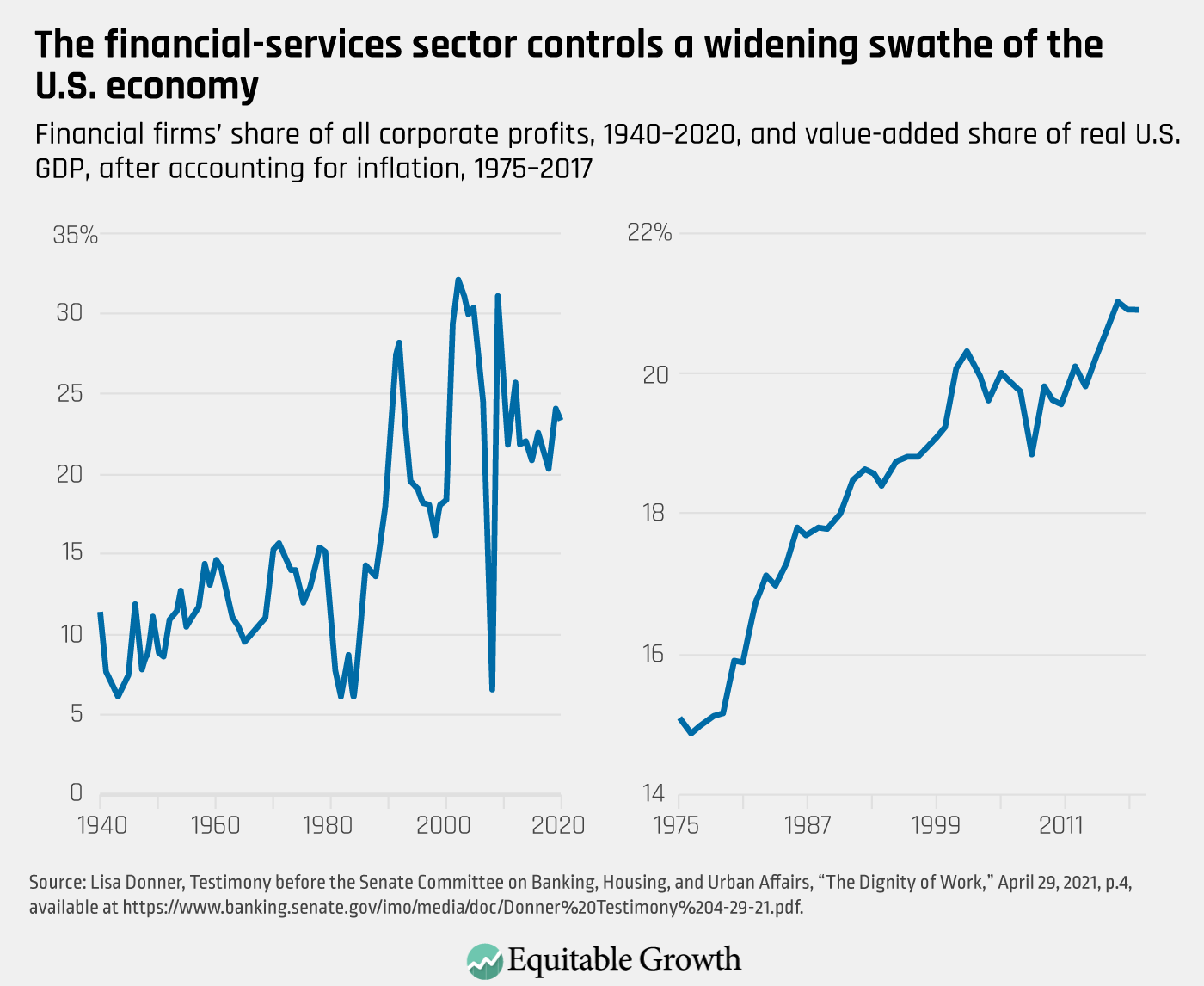
Further, the profits of financial firms comprise a greater share of all corporate profits and of total U.S. GDP. In her April 29 testimony (opens in a new tab) before the Senate Banking Committee, Donner of Americans for Tax Reform presented U.S. Bureau of Economic Analysis data to show that financial-sector profits and their share of GDP have skyrocketed since the 1970s.134 (See Figure 1.)
Financial firms’ share of all corporate profits, 1940-2020, and value-added share of real U.S. GDP, after accounting for inflation, 1975-2017
And despite the growth of the finance industry, the costs of intermediation (opens in a new tab)—the toll taken by financial-services firms to funnel money between savers and spenders—are about the same as they were a century ago.135
Finally, financialization can impede overall economic growth, dragging the entire global economy down. Researchers from the Bank for International Settlements surveyed international economies and found that financial booms can create “bloat” (opens in a new tab) in the global economy that drags resources away from productive activities and into nonproductive trading and speculation.136 Further, according to Adair Turner, a former British banking regulator, only 15 percent of financial flows actually fund new projects and jobs (opens in a new tab) in the global economy, with the rest going toward securitizing and speculating on existing assets.137
As pointed out by Color of Change’s McGhee in her testimony (opens in a new tab), the subprime mortgage crisis of 2008 is the paradigmatic example of this phenomenon, with a relatively small number of toxic mortgage loans, sold disproportionately to Black and Latinx individuals and families, able to cause a global financial crisis due to the magnifying effect of financial derivatives.138
Financialization isn’t natural law or the logical outgrowth of improving technology or a changing economy. Instead, it is driven by policy choices motivated by Friedman’s ethos taking hold among economists and policymakers alike. Tax policy, for example, encourages executive compensation structures that focus on short-term gains over long-term value creation by making performance-based equity awards tax-deductible for corporations.139 Compensation in the form of unrestricted stock can encourage CEOs to pursue juicing share prices (opens in a new tab) over long-term value creation, particularly as 43 percent of CEOs admit to having a planning horizon of 3 years or less (opens in a new tab).140
The swirl of tax policy and shareholder supremacy also leads to an increasing number of firms using profits to enable capital distributions to stockholders in the form of dividends and share repurchases, rather than investment in longer-term growth. Research suggests that this short-term focus encourages companies to increasingly focus on financial engineering rather than slow and steady value creation. In fact, some research suggests that capital markets actually reward companies with the highest levels of share repurchases rather than the firms with the highest growth potential (opens in a new tab).141
These phenomena are further exacerbated by the tax deductibility of interest payments on debt. This leads to firms not only privileging capital distributions over investments in their own operations and future growth, but also to relying on debt to do so. Recent data suggest that about half of share buybacks are financed (opens in a new tab) by debt.142 While the Tax Cut and Jobs Act of 2017 did limit some of the deductibility of interest on corporate debt payments, the windfall to firms from reduced tax bills was met with declining business investment and tepid wage growth (opens in a new tab), even before the onset of the pandemic and recession.143
Laggard antitrust enforcement is another reason why firms are able to exercise outsized control in their markets, harming workers and their families and decreasing innovation in the broader economy. Researchers hypothesize that lax antitrust enforcement allows firms to sidestep competitive market forces as firms no longer have to invent new technologies or improve services when their market position allows them to extract monopoly profits. Common ownership by institutional investors (opens in a new tab) also can lead to businesses competing less vigorously against one another.144
When combined with the legislative and judicial erosion of worker power over recent decades, these firms can easily exercise outsized control over their workers. Ohio State economist Logan in his testimony (opens in a new tab) points to the coercive control exercised by firms not only via low wages but by policies such as limiting bathroom breaks or social interaction with colleagues, requiring entry-level employees to sign nondisclosure agreements that foreclose on their ability to switch jobs, and using aggressive tactics to prevent collective bargaining.145 Workers of color are disproportionately represented in jobs governed by what Logan, in his testimony, calls “factory discipline,” (opens in a new tab) or the ability of managers to exercise de facto authoritarian control, underscoring the racialized harm caused by monopsonistic behavior.146
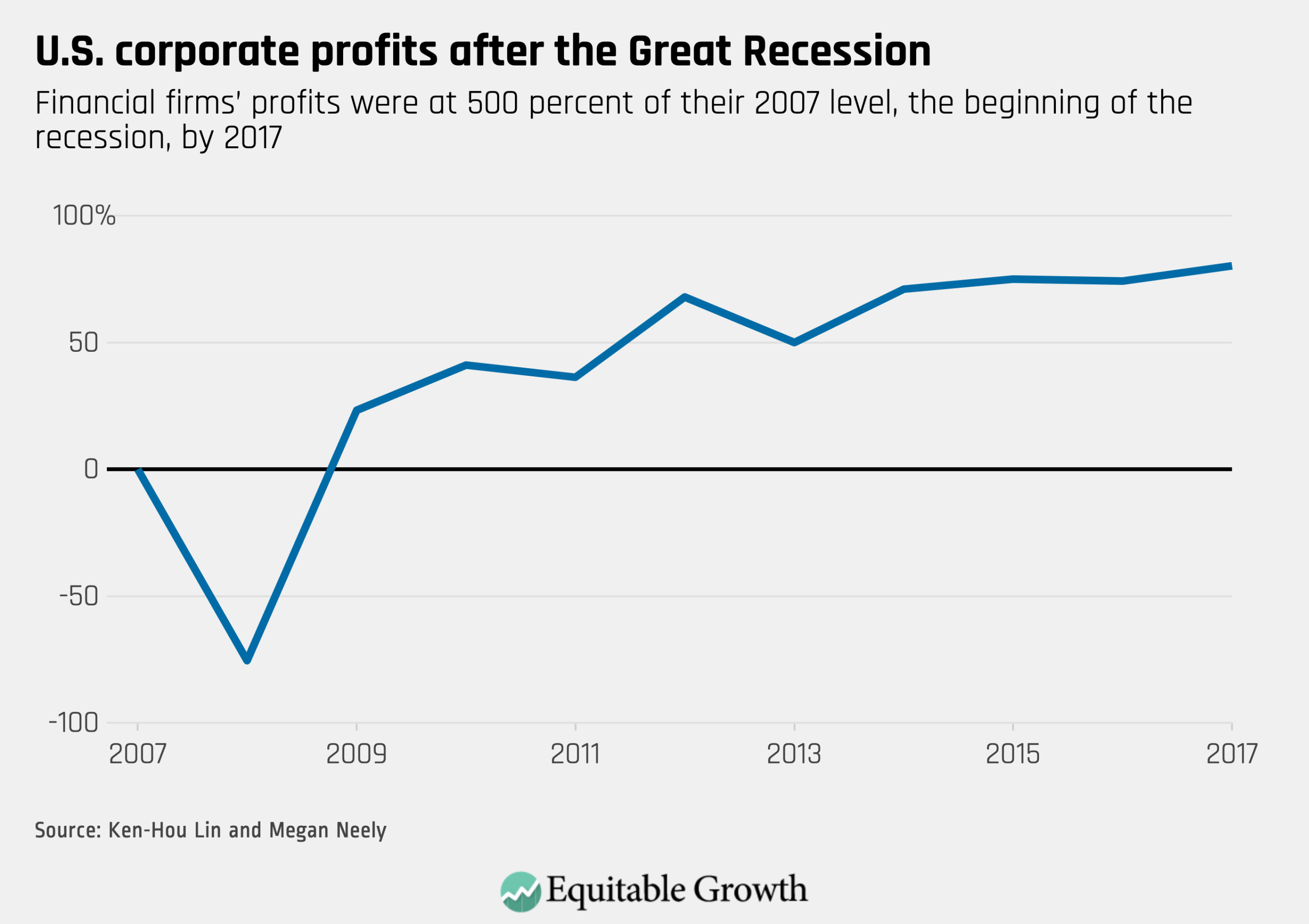
Financial deregulation also plays a role. Donner’s testimony (opens in a new tab) describes the process by which Wall Street eroded bank safety and soundness protections, defeated laws governing predatory mortgages, prevented measures to bring transparency to financial derivatives markets and weakened corporate accounting and governance rules in the lead-up to the Great Recession.147 In turn, financial crises inevitably harm vulnerable communities much more than they hurt the financial sector itself. While the Great Recession wiped out (opens in a new tab) almost three-quarters of financial-sector profits, the sector had fully recovered by midway through 2009.148 (See Figure 2.)
Financial firms’ profits were at 500 percent of their 2007 level, the beginning of the recession, by 2017
Meanwhile, it took a decade for wages to recover (opens in a new tab) to pre-Great Recession levels.149 As Heather McGhee points out in her testimony (opens in a new tab), communities of color are most likely to suffer earliest and harshest during financial bust periods—and in the 2008 crisis, were both the targets of predatory financial behavior and the last to recover from its effects.150
The banking sector itself perhaps provides the best case by which to illustrate the feedback loops caused by financialization. The largest U.S. banks benefitted from record revenue in trading (opens in a new tab) in 2020 and early 2021, profiting from volatility across equities, fixed income, currencies, and commodities during the pandemic and the Fed’s intervention in the markets.151 Meanwhile, loans to consumers and small businesses remained flat. Bank executives contend (opens in a new tab) that weak loan demand is driving the lackluster lending volumes.152 Yet community banks have continued lending at nearly 2.5 times the rate of noncommunity banks (opens in a new tab).153
Other research evidence suggests that large bank concentration in a community can impede lending to the real economy. One study conducted during the policy response to the coronavirus pandemic finds that a small business merely being located in an area predominately served by megabanks lowered the chances of an eligible small business receiving a Paycheck Protection Program loan.154 The lack of connection between Wall Street profits and provision of credit in the real economy is particularly troubling, given the regulatory forbearance (opens in a new tab) afforded to big banks by U.S. financial agencies during the pandemic recovery in the name of jumpstarting lending.155
Meanwhile, front-line bank workers themselves have been exposed to significant risk (opens in a new tab) during the pandemic, protesting a lack of personal protective equipment and intense stress from having to coach customers in navigating an economic crisis.156 At the same time, bank workers’ pay remains modest (opens in a new tab), with 75 percent of bank workers earning less than $15 an hour and about a third of bank workers relying on some form of public assistance to make ends meet.157 People of color are overrepresented in front-line bank positions (opens in a new tab) such as tellers and underrepresented in senior management roles.158
Lisa Donner in her testimony (opens in a new tab) also pointed to the private equity industry as being at the nexus of many of these phenomena.159 Emboldened by favorable tax treatment of their debt-driven business operations and a focus on short- to medium-term value creation, private equity funds buy up floundering companies, typically increase those companies’ debt levels, and seek to minimize business costs—most notably, labor costs. Some private equity funds may bring management expertise or process improvements to the businesses they own, but some research also shows that private-equity-owned firms are more likely to default (opens in a new tab) on loans related to large buyouts.160 They also are more likely to go bankrupt (opens in a new tab).161 And they are more likely to cut jobs and reduce wages (opens in a new tab) than similarly situated firms with other ownership models.162
Over the past year, research also suggests that private-equity-owned businesses such as nursing homes have a higher incidence of death (opens in a new tab) among residents.163 And private-equity-owned hospitals (opens in a new tab) were quicker to cut practitioners’ pay and benefits at the onset of the pandemic.164
Witnesses at the April 29 hearing pointed to a number of policy solutions to these challenges. The $1.9 trillion American Rescue Plan, enacted in March 2021, directed substantial aid to those suffering the most from the pandemic and the recession it created, with $1,400 direct payments, an expanded refundable Child Tax Credit, and strengthened Unemployment Insurance compensation and child care investments. All are likely to improve the lives of those affected and help grow the U.S. economy.
Further efforts proposed in the $2.3 trillion American Jobs Plan and $1.8 trillion American Families Plan can help entrench those investments so that structural changes in the economy will help workers and their families more sustainably as the economy recovers.165 These policy actions and proposals, if fully implemented, would help correct the disinvestment in public institutions that began in the 1970s—timed just as our legislative and judicial systems removed formal barriers to access for people of color and thus removed an important counterweight to the forces of financialization.
The Senate Banking Committee also heard testimony on April 29 about other policy changes that could combat the deleterious effects of financialization. Ohio State’s Logan emphasized (opens in a new tab) ways to empower workers by using antitrust enforcement to break up monopsonistic power and break the feedback loops created by financialization.166 Donner discussed (opens in a new tab) how to rein in the outsized power at the very top of the U.S. wealth and income ladders by strengthening the rules and regulations governing Wall Street’s rising control of the U.S. economy. Specifically, she wants policymakers to address concentration among banks, strengthen protections against predatory lending, and reform the tax code to end the favorable treatment afforded to income gained via investments rather than labor.167
All of the witnesses also discussed the need to enact policy that addresses the roots of systemic racism, which is deeply interlinked with the causes and consequences of financialization. As McGhee pointed out, the legacy of the racial wealth divide is maintained and exacerbated by financialization, which pulls income away from workers and their families and directs it to those already exceedingly wealthy. Those with the least savings—mostly families of color historically cut off from wealth-building opportunities—are left the furthest behind, with fewer and fewer opportunities (opens in a new tab) to catch up.168
On this point, witnesses also provided a host of policy recommendations to address economic disparities by race and ethnicity. They recommended that policymakers should collect more and better data, disaggregated by race and ethnicity,169 to provide better measures of the U.S. economy. Another suggestion was to enact policies such as baby bonds so that children have assets to help enable wealth-building activities as they head into adulthood.170 A third proposal would be to support worker power to help level the playing field between wage-earners and increasingly powerful corporations.171 Another recommendation was to examine how minority-owned small businesses were left behind in previous rescue efforts, including in response to the coronavirus recession.172 And more broadly, they recommended protecting against financial deregulation (opens in a new tab), which increases the risk of predation and its economic fallout for Black and Latinx individuals and families.173
The roots of financialization run deep, and its causes stretch far beyond the U.S. banking and financial-services sector. But with a broad set of investments in workers and families, policymakers can reverse these harmful decades-long trends and build a framework for sustained and broadly shared prosperity.
Issue Briefs SEP 17, 2020
By: Amanda Fischer
Blog MAY 7, 2021
By: Kate Bahn, Carmen Sanchez Cumming
Issue Briefs JUL 15, 2020
By: Amanda Fischer
Get updates on our latest research, event announcements, and policy insights delivered straight to your inbox. Stay connected with the leading voices on equitable growth.