




Policy
What Work Does Generative AI Do?
Essays SEP 8, 2026
By: Alexander Bick, Adam Blandin, David Deming, Tyler Schumacher
AI, Tech & Energy
Labor, Wages & Worker Power
 Browse All Resources
JAN 14, 2021
By: Robert Manduca

This essay is part of Boosting Wages for U.S. Workers in the New Economy (opens in a new tab), a compilation of 10 essays from leading economic thinkers who explore alternative policies for boosting wages and living standards, rooted in different structures that contribute to stagnant and unequal wages. The authors in the new book demonstrate that efforts to improve workers’ access to good jobs do not need to be limited to traditional labor policy. Policies relating to macroeconomics, to social services, and to market concentration also have direct relevance to wage levels and inequality, and can be useful tools for addressing them.
To read more about Boosting Wages for U.S. Workers in the New Economy 20 and download the full collection of essays, click here.
Over the past four decades, geographic inequality between regions of the United States has grown dramatically. A handful of metropolitan areas, largely along the coasts, have become some of the richest economic regions—cohesive groups of counties linked by strong economic ties, such as those between a city and its suburbs—in world history. At the same time, large swaths of the country have been trapped in economic decline, struggling with deindustrialization, stagnant incomes, and rising unemployment.
These economic challenges have contributed to a host of social and political problems, among them public health crises (opens in a new tab),378 declining social mobility (opens in a new tab),379 racial inequality (opens in a new tab),380 and political (opens in a new tab) polarization (opens in a new tab).381 They also reduce national economic growth by reducing investment in local public goods, limiting aggregate demand, and lessening the effectiveness of federal economic policy. Absent an innovative and muscular policy response, the coronavirus pandemic and its accompanying economic collapse are likely to only worsen the outlook (opens in a new tab) for struggling economic regions (opens in a new tab).382
After decades in which regional economic challenges were largely considered a problem for state and local civic leaders alone, today, there is an increasing appetite for federal policy action to reduce this form of geographic inequality—distinct from the different challenge of economic inequality within regions. Most recent proposals (opens in a new tab) for reducing interregional inequality have tended to take the form of “place-based policies (opens in a new tab)” that target government investment or subsidies to economically struggling cities or neighborhoods (opens in a new tab).383
This essay argues that to successfully boost wages and employment levels in struggling areas, policymakers must instead adopt a “place-conscious” approach that treats reducing interregional inequality as a priority throughout federal policymaking rather than something to be remedied after the fact. Recent research shows that the growth in geographic inequality since 1980 stems in large part from changes made to federal policy that seem, at first glance, to be geographically neutral, such as the relaxation of (opens in a new tab) antitrust enforcement (opens in a new tab),384 the lowering of trade barriers (opens in a new tab),385 and the deregulation of the transportation and communications industries (opens in a new tab).386 Although these policies were the same everywhere, they interacted with the existing spatial patterns in the economy in ways that systematically advantaged some places while harming others (opens in a new tab).387

June 30, 2021 2:00PM – 3:30PM
Meaningful and sustained reductions to interregional inequality will require structural changes to the U.S. economy made through federal action. Almost every domain of federal policy, from food policy to military spending to public finance, has a spatial footprint. Policies that take the geographic consequences of federal action seriously—that seek to alter the economic structures that create disparities to begin with—are much more likely to succeed than policies that seek to ameliorate geographic income disparities after the fact while leaving the underlying structures that generate them intact.
To illustrate how place-conscious federal policies can reduce interregional inequality, I consider four examples of such policies:
Each of these policies would have the effect of reducing interregional inequality, without explicitly targeting struggling regions for subsidies or investment. Taken together, they represent a revival of the federal government as a proactive force for uniting disparate regions into one national economy—a role it has repeatedly played throughout U.S. history, from the development of the U.S. Postal Service to the building of the interstate highway system.
Over the past four decades, regions of the United States have diverged economically from one another. In 1980, most U.S. commuting zones (opens in a new tab) had mean family incomes roughly in line with the national average.388 While there was certainly inequality within these areas, average incomes were roughly the same across most of the country—with important exceptions in the rural South, the Rio Grande Valley, and other long-identified areas (opens in a new tab) of persistent rural poverty (opens in a new tab).389 By 2013, there were far more places with mean incomes that were either much higher or much lower than the nation as a whole.
Overall, the income gap between the richest 10 percent of U.S. commuting zones and the poorest 10 percent grew by almost 50 percent during this period. The fraction of the U.S. population living in areas more than 20 percent richer or poorer than the national mean almost tripled (opens in a new tab), from 12 percent to 31 percent.390 (See Figure 1.)
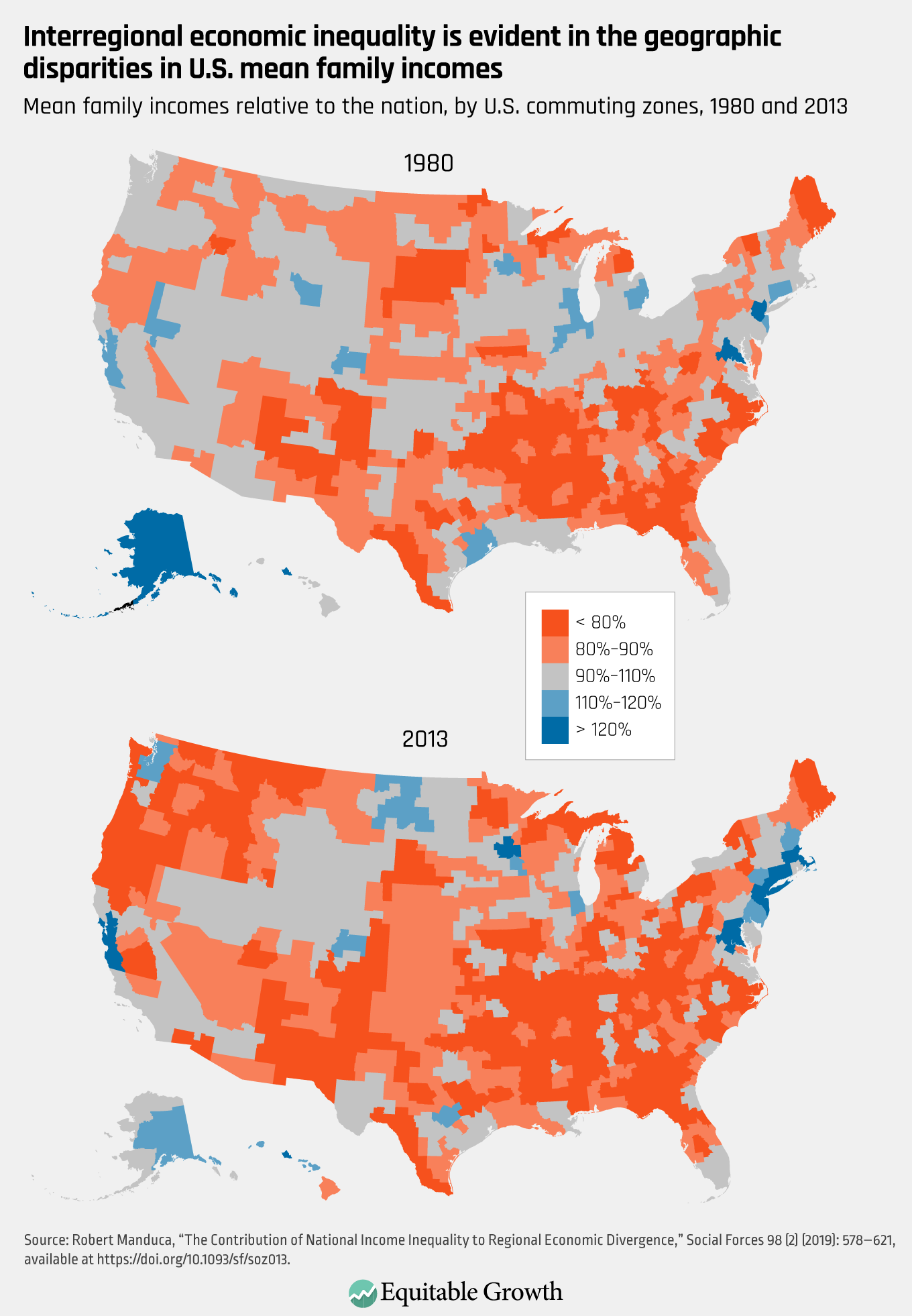
Mean family incomes relative to the nation, by U.S. commuting zones, 1980 and 2013
Growing interregional economic inequality, and the local economic dislocations that contribute to it, are major contributors to many of the most pressing social, economic, and political challenges facing the United States today. Public health crises (opens in a new tab)—from (opens in a new tab) the (opens in a new tab) opioid (opens in a new tab) epidemic (opens in a new tab)391 to exposure (opens in a new tab) to environmental (opens in a new tab) toxins (opens in a new tab)392—are disproportionately concentrated in economically struggling areas. Deindustrialization has contributed to a host of other social problems (opens in a new tab), from family instability (opens in a new tab) to declining upward mobility (opens in a new tab).393 Regional divergence also contributes to political disfunction, both by altering the material conditions in different places such that their material interests diverge, making compromise more difficult, and by contributing to growing anger (opens in a new tab), political (opens in a new tab) extremism (opens in a new tab), and polarization (opens in a new tab).394
Regional disparities are both a driver and a consequence of racial inequality. Black Americans in particular disproportionately live (opens in a new tab) in the large, multistate regions—especially the Midwest and the South—that have higher-than-average poverty rates and that were hit hardest by the economic shocks of the past several decades.395 The effects of these economic dislocations were felt earliest and most strongly (opens in a new tab) in communities of color, although they have now spread (opens in a new tab) to many White communities as well.396
That said, some regional economic challenges can be traced directly to racist policies at all levels of government. Local and state governments in parts of the country with large Black populations—historically in the South, but also in Northern cities that received large numbers of Black migrants during the Great Migration of the 20th century (opens in a new tab)—historically spent less (opens in a new tab) on public goods such as education and infrastructure that contribute to regional prosperity.397 After the passage of the Voting Rights Act of 1965, state and local governments in the South began making such investments at greater rates in response to electoral pressure from African American voters, which had the effect of boosting the economy of the entire region (opens in a new tab).398
At the federal level, early examples of place-conscious policies, such as the Social Security Act of 1935 and the Fair Labor Standards Act of 1938, were originally designed to exclude African Americans, reducing their impact on regional disparities while entrenching racial inequality (opens in a new tab).399
The economic consequences of interregional inequality are not limited to struggling regions, but are felt nationally through slower overall growth and greater macroeconomic volatility. Within regions, local economic multipliers mean that when workers lose their jobs, those job losses build on themselves (opens in a new tab): Each job lost in an initial shock from, say, a tariff reduction or a factory closing reduces demand for local services, creating further job losses (opens in a new tab) that can persist for decades (opens in a new tab).400
These shocks are exacerbated by our current system of fiscal federalism, which precludes deficit spending by state and local governments and thus requires them to implement pro-cyclical fiscal policy—strengthening booms and worsening recessions (opens in a new tab).401 During the first few months of the coronavirus recession, for instance, state and local governments (opens in a new tab) collectively laid off or furloughed (opens in a new tab) 1.5 million workers (opens in a new tab), and layoffs are expected to continue in the absence of new federal fiscal aid.402 Cutting government spending in the middle of a recession is the definition of macroeconomic malpractice, yet it is consistently done in the United States because of how our cities and states are funded.
At the federal level, geographic inequality makes macroeconomic policymaking more challenging because the same set of federal policies must meet the needs of regions with very different economic circumstances. Interest rates (opens in a new tab) have strong regional economic impacts, for example,403 and the interest rate that best serves high-cost areas such as San Francisco and New York is likely to be very different from that which meets the needs of areas struggling with unemployment. But because our country is a monetary union (opens in a new tab), we must set just one interest rate (opens in a new tab) for our shared currency.404
For decades, regional economic challenges were largely considered a problem for local civic leaders alone. But today, there is an increasing appetite for federal policy action to reduce geographic inequality. Initial proposals have largely taken the form of “place-based policies (opens in a new tab)” that target struggling neighborhoods, cities, or regions for investment or subsidies with the goal of increasing incomes and employment.405 Recent proposals for place-based policies include geographically targeted tax breaks (opens in a new tab) tied to job creation406 and direct federal investment (opens in a new tab) in research and development (opens in a new tab) located in struggling regions.407
Place-based policies have historically been the subject of skepticism on several grounds. First of all, deciding which places deserve to be targeted with extra subsidies is both technically challenging and politically fraught. Secondly, there is no guarantee that residents of a targeted place will be the final beneficiaries of these investments, since newly created jobs are often filled by in-migrants rather than current residents. Finally, such policies often appear to have the effect of simply moving economic activity (opens in a new tab) from one place to another (opens in a new tab) rather than increasing the total amount.408
Recent interest in place-based policies is welcome because it indicates support for federal action to reduce interregional inequality. But long-identified weaknesses remain major challenges. On the technical front, effective place-based policies require constantly identifying and judging which places are truly in need and merit federal investment. This is genuinely difficult and can lead to perceptions of corruption or that the government is “picking winners.” Any missteps cast doubt on the entire project.
This concern is prominent in critiques (opens in a new tab) of the Opportunity Zones tax credit program, created in the 2017 tax bill, which has come under fire (opens in a new tab) from both the left and the right for directing federal subsidies to people and areas argued not to need the help.409 Further, given the sheer magnitude of geographic inequality, the amount of subsidies required to meaningfully reduce interregional income disparities—as opposed to merely offering some relief to struggling regions—is likely to be enormous.
The key fact about regional economic divergence is that while it appears to be the result of many different local trends, it is fundamentally a national process driven in large part by national economic trends and federal policies. As recent research shows, much of the increase in interregional inequality since the 1970s is attributable to federal policy changes that seem geographically neutral at first glance.410 These include:
Though implemented nationally, these policies interacted with existing spatial patterns in the economy in ways that systematically helped some places while disadvantaging others (opens in a new tab).414
Addressing interregional inequality, then, will be most effectively accomplished at the federal level through what might be termed “place-conscious policies.” Unlike place-based policies, place-conscious policies are implemented everywhere but are designed in such a way that their benefits disproportionately fall on those places that need the most help. In this, they are the spatial analogue of the “targeting within universalism (opens in a new tab)” that has long been one of the most successful ways (opens in a new tab) to sustain support for programs that benefit disadvantaged individuals.415
Rather than attempting to identify and compensate regions that are “losing” the economic competition after the fact, as place-based policies do, place-conscious policies seek to even the economic playing field and lower the stakes of interregional competition to begin with. This will make them easier to administer, less susceptible to critiques for being unfair or corrupt, and ultimately more effective.
A place-conscious approach can be applied in almost every area of federal policy, from trade to taxes to military spending. Here, I briefly consider four types of place-conscious policy:
Let’s look at each of them in turn.
The growing economic disparities between regions of the United States are fundamentally intertwined with the growth of economic inequality more generally. In fact, more than 50 percent (opens in a new tab) of the cross-regional divergence in mean family incomes since 1980 is strictly attributable to rising overall economic inequality rather than any spatial reallocation in who lives where.416
Any federal program that benefits lower-income Americans, then, will have the effect—without explicit spatial targeting—of reducing interregional income disparities. This applies to existing transfer programs such as Social Security, disability insurance (opens in a new tab),417 and the Earned Income Tax Credit; but it would also apply to new or expanded programs such as child allowances or an expanded Child Tax Credit—proposals that have received (opens in a new tab) bipartisan (opens in a new tab) support (opens in a new tab)418—or even a full-fledged Universal Basic Income (opens in a new tab).419
The geographic impacts (opens in a new tab) of such universal antipoverty programs (opens in a new tab) can be substantial. One recent study found that in Brazil, the Bolsa Família and Benefícios de Prestação Continuada programs of conditional cash transfers to families in poverty were responsible for a full 24 percent of the reduction in cross-state inequality from 1995 to 2006, despite comprising just 1.7 percent of disposable household income.420 An earlier study in the Netherlands (opens in a new tab) found that social insurance programs, taken together, reduced regional inequality by 40 percent.421
Governments set the rules and determine the playing field in which markets operate. Through much of U.S. history, the federal government used its power to create a playing field that would disperse economic activity and integrate geographically isolated regions into the national economy. These efforts began with the creation of the U.S. Postal System (opens in a new tab) in 1775,422 and continued through the regulation of railroads (opens in a new tab) with the Interstate Commerce Commission in the late 19th century,423 rural (opens in a new tab) electrification (opens in a new tab) in the 1930s,424 and the first 70 years of air travel (opens in a new tab).425
Proximity to natural resources, trade routes, and other economic advantages has always mattered for regional economic performance, but these federal efforts had the aim and consequence of making geography less determinative of economic success (opens in a new tab), reducing the advantages that large urban centers or centrally located towns would otherwise receive due to their location alone.426 The strong American tradition of antitrust enforcement (opens in a new tab) and skepticism of “bigness” (opens in a new tab) similarly sought to reduce economic concentration (opens in a new tab) in general, often with the effect of spatially distributing economic activity.427
Since the 1970s, deregulation—particularly of the transportation and communications industries—and weakening antitrust enforcement have shifted the economic playing field in favor of large corporations and large, well-connected urban centers. That is, market concentration has contributed to the geographic concentration of prosperity and, conversely, disadvantage. The airline industry offers a useful illustration (opens in a new tab). Under the old regulatory regime, price and firm entry regulations created a system in which profits from well-traveled routes cross-subsidized service on less-profitable routes, consistent with the policy goal of providing similar levels of service to similarly sized cities.428 Following deregulation in the 1970s (opens in a new tab), airlines shifted their focus (opens in a new tab) to the cities and routes with the highest traffic, cutting service to small and mid-size cities.429
With lax antitrust enforcement, airlines also consolidated (opens in a new tab), reducing competition and the number of hub airports (opens in a new tab) that offer large numbers of direct flights.430 This change to transportation geography, driven primarily by changes to federal regulation, triggered a reshuffling of corporate headquarters. Companies have moved (opens in a new tab) from cities that lost service (opens in a new tab), such as Cincinnati or St. Louis, to cities currently blessed with extensive air connections, such as Charlotte or Atlanta.431
A place-conscious approach to regulation would return the federal government to its historic goal of binding the disparate parts of the country into one national economy and society (opens in a new tab).432 This would primarily involve once again requiring that the key industries that connect people and places—telecommunications and transportation in particular—do so on an equal footing. Reinvigorated antitrust enforcement, meanwhile, would also reduce the stakes of geographic competition: When more firms exist in an industry, small cities have more opportunities to land a headquarters or foster a successful entrant.
The current U.S. system of fiscal federalism (opens in a new tab) is inefficient, unequitable, and almost unique among high-income countries.433 In the United States, states and localities are the primary providers of many standard government services, yet they are denied access (opens in a new tab) to many of the most important tools of governance (opens in a new tab)—running deficits, controlling the entry and exit of capital and labor, and printing money.434 This harms individuals, economically struggling regions, and the country as a whole.
For individuals, it makes access to basic government services (opens in a new tab) contingent on the wealth of one’s community, entrenching inequality.435 It also creates economic distortions (opens in a new tab) by artificially bundling choices about fiscal policy with the decision of where to live.436 For regions, it advantages already-wealthy areas by allowing them to provide more public services at lower tax rates (opens in a new tab).437 This, in turn, encourages race-to-the-bottom (opens in a new tab) tax and incentive competitions (opens in a new tab).438
For the country as a whole, the current system of fiscal federalism makes recessions worse, because most state and local governments are legally prohibited (opens in a new tab) from deficit spending (opens in a new tab).439 This frequently requires that cities and states, which employed about 20 million Americans (opens in a new tab) prior to the coronavirus pandemic,440 cut spending and lay off workers in the middle of recessions—a highly costly emergency measure that creates further job losses through multiplier effects, worsening economic volatility.
There are ways to fix the problems baked into fiscal federalism. As recently as the 1980s, municipal governments in the United States received more than 15 percent of their revenue from federal grants. Today, that share has fallen (opens in a new tab) to less than 5 percent (opens in a new tab).441 New proposals to increase federal grants to state and local governments (opens in a new tab)—especially ones that disproportionately help lower-income parts of the country—enjoy support across the ideological spectrum and would provide a large and immediate boost (opens in a new tab) to national economic activity—one that is greatly needed to combat the coronavirus recession (opens in a new tab).442
A final example of federal policy to reduce interregional economic inequality is straightforward public investment. When the federal government makes investments around the country to meet national policy priorities, it contributes employment and spending to local economies. Unless these investments deliberately target only prosperous areas, the net effect will be to reduce interregional inequality.
Historically, the largest such investment has been military spending (opens in a new tab), which dramatically reshaped the economic geography of the postwar United States (opens in a new tab) and continues to provide the economic base for many communities around the country.443 Federal infrastructure investments in the 1940s and 1950s were likewise a key driver of regional convergence in that era, particularly the growth of (opens in a new tab) the South (opens in a new tab).444 In the future, investments in climate resilience and clean energy offer a similar opportunity to reboot lagging regional economies while meeting an overriding national goal. More broadly, federal agencies can consider spatial implications (opens in a new tab) whenever they make investment or staffing decisions.445
Place-conscious structural fixes along the lines of what I have described—from reinvigorated antitrust, transportation, and communications regulation to fiscal federalism reform to universal anti-poverty programs—are likely to be both more effective at reducing interregional inequality and more durable than explicitly targeted place-based policies. Because they are implemented everywhere simultaneously, place-conscious policies do not require politically fraught decisions about which places qualify for help.
This universality also makes them more agile, able to respond instantly to future changes in economic geography. And because place-conscious policies would produce clear benefits to residents of all parts of the country, they offer the potential for broad-based political coalitions.
A common concern about universal programs is that they are too costly. This concern is misguided when it comes to place-conscious policies for regional development. First of all, several of the programs I outline involve changes to regulation, which would entail minimal costs to the federal government. More importantly, though, the ongoing economic and budgetary costs of local economic struggles around the country are enormous. Each person who is unemployed against their will represents tens of thousands of dollars of lost economic output each year. Investments in reviving the economies of struggling areas, then, offer an enormous economic upside for the national economy and the federal budget.
The four policy areas I explore in this essay are only the beginning of what is possible. A place-conscious approach to policymaking can and should be adopted throughout the federal government. Every policy has a spatial footprint, and while spatial considerations will rarely be the primary or sole consideration in policymaking, they deserve to be articulated and considered.
There have been multiple recent proposals to formalize this consideration of spatial equity in federal policymaking. One such proposal (opens in a new tab) would implement an executive order requiring that agencies consider the geographic impact of the regulatory choices they make, much as they are currently required to consider the impact on federalism.446 Another recent proposal (opens in a new tab) would subject major federal discretionary spending decisions to a place-conscious equity review,447 building on past (opens in a new tab) efforts (opens in a new tab) to consider geographic equity throughout the federal budget.448
At the broadest level, addressing interregional inequality requires embracing two fundamental truths. First, the United States is one country and will ultimately prosper or perish as a unit. Second, very little in economics is inevitable, and Americans have the collective power, through the federal government, to make the economy serve the needs of all parts of the country.
—Robert Manduca is an assistant professor of sociology at the University of Michigan.
Essays SEP 8, 2026
By: Alexander Bick, Adam Blandin, David Deming, Tyler Schumacher
Working Papers SEP 8, 2026
By: Alexander Bick, Adam Blandin, David Deming, Tyler Schumacher

Essays SEP 2, 2026
By: Megan Rivera
Get updates on our latest research, event announcements, and policy insights delivered straight to your inbox. Stay connected with the leading voices on equitable growth.


