



Policy
What Work Does Generative AI Do?
Essays SEP 8, 2026
By: Alexander Bick, Adam Blandin, David Deming, Tyler Schumacher
AI, Tech & Energy
Labor, Wages & Worker Power
 Browse All Resources
OCT 16, 2025
By: Susan Lambert and Julia Henly

Fair Workweek laws set new standards for scheduling U.S. workers in jobs and industries characterized by fluctuating and unpredictable work hours, such as jobs in retail and food service. A number of cities and states (opens in a new tab) have implemented these laws in the absence of a federal policy. These laws often feature multiple provisions, including those that govern when and how employers must inform employees of their schedule and how employees are compensated for schedule changes.
There are two types of compensation for schedule changes that employees can qualify for:
Some employers have expressed concern that Fair Workweek laws will hurt profitability by limiting their ability to adjust their labor supply to changing demand. But the provisions of most Fair Workweek laws do not prohibit employers from making schedule changes—they simply require employers to compensate employees when changes to a work schedule are made.52
In other words, predictability pay can be viewed as a risk-sharing approach to improve employees’ work schedules. Payment for schedule changes is intended to protect labor flexibility for employers while compensating workers for at least some of the costs that schedule changes create, such as earning reductions, disrupted child care or transportation arrangements, or interferences with school and training schedules.
This factsheet reports on findings from two studies of Fair Workweek laws that offer insights into employee compensation for schedule changes and managers’ experiences providing compensation as required by their local Fair Workweek law. The first is a survey of 1,781 retail and food-service workers in Chicago, Seattle, and New York City conducted in 2024, and the second is a four-wave interview study (done between 2017 and 2022) with local managers responsible for implementing Seattle’s Secure Scheduling Ordinancein 139 retail or food-service worksites.53
Not often, unless there’s like, we had a call out that day or we’re super understaffed for some reason [like] sickness … but usually we try to make it work and not try to ask people to extend because we’d still have to pay the predictive pay if you ask people.
—Apparel retail manager, Seattle, June 2022
Yeah [we extend shifts] …. And generally, whenever we are asking someone to extend their shift, that is always just an extra perk that we let them know, like, “Hey, if you do stay, you can get predictability pay,” and that’s almost their, in a way, incentive if they’re willing to stay longer.
—Apparel retail manager, Seattle, June 2022
Manager: “If it’s a slow day and there aren’t a lot of tasks to do … sometimes we do just ask associates if anyone would like to go home early. We don’t ever send anyone home. We just ask them, “Hey, if there’s anyone who would like to go home early today…”
Interviewer: “Would they receive compensation for the hours that they would’ve worked if they completed their full shift?”
Manager: “… from my understanding, if they are sent home, then yes, they do get that compensation. But if it’s something that we present to them as something that’s a voluntary choice and no one’s required to go home … [no].”
Just as an overtime premium compensates hourly employees for working beyond what is conventionally viewed as a reasonable workweek, predictability pay compensates employees for accommodating employer requests for schedule flexibility. Moreover, predictability pay incentivizes managers to limit schedule changes to those really worth it to their businesses. A federal framework that minimizes exemptions from predictability pay could provide a useful foundation for ensuring consistency across municipalities and states, furthering the goal of establishing universal standards for employers and meaningful improvements for employees. The benefits of such a policy would accrue to both employers and workers across the United States. (See Table 1.)
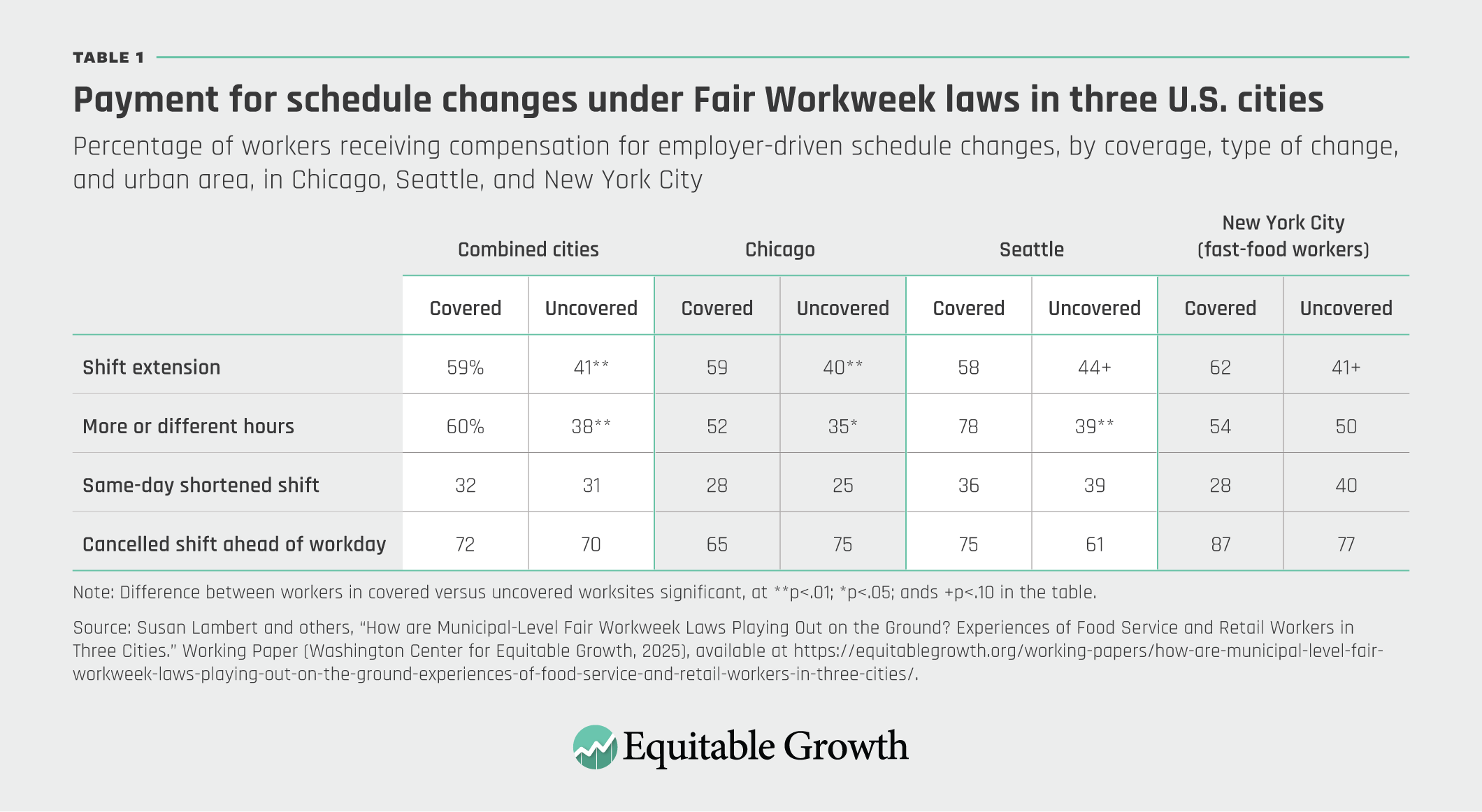
Percentage of workers receiving compensation for employer-driven schedule changes, by coverage, type of change, and urban area, in Chicago, Seattle, and New York City
 Did you find this content informative and engaging?
Get Updates
Did you find this content informative and engaging?
Get Updates
Essays SEP 8, 2026
By: Alexander Bick, Adam Blandin, David Deming, Tyler Schumacher
Working Papers SEP 8, 2026
By: Alexander Bick, Adam Blandin, David Deming, Tyler Schumacher

Essays SEP 2, 2026
By: Megan Rivera
Get updates on our latest research, event announcements, and policy insights delivered straight to your inbox. Stay connected with the leading voices on equitable growth.


