

Skip to content
Browse All Resources
Blog

FEB 18, 2020

Overcoming social exclusion: Addressing race and criminal justice policy in the United States

Overcoming social exclusion: Addressing race and criminal justice policy in the United States

Abstract

This essay is part of Vision 2020: Evidence for a stronger economy (opens in a new tab), a compilation of 21 essays presenting innovative, evidence-based, and concrete ideas to shape the 2020 policy debate. The authors in the new book include preeminent economists, political scientists, and sociologists who use cutting-edge research methods to answer some of the thorniest economic questions facing policymakers today. 

To read more about the Vision 2020 book and download the full collection of essays, click here.

Overview

The United States incarcerates more people (opens in a new tab) than any other country in the world, at a rate of 860 per 100,000 U.S. residents age 18 or older.451 The majority of the growth in the nation’s prison population can be attributed to changes in public policies (opens in a new tab).452 By the mid to late 1970s, American society became more punitive, and the shift in demand for more retributive policies led to an exponential increase in the incarceration rate.

Specifically, many states moved from indeterminate sentencing systems to determinate ones. Determinate sentencing systems set fixed or narrow ranges for statutory terms outlined for each crime, which replaced the sentencing discretion of judges, where the exact sentence is unknown but typically has a wider range, and discretionary parole boards. Determinate sentencing led to more draconian sentencing policies such as mandatory minimums (state statutes requiring individuals to be imprisoned for a definite amount of time), truth-in-sentencing laws (which limit the possibility of early release by requiring those imprisoned to serve a significant proportion of their prison sentence), and three-strikes laws (which result in more severe prison punishments after a third criminal offense).

These policies resulted in more individuals being incarcerated for less serious offenses, as well as individuals being incarcerated for longer periods of time. While incarceration is the most visible representation of the misaligned U.S. criminal justice system, less discussed is the number of individuals who have a criminal record in general, and a felony conviction in particular, within the United States. According to the 2014 Bureau of Justice Statistics Survey of State Criminal History Information Systems, there are more than 100 million recorded criminal records in the United States.453 University of Georgia sociologist Sarah K.S. Shannon and her co-authors estimate that (opens in a new tab) by 2010, there were 18 million Americans with a felony conviction compared to a little more than 7 million who have been incarcerated.454

While it is generally accepted that changes in public policy are responsible for the expansion of the modern U.S. penal system over the past five decades, what is less clear is how ostensibly colorblind policies led to the concentrated incarceration we see today within minority communities and especially African American communities. Harvard University historian and African American studies professor Elizabeth Hinton persuasively argues that the infrastructure necessary for the growth in incarceration began during an era of liberal reform amid the Civil Rights period with the passage of the 1965 Law Enforcement Assistance Act, which marshalled in an era of law enforcement and a focus on fighting racial and economic inequality through the vehicle of law enforcement (opens in a new tab) instead of social programming.455

Largely in response to the civil unrest that stemmed from urban protests against police brutality, targeted crime-control policies led to increased supervision of black urban communities, especially black youth, which ultimately led to mass incarceration. Racialized perceptions of crime and poverty led the federal government to use a punitive approach (opens in a new tab) to poverty alleviation and racial economic justice.456 Indeed, an often overlooked topic within the mass incarceration discussion is the national crime-control policies that provided the funding and incentives that guided state governments to adopt more punitive laws. As Hinton asserts:

The federal government’s long mobilization of the War on Crime promoted a particular type of social control, one that signals that the targeted arrest of racially marginalized Americans and the subsequent creation of new industries to support this regime of control are among the central characteristics of domestic policy in the late twentieth century.457

This last point should not be lost, as many localities in the nation unsuccessfully used prison construction as economic growth engines.458

The purpose of this essay is twofold. The first is to argue for a shift in focus away from dealing with economic inequality through the lens of the criminal justice system—which is ill-equipped to address the root causes of poverty and racial inequality, and may actually increase social costs in the long run. The second is to argue for a widespread audit of current federal crime-control policies and funding, not only to understand whether their social benefits outweigh their social costs, but also to determine and eradicate the policies that are leading to greater racial disparities within the criminal justice system.

The essay begins with a brief discussion of race and crime, then moves on to discuss the relationship between federal crime-control policies and racial disparities in the criminal justice system. I then conclude with some policy recommendations, among them concerted federal efforts to understand and document the historic and still-prevalent role of racial bias in our criminal justice system, and the education of the American public on the persistence and consequences of these biases.

Understanding our past: Race and the criminal justice system in the United States

Toward the end of his life, Dr. Martin Luther King, Jr. began fighting for economic justice because he understood that up to that point, American society had paid very little to enact civil rights legislation, and there could be no true social justice and inclusion of African Americans without economic justice.459 King also seemed to realize that an important component in the fight for equity, justice, and social inclusion was for white people to “reeducate themselves out of their racial ignorance.”460

Specifically, he noted that black people were putting in a mass effort to overcome the oppression that had hindered their progress over the years. Yet white people, King pointed out, were not as determined to overcome their racial obliviousness, arguing that considerable investments were required to close the racial gap, to accommodate black neighbors, and to enforce bona fide school integration—all of which were still terrifying for many white Americans.

More than 50 years later, there has been no meaningful racial education and only limited inclusion of black people within the social and economic fabric of the United States. Schools are just as racially segregated (opens in a new tab), if not more, than they were 25–30 years ago.461 Neighborhoods and communities across the country are still broadly divided along racial lines (opens in a new tab).462 Moreover, the racial wealth gap has persisted over time and is about the same level it was in 1962 (opens in a new tab).463

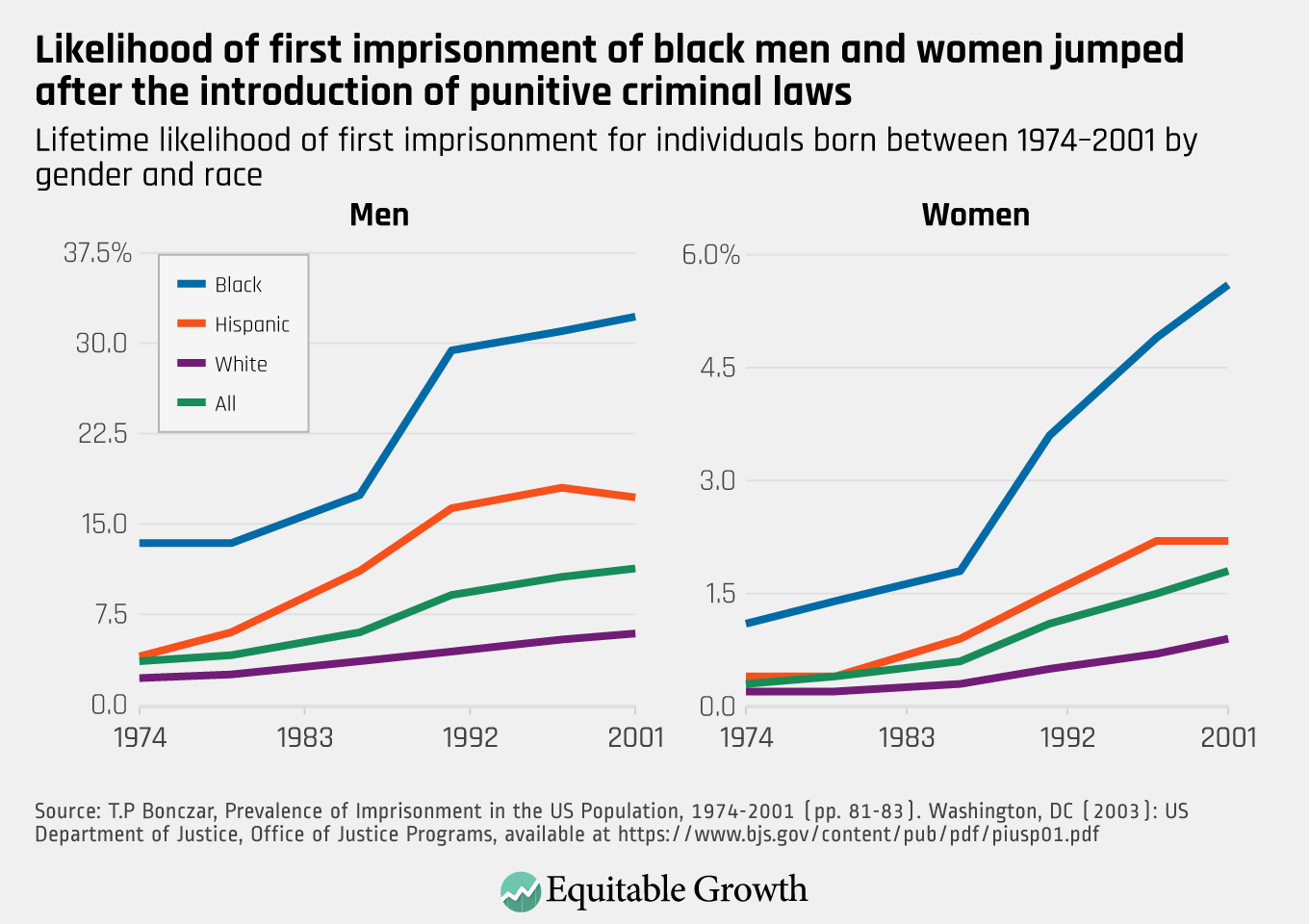
Along the way, the United States has achieved the highest incarceration rate in the world, with its prisons disproportionately filled (opens in a new tab) with black descendants of their enslaved ancestors: African American men born in 2001 have roughly a 1 in 3 chance of being imprisoned (roughly 5.5 times their white counterparts), while an African American woman born in 2001 has a 1 in 18 chance of being imprisoned (roughly 6 times their white counterparts).464 (See Figure 1.)

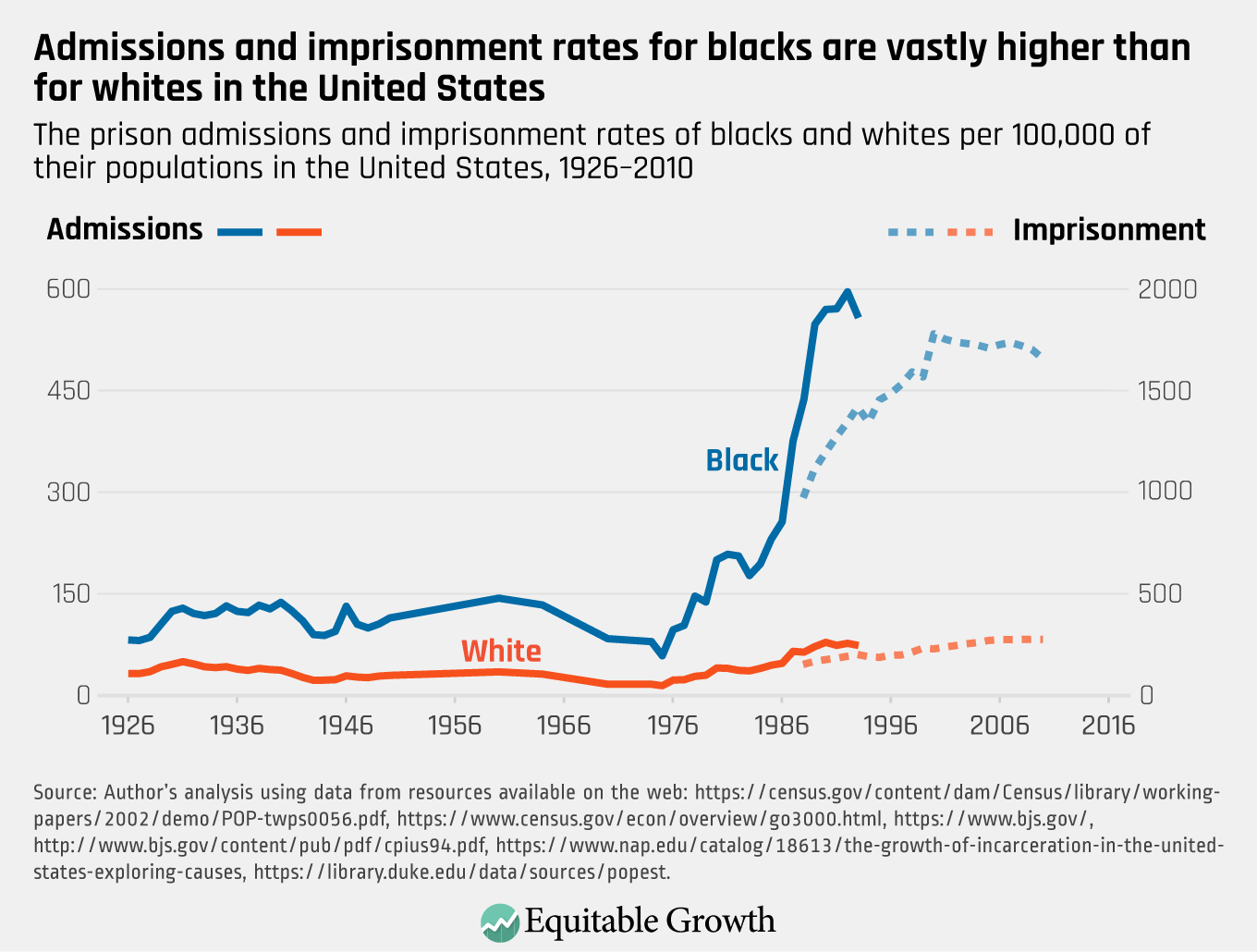
Consider the disproportionality in state and federal prison admissions rates from 1926 to 1993 by race. It should be noted that even in 1926, African American state and federal prison admission rates were more than twice the admission rates of white people, and this continued to increase over time. Yet admission rates began to increase at a much steeper rate for black Americans than for white Americans beginning in the mid-1970s through 1993, such that black admission rates were 7.6 times the white rate by 1993. Imprisonment rates by race from 1988 to 2010 show a similarly large disparity between black people and white people. (See Figure 2.)

Political science research suggests a duality in the way that society chooses to punish based on who is punished. Professors Jon Hurwitz at the University of Pittsburgh and Mark Peffley at the University of Kentucky find that (opens in a new tab) when white people are asked about how to address violent crime in general, and violent “inner city” crime in particular, respondents are more likely to prefer to build prisons to combat violent “inner city” crime—and this is true particularly among white people who hold negative stereotypes about black people and who view the criminal justice system as racially fair.465 In this context, “inner city” is used as a codeword for black.

Mainstream society’s view of black people as a degenerate race of inferior intellect, prone to criminal behavior, and incapable of governing themselves is a long-held belief that predates mass incarceration or even the unrest during the civil rights era.466 These highly racialized views and perspectives played an important role in the intellectual history of the United States in the 19th and early 20th centuries. American Polygeny, or the belief that human races stem from different species, was one of the primary theories to gain recognition on the international science arena at that time.467 This scientific movement (opens in a new tab) developed right before the American Civil War, during a time of uncertainty when the country was fervent about establishing racial inequalities.468

Indeed, the legacy of these racist beliefs spurred the intellectual and political foundation that time and time again led to social investment in policies that reinforced racial inequality and social control, such as black codes and convict leasing. It also laid the groundwork for the Jim Crow laws that took root at the end of Reconstruction in 1877 to limit the full participation of African Americans in the U.S. labor market, voting, residential preferences, and education. These regulations, along with the civil unrest protesting police brutality and other marginalizing institutions in black communities, paved the way in the 20th century for the integration of crime control and equal opportunity programs.469

Specifically, it was during President Lyndon Johnson’s “Great Society” in the 1960s that anti-poverty programs became intertwined with anti-crime programs, thereby setting the foundation for the mass incarceration policies of the past several decades. In fact, President Johnson’s Law Enforcement Assistance Act ended 200 years of domestic law-enforcement policy by instituting federal authority over local policing procedures.470

Federal crime-control policies and racial disparities in the criminal justice system

This section of the essay reviews some of the unintended consequences of these major crime-control policies—such as the Edward Byrne Memorial State and Local Law Enforcement Assistance Program, or Byrne Program, which provided federal funding for state and local drug law enforcement efforts—to show how colorblind policies could lead to racially biased results. Conceivably, financial incentives from intergovernmental grant programs and civil asset forfeiture laws, together with U.S. Supreme Court decisions awarding police extraordinary power to stop and search residents with minimal to no probable cause, contributed to the disproportionate policing and imprisonment of African Americans.471

A 1993 report by the congressional General Accounting Office (now the Government Accountability Office) found that federal grants provided under the Byrne Program were “the primary source of federal financial assistance for state and local drug law enforcement efforts.”472 These types of grants could lead to changes in policing and prosecution—if, for example, they enhanced collaboration between police and prosecutors—for drug and violent crimes.473

In fact, one of the key policing innovations stemming from the Byrne Program was multijurisdictional drug task forces. But some of these multijurisdictional task forces—such as the South Central Narcotics Task Force in Texas, which, at one point, arrested 15 percent of the young black men in the city of Hearne in one drug raid—have become infamous (opens in a new tab) for their selective enforcement of African Americans.474

The case of Hearne, Texas is especially egregious: The South Central Narcotics Task Force conducted raids in the black community each year for 15 years under the direction (opens in a new tab) of District Attorney John Paschall with the intent to “round up the n*****s.”475 Even though white and Hispanic people in the community were participating in drug activity at the same rates, there was a deliberate focus on the black community, according to an American Civil Liberties Union legal complaint.476 In fact, the same ACLU legal complaint specifically states that Paschall was open about his desire to rid Hearne of its black population using incarceration.

I and my co-author, Jamein Cunningham at the University of Memphis’ Department of Economics, investigate (opens in a new tab) the effect of the Byrne Program on crime and black and white arrests.477 We find this program significantly increased the number of drug sales arrests for white and black people, although the marginal effect on drug sales arrests for African Americans is much larger, suggesting that this program may have exacerbated already-present racial disparities in arrests. Although the Byrne Program also targeted violent crime, there is little evidence of significant changes for violent crime arrests.

While our analysis cannot specifically pinpoint the mechanism through which police increased arrests for drug sales by black people, such as by selective enforcement due to racial animus or implicit bias, sociologists Katherine Beckett, Kris Nyrop, and Lori Pfingst at the University of Washington find evidence of selective enforcement of African Americans in Seattle. Their research finds that selective enforcement was due to organizational practices established by policies driven by implicit racial bias and not the more common reasons provided for differences in arrests, such as differences in the structure of drug markets between drugs used and sold by black and white people or greater community complaints by black people.478 University of Chicago economist Derek Neal and Cornell University management professor Armin Rick also find that due to historical differences in arrest rates, mass incarceration policies disproportionately affect African American communities.479

Similarly, Emily Weisburst at UCLA’s Luskin School of Public Affairs, using data from Texas, finds that federal grant funds for school police from the Community Oriented Policing Services’ Cops in Schools program raises middle school discipline rates by 6 percent per year, and this increase is mostly driven by low-level infractions.480 Moreover, black students experience the greatest increase in their discipline rates. She estimates that a student who attends a school district that received one 3-year grant is 2.5 percent less likely to graduate high school and has a 4 percent reduced chance of enrolling in college.

While these crime-control policies were seemingly colorblind, they were certainly not race neutral in their effect.

Effective criminal justice policy

The United States’ history of racial bias and animus is so engrained in the soul of the country that failure to acknowledge and atone for its presence in the intellectual, political, and cultural fabric of our society allows for its continued reproduction.481 What’s more, the failure to recognize the intricate connection of racial bias to systems of social control, such as the criminal justice system, leads to challenges to the implementation of race-neutral public policy and causes additional social costs to society. Specifically, ignoring racism as an important policy variable leaves federal, state, and local policies vulnerable to be misused as a tool to oppress and disenfranchise historically oppressed groups.

The failure to recognize the role of race and racial bias as a key policy variable through which the United States arrived at the state of mass incarceration, as well as the role that race plays in criminal justice system outcomes in general, will only reproduce historically racially biased social structures, racial disparities in the criminal justice system, and social exclusion, regardless of any reforms we choose to implement.482 The impact (opens in a new tab) of these racial disparities on earnings is telling.483 But the collateral consequences of mass incarceration policies are far reaching and have been devastating to the black community. These consequences include greater health disparities, the destruction of the black family, greater obstacles to employment and human capital investment, and the forfeiture of citizenship status and political exclusion through felon disenfranchisement laws.484

Recent research on the consequences of racial bias in U.S. incarceration rates makes manifest many of these connections. University of California, Berkeley public policy professors Rucker Johnson and Steven Raphael observe (opens in a new tab) that male incarceration explains the bulk of the difference in HIV/AIDS rates between black and white women.485 And I and my co-author Sally Wallace, an economist at Georgia State University’s Andrew Young School of Policy Studies, find that the financial shock of an incarceration raises the likelihood that households with children will become food insecure.486 In fact, it is estimated that families with an incarcerated loved one incur almost $14,000 in debt, paying for court-related costs and fines, and that 1 in 3 families go into debt to maintain contact with an incarcerated family member.487

Action at the federal level is now required to undo the harm caused by racially biased mass incarceration policies. To begin addressing these concerns, the federal government should first seek to re-educate the public about the history of race in the United States in order to break flawed perceptions in the association between race and crime. The first step in this strategy would be reconciliation and atonement, which may include reparations for past and current oppressive policies enacted against historically marginalized groups in general and African Americans in particular.

As part of this strategy, the government should allocate funding to state and local governments for initiatives that will educate the public on the history of race in the United States and how this history affects social outcomes and our beliefs about others. This should be incorporated throughout Kindergarten through grade 12 public school curriculums in all subjects.

Moreover, the federal government should encourage and promote policies that work against the dehumanizing effect of racial biases by providing incentives for the development of programs that produce empathy toward others.488 As part of this strategy, these policies should address racial biases in the criminal justice system and their root causes, such as racial biases that persist in news media reports of criminals and victims. Research finds that the news media portray false accounts about the racial distribution of criminals, victims, and arbitrators of justice, and that these characterizations perpetuate false racial stereotypes about crime.489 To the extent that these racial stereotypes impede the execution of unbiased criminal justice policy, racial biases in the media should be addressed.490

The federal government also should conduct an audit of federal crime-control programs and policies (such as plea bargaining) to understand their impact on historically marginalized groups, encourage state and local governments to do the same, and then defund programs that inadvertently lead to greater net social harm, that increase racial disparities, or that have a disproportionate burden on historically marginalized communities. Such a benefit-cost analysis should be undertaken to determine how these policies not only influence crime but also their external costs (or benefits) to society. Policymakers can no longer condone partial equilibrium analyses that only consider the direct crime-fighting benefits of a program without also considering all of its direct and indirect costs to society, which includes determining the extent to which a policy is race neutral and its effect on marginalized groups.

These sets of recommendations would require unbiased data collection by the states and local governments of quality criminal justice data in order to understand why there are persistent racial disparities in the criminal justice system, including documentation not only for policing but also for prosecution, since prosecutors also are important gatekeepers to the criminal justice system.491 This effort also would require better data collection on arrests, convictions, and incarcerations in national datasets, such as the U.S. Census, in order to improve population estimates of the impact of incarceration on individuals, families, and communities.

Theoretically, crime-control policies include programs that promote economic justice and the elimination of racial disparities. Yet investments in economic opportunities should be done on the front end through social services organizations, not on the back end through the criminal justice sector, which may only serve to increase the contact of young minorities with the criminal justice system. In other words, federal and state governments should stop using the criminal justice system to address economic inequities. This would require decreasing the correctional population, both juvenile and adult, which could be done, for example, by placing a moratorium on incarceration for non-violent offenses and redirecting the cost savings to social programs. The federal government could provide monetary incentives to states that reduce their correctional population. These social programs should not be administered by law enforcement agencies. Examples of these programs are early childhood education, subsidized childcare programs, summer programs for youth, improving K–12 school quality, and more equitable healthcare—all targeted toward the most marginalized groups in society.

Finally, the federal government should tie federal funding for criminal justice programs to states’ eradication of felon disenfranchisement laws. Although African Americans’ right to vote became protected by law with the Voting Rights Act of 1965, the racial disparities in felony convictions suggest that they disproportionately bear the burden of felon disenfranchisement laws, and through these laws, many have effectively lost their right to vote.492 Most states prohibit individuals in prison or on probation or parole from voting, and although numerous states have developed protocols for restoring voting privileges to ex-offenders, these procedures are so burdensome (opens in a new tab) that many of them do not seek to restore their rights.493

Conclusion

Failure to address racial biases in our society risks democracy for all Americans. Failure to address the systematic racial biases in state, local, and federal policies in general, and the criminal justice system in particular, will only lead to the perpetuation of racial inequality and the overrepresentation of marginalized groups within sectors of social exclusion, especially the criminal justice system. While there is undoubtedly a behavioral aspect to crime, too much focus on the individual will not address the root causes of crime in our society or the structural barriers that have led to the social exclusion of historically marginalized individuals and communities.

—Robynn Cox is an assistant professor at the University of Southern California Suzanne Dworak-Peck School of Social Work.

Back to Vision 2020 full essay list (opens in a new tab).

Related

Your Direct Line to Cutting-Edge Research

Get updates on our latest research, event announcements, and policy insights delivered straight to your inbox. Stay connected with the leading voices on equitable growth.