
What happens to U.S. workers without access to Unemployment Insurance amid economic downturns or disruptions related to AI?
Essays SEP 2, 2026
By: Megan Rivera
MAY 16, 2018
By: Nisha Chikhale
Households are economically insecure when they’re unable to plan for expenses, save or invest for their future economic security, and pay down debts. Household insecurity in the United States can be influenced by differences in income, wealth, credit access, or family structure.
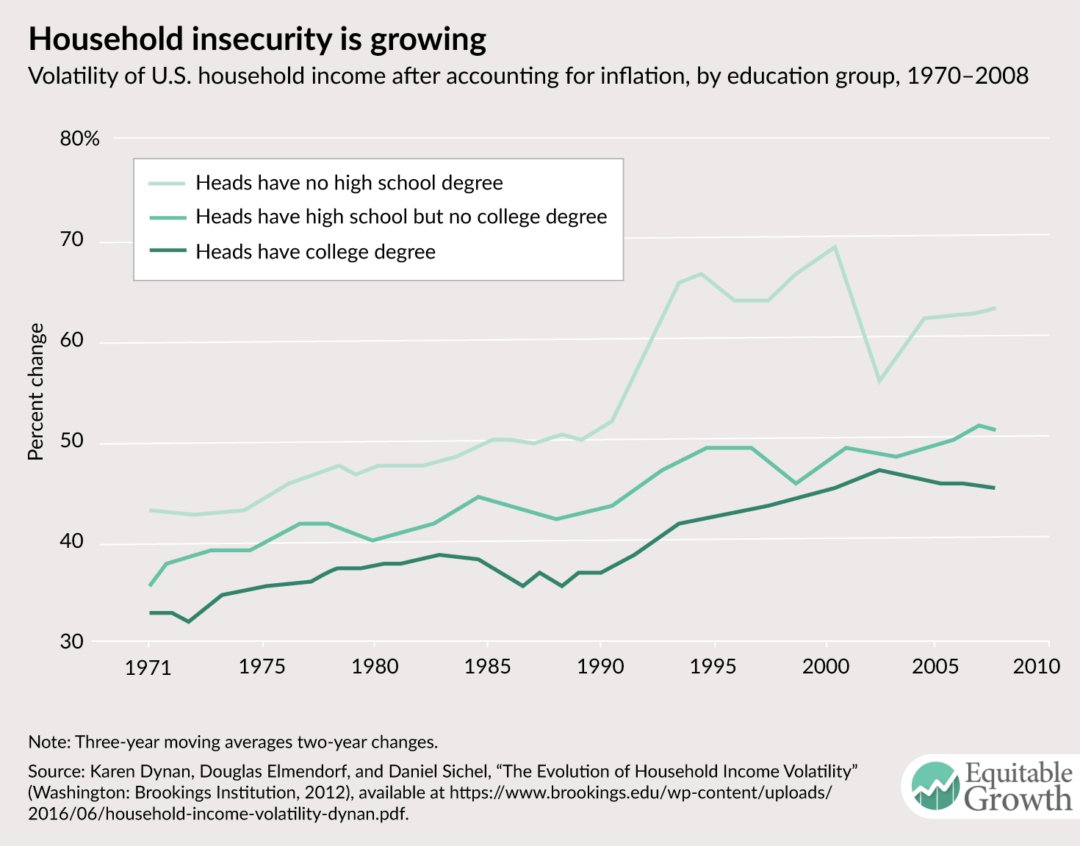
Economists use income volatility as the easiest proxy for household insecurity. Households that experience a gain or drop in income of 25 percent or more from one month to the next or one year to the next can be said to have a volatile income. Large swings in income can make it difficult to plan for expenses, and volatile drops in income increase a household’s likelihood of experiencing insecurity, especially if coupled with low savings (lack of wealth), lack of social insurance, and limited access to credit.
Household income volatility has been increasing for all families, even those with a college-educated head of household. A 2016 Federal Reserve report (opens in a new tab) found that 32 percent of U.S. adults report that their incomes vary from month to month, and 42 percent of those with volatile incomes and/or volatile expenses say that they have “struggled to pay their bills at times because of this volatility.” This insecurity matters, not only for a family’s ability to cope with daily expenses but also has implications for wider economic stability.

For low- and middle-income households, income from work is the largest source of total household income. Therefore, changes in labor market conditions that impact families’ incomes have significant implications for their economic security such as:
Savings and access to credit are stopgaps that families can use to fill in the gaps when income is insufficient to meet basic needs such as due to job loss. Specifically:
Social insurance is another buffer against income volatility, especially from job loss and in the absence of savings and credit. Examples include unemployment insurance and the Supplemental Nutrition Assistance Program.
Household insecurity has implications for how much families decide to consume. Household consumption contributes nearly 70 percent of overall Gross Domestic Product, the largest component of U.S. economic growth. Therefore, maintaining strong consumer demand is important for stable economic growth.
Factors that are drivers of household income volatility such as alternative work arrangements are on the rise. Factors that mitigate exposure to risk—such as social insurance programs and family savings—are declining. Therefore, in order to help increase household security and support stable economic growth, we must look for remedies to promote access to stable economic resources and to minimize risk. Some examples of ways to do this include:
This brief summarizes the paper “Household insecurity matters for U.S. economic growth and stability” by Nisha Chikhale. The paper lists sources for the research summarized here.
Essays SEP 2, 2026
By: Megan Rivera
Essays AUG 31, 2026
By: Christopher Bangert-Drowns
Essays AUG 14, 2026
By: Carlos Fernando Avenancio-Leon
Get updates on our latest research, event announcements, and policy insights delivered straight to your inbox. Stay connected with the leading voices on equitable growth.