



Policy
What Work Does Generative AI Do?
Essays SEP 8, 2026
By: Alexander Bick, Adam Blandin, David Deming, Tyler Schumacher
AI, Tech & Energy
Labor, Wages & Worker Power
 Browse All Resources
OCT 2, 2025
By: Susan Lambert and Julia Henly

This factsheet, “How Are Workers Experiencing Fair Workweek Laws? Evidence for policymakers and advocates,” originally appeared on WorkRise (opens in a new tab) at https://www.workrisenetwork.org/sites/default/files/2025-08/howareworkersexperiencingfairworkweeklaws.pdf (opens in a new tab).
New laws that regulate employer scheduling practices have been enacted in ten US localities over the last decade. Known as Fair Workweek laws, these rules target industries in which a large proportion of employees are in lower paid jobs and face the constant uncertainty of fluctuating, unpredictable hours, such as retail and food service. The local laws address similar dimensions of work schedules, but the specific industries, size and type of employer, and administrative rules that define compliance vary by locality. Adapted from the brief, How Are Municipal-Level Fair Workweek Laws Playing Out on the Ground? Experiences of Food Service and Retail Workers in Three Cities, the chart below shows how workers are experiencing Fair Workweek laws in Chicago, Seattle, and New York City.
Figure 1
Share of retail and food service workers experiencing practices in alignment with scheduling laws, by coverage
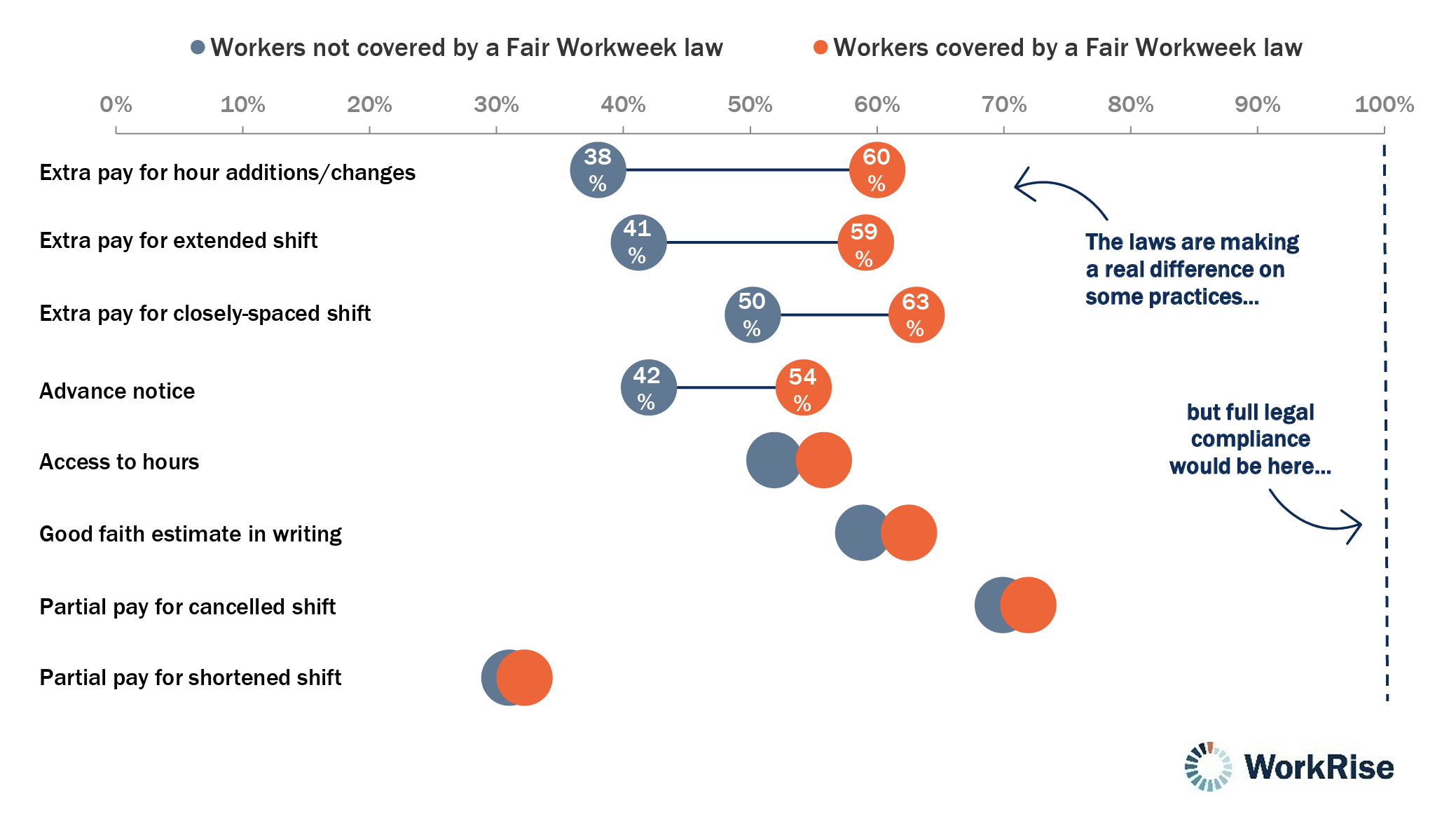
Note: Scheduling practices without values shown do not have significant differences between groups of workers.
For policymakers in cities that have already approved Fair Workweek laws, implementation is the critical next step. These cities can support effective implementation by adopting easy-to-understand rules that encourage employer compliance, strengthen enforcement by city agencies, and educate employees and employers on their rights and responsibilities under Fair Workweek laws. In cities that have not yet adopted comprehensive Fair Workweek legislation, policymakers can still take meaningful steps by providing incentives to employers for adopting high-road scheduling practices, setting up a hotline for employees to report problematic scheduling experiences, and assembling information to inform future Fair Workweek legislation. Specific actions include:
For more insights on these findings, see the full report How Are Municipal-Level Fair Workweek Laws Playing Out on the Ground? Experiences of Food Service and Retail Workers in Three Cities at urbn.is/WRFWW (opens in a new tab)
This summary was funded by WorkRise, a research-to-action network hosted by Urban Institute and supported by a multifunder (opens in a new tab) collaborative. Our philanthropic supporters make it possible for WorkRise and Urban to advance their shared missions of bringing high-quality evidence to changemakers with the power to transform economic opportunity for all. The views expressed are those of the authors and should not be attributed to WorkRise or to the Urban Institute, its trustees, or its funders. Funders do not determine research findings or the insights and recommendations of Urban experts. Further information on the Urban Institute’s funding principles is available at urban.org/fundingprinciples (opens in a new tab).
 Did you find this content informative and engaging?
Get Updates
Did you find this content informative and engaging?
Get Updates
Essays SEP 8, 2026
By: Alexander Bick, Adam Blandin, David Deming, Tyler Schumacher
Working Papers SEP 8, 2026
By: Alexander Bick, Adam Blandin, David Deming, Tyler Schumacher

Essays SEP 2, 2026
By: Megan Rivera
Get updates on our latest research, event announcements, and policy insights delivered straight to your inbox. Stay connected with the leading voices on equitable growth.


