



Policy
What Work Does Generative AI Do?
Essays SEP 8, 2026
By: Alexander Bick, Adam Blandin, David Deming, Tyler Schumacher
AI, Tech & Energy
Labor, Wages & Worker Power
 Browse All Resources
JUL 1, 2020
By: Kate Bahn and Carmen Sanchez Cumming

Occupational segregation—the disproportionate representation of a group in any type of job—hurts workers and the entire U.S. economy by entrenching racial and gender wage gaps, depressing earnings, and limiting workers’ ability to go into their preferred fields of work. Research shows that differences in education or skills fail to explain (opens in a new tab) a large chunk of persisting job stratification, and that discrimination (opens in a new tab) and longstanding social norms play an important role in preventing workers from being proportionately represented in the U.S. occupational structure.
To illuminate the current status of occupational segregation in the United States, below are four graphs that demonstrate the extent to which workers are crowded into some jobs and have limited access to others along the lines of race and gender, contributing to persistent wage inequality across the labor market. Along with labor market polarization and the rise of insecure and lousy jobs, White men continue to make up the disproportionate majority of workers in top-paying positions, such as CEOs. Conversely, Latinx workers, Black workers, and Asian American or Pacific Islander workers are underrepresented across many of the highest-paying occupations. (See Figure 1.)
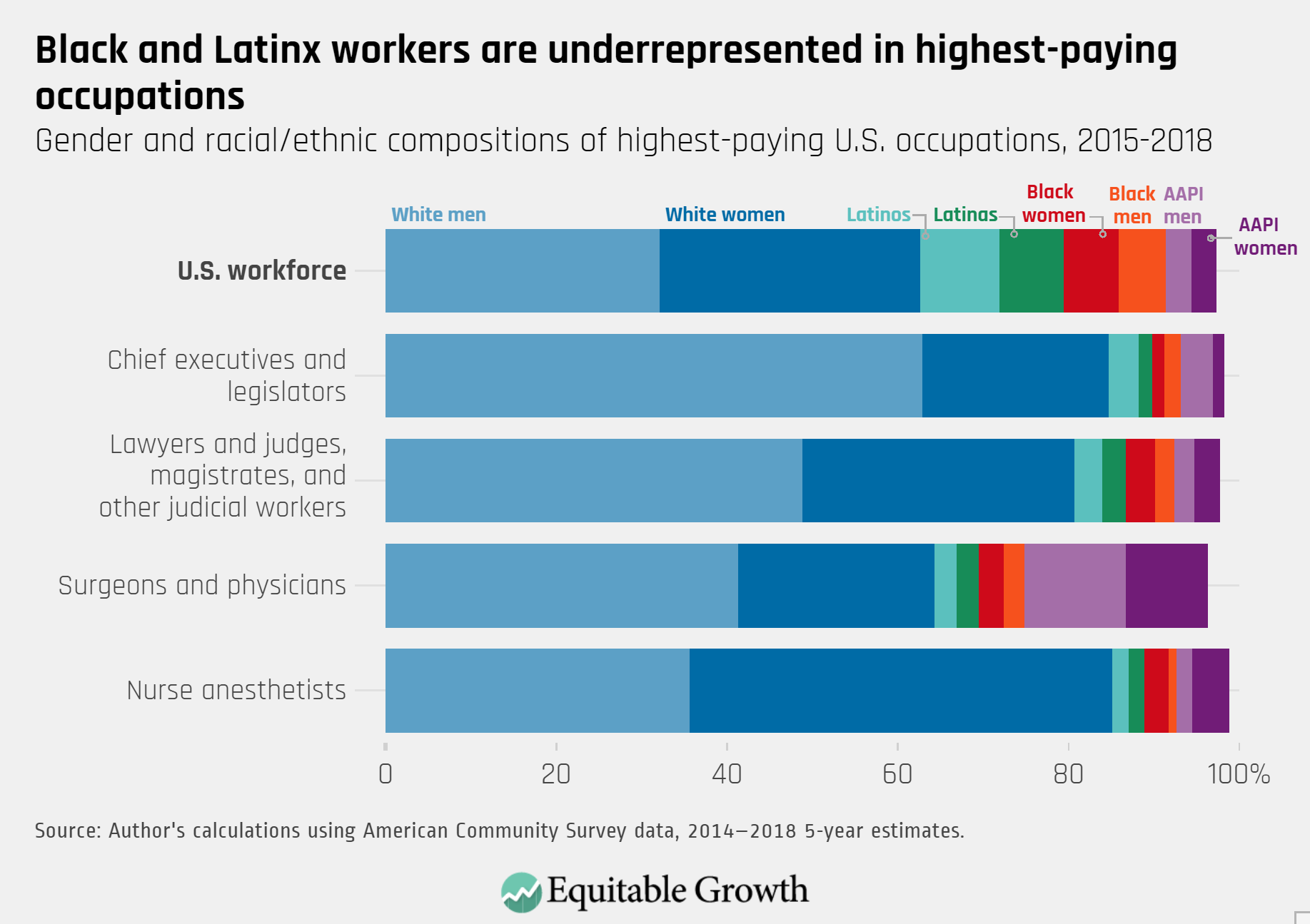
Gender and racial/ethnic compositions of highest-paying U.S. occupations, 2015–2018
From the 1940s to the 1980s, women in general and Black women in particular made big strides (opens in a new tab) toward greater occupational integration, and more Black women entered clerical, management, professional, and technical fields—a process that explains (opens in a new tab) a large share of the wage gains that Black women have made since the 1960s. Around 2000, however, the trend toward greater integration seems to have reversed (opens in a new tab) slightly, and Black women continue to be greatly overrepresented (opens in a new tab) in low-wage service-sector jobs such as in healthcare and retail. (See Figure 2.)
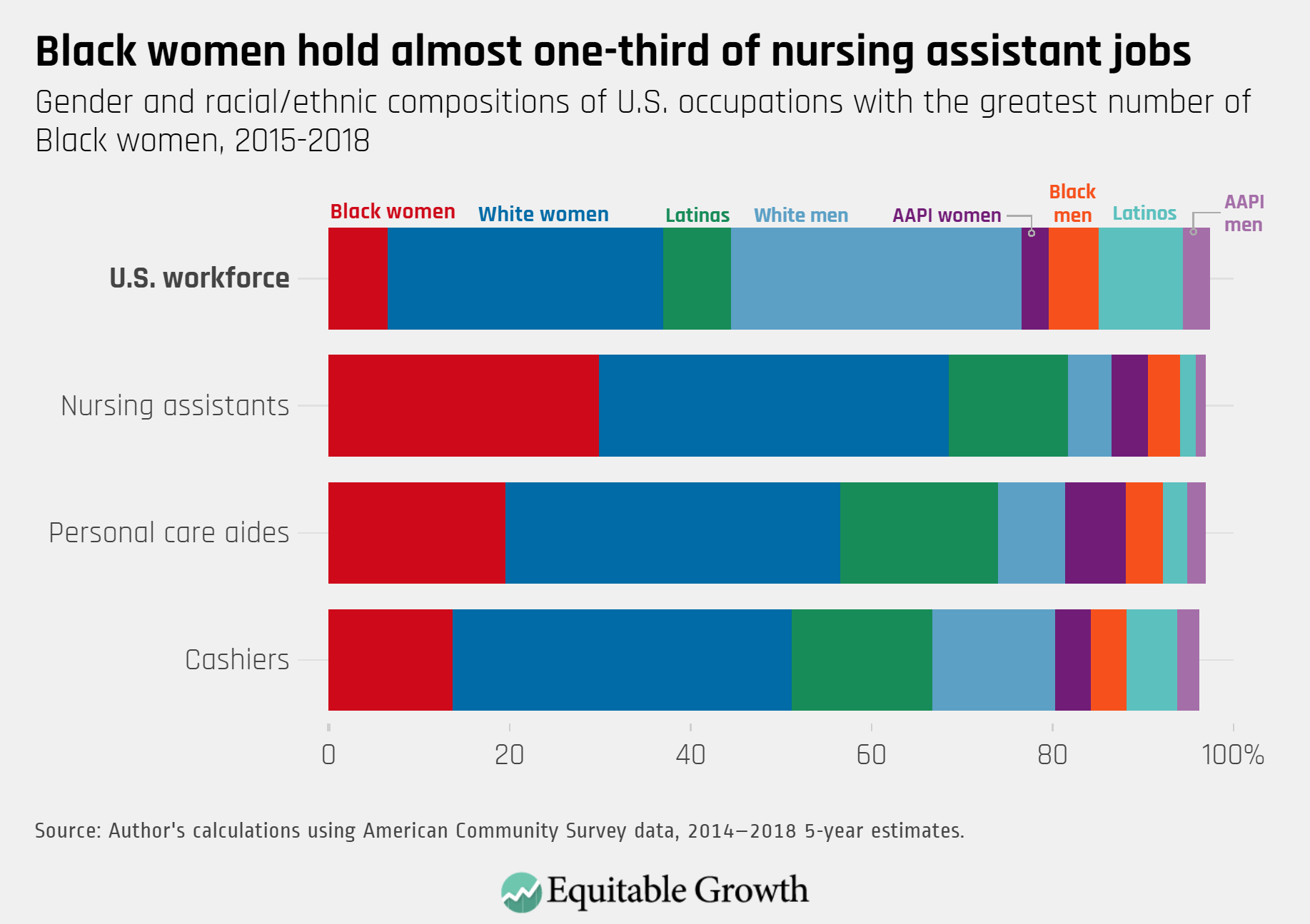
Gender and racial/ethnic compositions of U.S. occupations with the greatest number of Black women, 2015–2018
Latino men are overrepresented in many construction occupations, making up 17 percent (opens in a new tab) of the entire industry, while they only represent about 9.3 percent of the U.S. workforce. As measured by the Index of Dissimilarity, which shows how many men or women would need to switch jobs in order to reach the same gender distribution in each occupation as in the overall workforce, Latinx men and women are the most segregated (opens in a new tab) of the major racial or ethnic groups. (See Figure 3.)
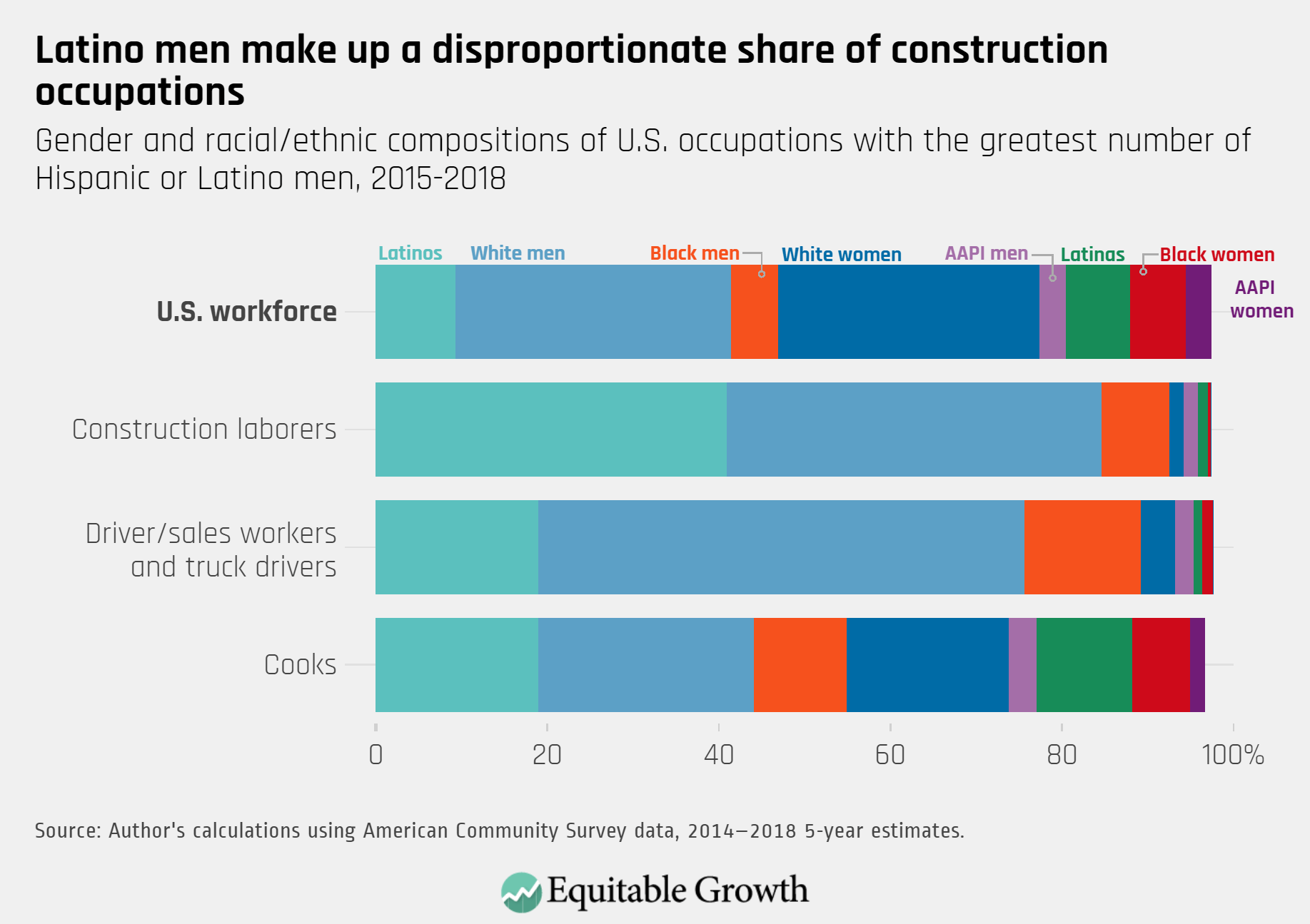
Gender and racial/ethnic compositions of U.S. occupations with the greatest number of Hispanic or Latino men, 2015–2018
Conversely, Asian American or Pacific Islander men and women experience the least gender-based segregation (opens in a new tab) of the major racial or ethnic groups—though they also experience occupational segregation—and have made the greatest advance toward integration. AAPI women in the workforce are also more likely (opens in a new tab) than their Black, Latinx, and White counterparts to work in management or professional fields, with 50 percent of AAPI women employed in those occupations. (See Figure 4.)
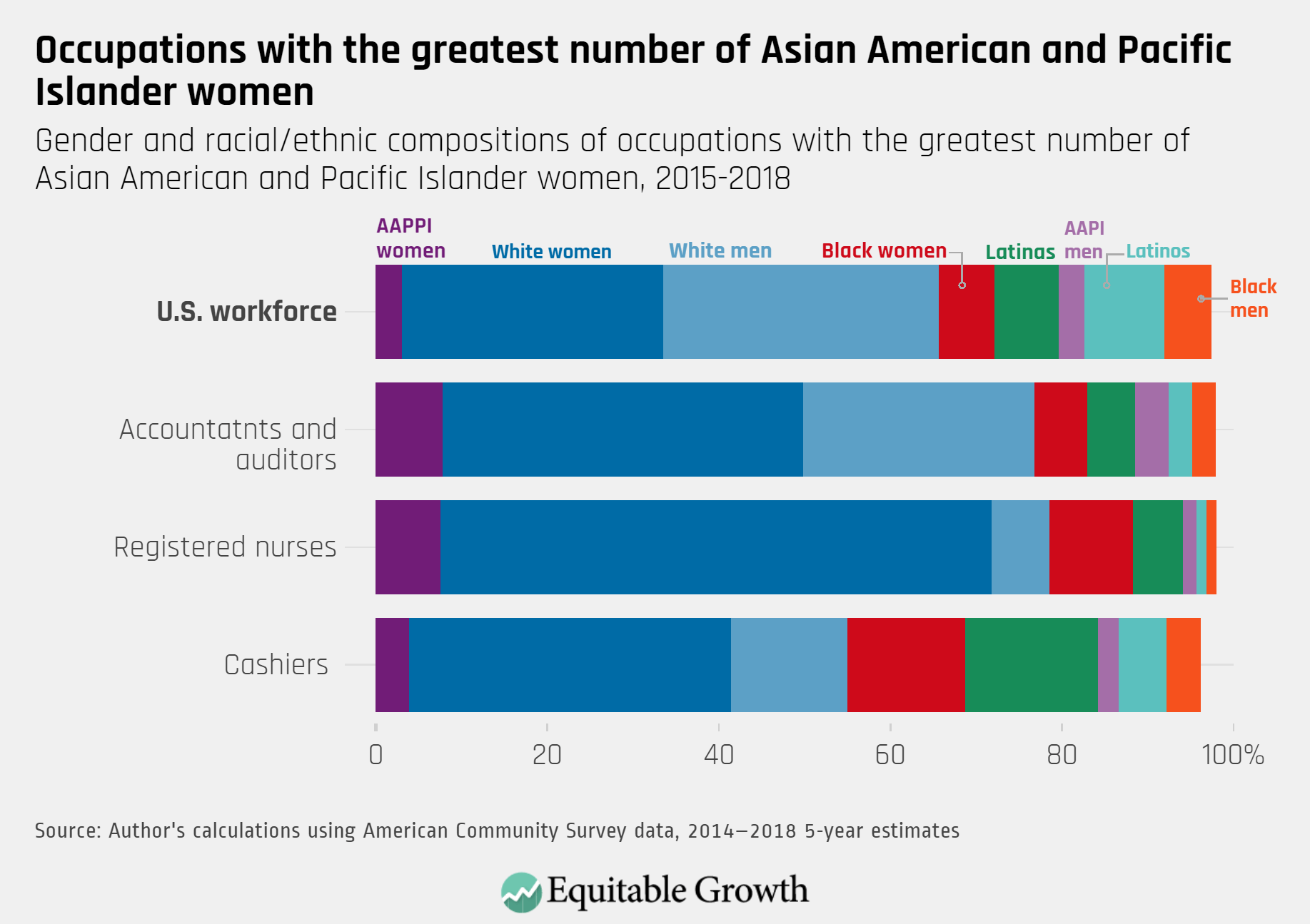
Gender and racial/ethnic compositions of occupations with the greatest number of Asian American and Pacific Islander women, 2015–2018
Progress toward a less segregated occupational distribution of work in the United States has stalled and, in some cases, reversed in the 21st century. This points to the persisting obstacles many women workers and workers of color face in the U.S. labor market. Striving toward greater integration would foster a more equitable economy and help counteract longstanding U.S. labor market disparities.
Essays SEP 8, 2026
By: Alexander Bick, Adam Blandin, David Deming, Tyler Schumacher
Working Papers SEP 8, 2026
By: Alexander Bick, Adam Blandin, David Deming, Tyler Schumacher

Essays SEP 2, 2026
By: Megan Rivera
Get updates on our latest research, event announcements, and policy insights delivered straight to your inbox. Stay connected with the leading voices on equitable growth.


