


Policy
U.S. economic mobility trends and outcomes
Reports MAR 29, 2024
By: Hiba Haroon, Shaun Harrison
Economic Equity & Opportunity
 Browse All Resources
MAY 13, 2025
By: Timothy Bartik

Places in the United States differ greatly in their residents’ access to jobs, including access to good jobs. In economically distressed places, these job problems can be addressed by creating more jobs, particularly good jobs, and by improving residents’ access to those jobs. Effective policy solutions require customized public services for businesses to create jobs where they are needed alongside similarly customized public services for individuals seeking work to improve their access to good jobs.
The federal government and state governments already provide about $80 billion a year to help create jobs around the nation through a variety of longstanding programs that are detailed in my analysis below. These current job-creation programs are rarely targeted to distressed places, however, and instead spread job creation to all places. In addition, as I discuss below, most of the dollars devoted to these job-creation policies are business tax incentives, which are less cost-effective than some alternative job creation policies that emphasize various public services to businesses and individuals. Although the Biden administration did adopt some programs to spur job creation in distressed places, these programs were funded by Congress at a pilot scale compared to the need.210
Because distressed places lack the resources to provide such public services at a large enough scale, federal or state aid that is specifically adapted to places’ diverse needs is required. As I have proposed in the past—and again propose in this essay—this flexible federal or state aid should be targeted in its per-capita funding based on a local community’s prime-age employment rate. As I argue below, a place’s prime-age employment rate provides a good measure of the availability of labor market opportunities for local residents.
In this essay, I will discuss how best to target distressed places with job creation programs and what job creation programs are most effective. First, I will map out how the prime-age employment measure gauges the job creation needs of local labor markets and neighborhoods across the country. Then, I will examine a number of different government programs at the federal and state levels that have tried to increase people’s access to jobs—and particularly good jobs—and, importantly, what types of programs are most successful at a reasonable cost per job opportunity created. I then close my essay with a set of principles and policy proposals to help guide federal and state aid to distressed places so that the scale is sufficient to significantly alleviate these distressed places’ problems and the aid’s design is targeted, cost-effective, and adaptable to each place’s needs.
Distressed places include both local labor markets and neighborhoods. A local labor market is one or more counties that are sufficiently linked by commuting such that changes in labor market conditions can quickly spread throughout the area. A neighborhood is a portion of a county that has a defined identity and similar within-neighborhood amenities, such as the quality of schools and levels of crime. Examples of local labor market definitions include metropolitan areas, commuting zones, and a definition that I developed of “spillover-based” local labor markets.211 Neighborhoods are defined in an ad hoc way in different local communities and are typically based on what residents identify as distinct neighborhoods.
A useful measure for discerning whether a local labor market or neighborhood is experiencing labor market distress is its so-called prime-age employment rate, or the employment-to-population ratio for those ages 25 to 54. Prime-age persons generally both want to work and are expected by society to work. As a result, increases in employment for this prime-age group are widely perceived as enhancing social well-being, in contrast to increased employment for persons who might be closer to retirement or enrolled in college or graduate school.
In addition, a focus on the local prime-age employment rate roughly controls for a place’s age mix. It would be a mistake to classify a place as “distressed” simply because there is a high proportion of its population that is not working due to being in college or retired.
An increase in the local prime-age employment rate by itself signifies increased earnings per capita for residents, due to a higher proportion of the population having a job. A higher prime-age employment rate also indirectly increases earnings per capita by putting upward pressure on local real wages and making it easier for residents to get hired for better jobs.212 A reduced prime-age employment rate has the reverse effects.
The prime-age employment rate is not a perfect or comprehensive measure of local labor market distress.213 But it is a measure that is closely associated with how many of a place’s residents are experiencing problems in getting jobs or getting good jobs. Furthermore, the prime-age employment rate is one of the few reasonable measures of local labor market distress that can be consistently defined for all U.S. counties and census tracts.214
The most recent comprehensive data on the prime-age employment rate for all counties and census tracts comes from the 2019–2023 period.215 However, as discussed further below, the relative prime-age employment rate for places, compared to the national rate, is highly persistent over time. Therefore, places whose prime-age rate is far below the national average in 2019–2023 will typically be similarly far below the national average in 2025.
Based on 2019–2023 data, the prime-age employment rate varies widely across local labor markets in the United States. About 10 percent of the U.S. population lives in local labor markets that, as of 2019–2023, have a prime-age employment rate of 84.1 percent or higher. These places’ economies are not showing escalating wage and price inflation and thus, their labor market situation can be considered economically sustainable. Indeed, this 84.1 percent rate is a rough-and-ready approximation of full employment because the overwhelming majority of local residents who want a job can find a reasonable-quality job, and yet the economy is not experiencing excess inflationary pressures.
In contrast, 10 percent of the U.S. population lives in local labor markets where the prime-age employment rate, as of 2019–2023, was 73.8 percent or lower, indicating that local residents have much more difficulty finding jobs and, in particular, finding good jobs. These difficulties have large social costs: Low employment rates lead to poorer mental health, increased substance abuse, higher crime, more family break-ups, and poorer outcomes for children.216
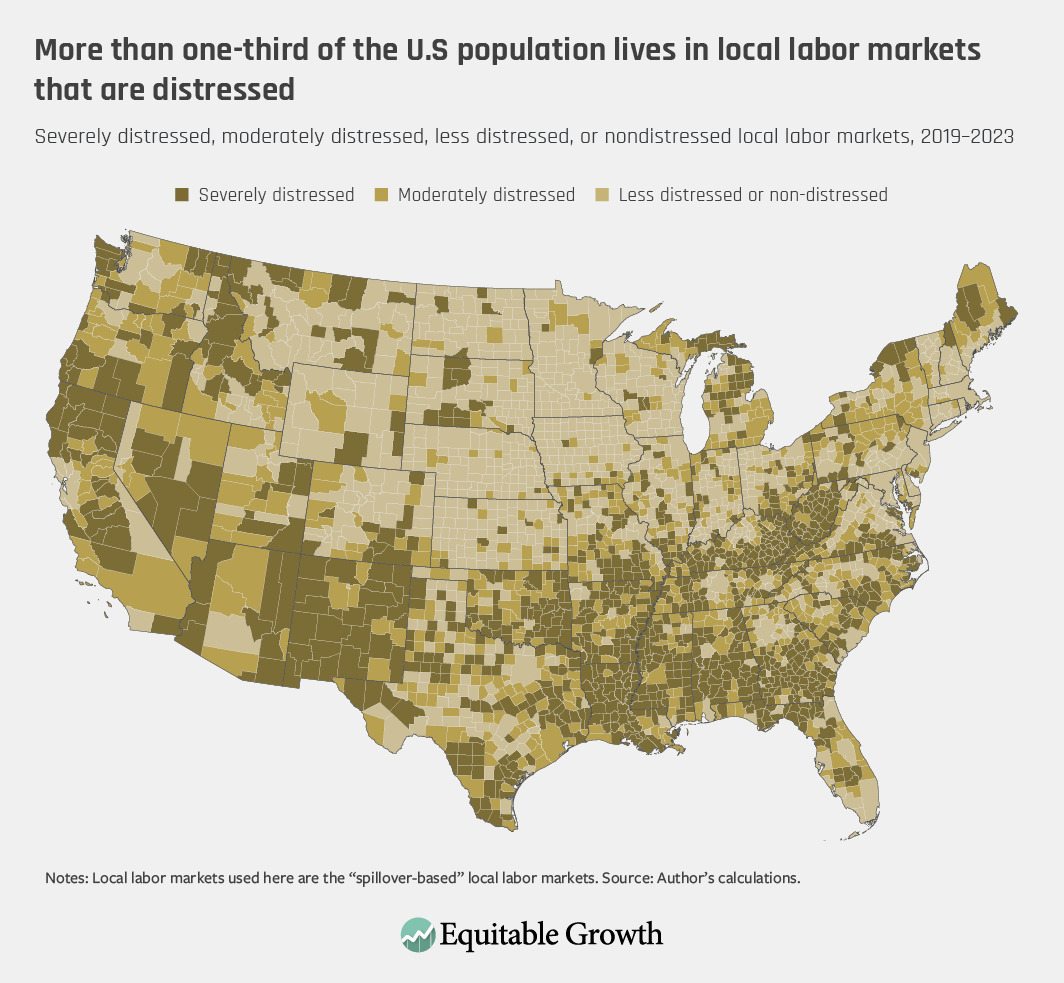
The map below shows local U.S. labor markets that are “severely distressed” or “moderately distressed,” as well as those that are less distressed and not distressed, according to the 2019–2023 data. The former is defined as more than 10 percentage points below the “full employment” prime-age employment rate of 84.1 percent and the latter as between 5 percentage points and 10 percentage points below that rate. Under these definitions, 10.5 percent of the U.S. population lives in local labor markets that are severely distressed, and another 28 percent lives in moderately distressed areas. (See map.)
10.5 percent of the U.S. population lives in local labor markets that are severely distressed, and another 28 percent lives in moderately distressed areas.
Map
Severely distressed, moderately distressed, less distressed, or nondistressed local labor markets, 2019–2023
Severely distressed, moderately distressed, less distressed, or nondistressed local labor markets, 2019–2023
Distressed local labor markets include most of Appalachia and the rural South and Southwest. But many rural areas elsewhere in the country also are distressed, including in upstate New York, northern Maine, Michigan, and many rural areas in the western United States. Many urban areas are at least moderately distressed, among them Detroit and Flint, Michigan; Gary, Indiana; Fresno and Bakersfield in California; Memphis, Tennessee; and Spokane, Washington.
In both booming and distressed local labor markets, some neighborhoods have much lower prime-age employment rates. If we define a distressed neighborhood as at least 10 percentage points below this local labor market average, then 10.7 percent of the U.S. population lives in distressed neighborhoods, based on the 2019–2023 data.
Although distressed neighborhoods are widespread, the size of the problem differs. Among the 30 largest local labor markets, the three local labor markets with the highest percentage of their population in distressed neighborhoods are Detroit (16.2 percent), Philadelphia (14.3 percent), and Cleveland (14.3 percent). The three local labor markets with the lowest percentage of their population in distressed neighborhoods are Portland, Oregon (6.1 percent), Seattle (6.5 percent), and Minneapolis/St. Paul (6.5 percent).
The racial and ethnic composition of distressed local labor markets is similar across demographic groups. In contrast, Black and Hispanic people are more likely to reside in distressed neighborhoods: The national average percentages of the population living in distressed neighborhoods are 7.3 percent for White, non-Hispanic persons, 11.8 percent for Hispanic persons, and 21.7 percent for Black persons.217
The prime-age employment rate in different local labor markets goes up and down with the national economy’s rate, yet different places’ relative positions, compared to the nation, often persist. In 2000, for example, about 47 percent of the U.S. population lived in severely or moderately distressed local labor markets. Of this population living in distressed local labor markets as of 2000, 74 percent still lived in severely or moderately distressed local labor markets as of the 2014–2018 period.218
But, sometimes, places dramatically improve. The local labor market’s prime-age employment rate in the New York City area, for example, went from 6.9 percentage points below the national average in 2000 to slightly above the national rate in the 2014–2018 period.219
The jobs problems of distressed places cannot be solved at scale by moving people from distressed places to better places, a strategy that local economic development specialist Jason Segedy has called the “U-Haul School of Urban Policy.”220 Why doesn’t the “U-Haul” strategy work? The arguments for this position are two-fold. First, people are hard to move. More than half of Americans spend most of their careers in their childhood local labor market.221 Even large local job losses increase out-migration over the next decade by less than 1 percentage point.222 Estimated moving costs, both financial and psychological, often exceed 100 percent of annual income.223
Second, moving some people out of distressed places does not help those left behind. In local labor markets, population loss leads to a similar percentage loss of employment, with no improvement in the local employment rate.224 Population loss lowers demand for local goods and services and disproportionately removes younger and more entrepreneurial workers. In neighborhoods, population loss leads to abandoned housing, higher crime, and loss of local retail outlets.225
In sum, places that are distressed cannot be helped simply by encouraging individual out-migration because people have valuable ties to places, and out-migration has spillover costs. Instead, policymakers need to enact place-based policies to help people in their home places.
Boosting employment rates in distressed places requires different strategies for local labor markets versus neighborhoods. For distressed local labor markets, local employment rates can be increased by creating jobs. In severely distressed places, local job creation can result in half the jobs boosting local employment rates and the other half going to in-migrants.226 In other words, if a distressed local labor market is able to add 100 jobs, 50 of those jobs could go to additional in-migrants to the local economy, while the other 50 jobs would then be reflected in the original local residents having a higher probability of having a job.
In contrast, in booming local labor markets with high employment rates, any added local job creation almost entirely boosts in-migration, with little effects on local employment rates.227 In booming local labor markets, newly created jobs will be filled mostly by in-migrants or already-employed local workers, as few readily employable, local, nonemployed workers are available.
The hiring of already-employed local workers results in job vacancies, filled in the same two ways. At the end of this job-vacancy chain, the initial job creation will be reflected close to 100 percent in in-migration.228 In booming places, job creation mostly increases property values for property owners rather than helping workers.229
How can local jobs be created? Most government job creation dollars come from state and local governments, and most of these job creation dollars are in the form of business tax incentives or cash grants to business to create jobs, which total more than $70 billion annually.230 Examples include property tax abatements, job creation tax credits, or cash grants tied to a firm’s job creation or investment.
But federal, state, and local governments together devote about $10 billion annually to various spending programs that promote job creation by what I describe as customized business services: providing business with better business sites, more productive labor, or business-relevant information.231 These services are customized in that they are typically designed to meet the needs of a particular industry, or even a particular firm.
One type of customized business service is business-specific infrastructure. A regular part of the local economic developer’s toolkit is to create industrial parks or high-tech research parks, which provide land that is zoned for a particular industry type and has appropriate supportive infrastructure. State economic development agencies or state transportation agencies frequently pay for industrial access roads, which provide new roads in association with a major new firm location, to facilitate movement of supplies, workers, or output. Business incubators, of which there are about 1,400 in the United States, help provide affordable business space for new or small businesses, along with some support services.232
States also seek to create jobs through customized job training programs. Rather than targeting disadvantaged residents, these programs target firms that are either creating jobs or facing competitive threats, providing them with free or heavily subsidized job training. This training is customized in that it is designed around the particular firm’s skill needs. Training is typically provided by local community colleges. Around 42 states provide such customized training, at a cost of around $1 billion annually.233
Jobs also can be created by providing individual firms with business-specific information or advice. For example, the Manufacturing Extension Partnership in the U.S. Department of Commerce provides federal support that pays for part of the costs of manufacturing extension services in all 50 states.234 In manufacturing extension services, program staff or reliable consultants provide small- and medium-sized manufacturers with advice, typically paid for partly by fees and partly supported by government, on how to best adopt new technology or move into new markets.
The federal Small Business Administration also provides funding that pays for part of the costs of Small Business Development Centers that exist in all 50 states and help new or small businesses develop and implement better business plans.235 In both manufacturing extension services and Small Business Development Centers, the information and advice is customized to the needs of the individual business.
Which of the above types of job creation is most cost-effective? While tax incentives can create jobs, the cost per job is high. The various customized business services are more cost-effective because they provide businesses with better access to inputs, such as real estate, labor, and information, which are difficult for many firms, particularly smaller firms, to access on their own.
Based on my research, Figure 1 below shows the cost in severely distressed local labor markets of increasing the overall employment rate by one job.236 To avoid possible misinterpretations, it is important to note that this figure is based on research that estimates the cost of government job-creation programs per job actually induced by the particular program. These induced jobs numbers will be lower than the number of jobs subsidized by the program. For example, only a minority of firms receiving tax incentives or customized services would have changed their location and job creation decisions due to being provided this incentive or service.237
The figure then takes these research findings on costs per job actually induced and translates these costs into costs in 2024 dollars. Furthermore, this figure translates research findings about costs per induced job into costs, divided by total jobs created, for jobs that actually boost the employment rate of local residents in distressed local labor markets. As mentioned above, in severely distressed local labor markets, about half of jobs created can go to increase the employment rate of local residents, and the other half go to in-migrants. This focus on jobs that boost the local employment rate actually doubles the cost per job.238
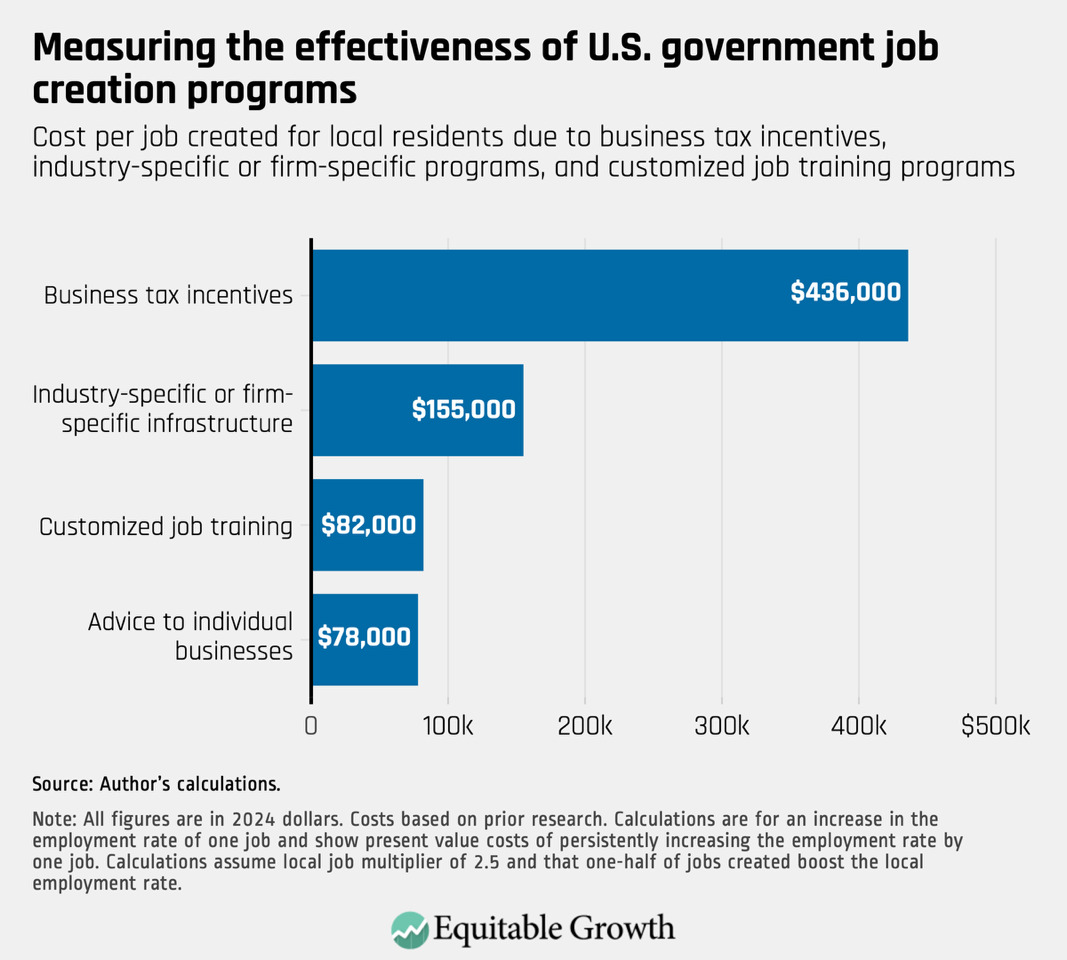
Cost per job created for local residents due to business tax incentives, industry-specific or firm-specific programs, and customized job training programs
Are these costs of increasing the employment rate outweighed by the benefits? In severely distressed local labor markets, benefits probably do outweigh the costs. Permanently increasing the employment rate has economic benefits whose present value in many cases will exceed $1 million per job.239 As a result, even business tax incentives can have benefits greater than costs. But the cost per job of these three types of customized business services is less than half the cost of business tax incentives, as presented in Figure 1. More cost-effective local job creation strategies would emphasize these services, as opposed to tax incentives.
One example of successful local use of these job creation strategies is Grand Rapids, Michigan.240 This medium-sized city in the west-central part of the state has experienced manufacturing job growth of more than 10 percent since 1990, while the United States as a whole has lost one-quarter of its manufacturing jobs. Grand Rapids’ economic development strategy included extensive use of both state and local incentives but also included supporting a local manufacturing extension office that helps some auto suppliers diversify their markets into health care, customized training programs to better meet the skill needs of different local manufacturing clusters, and support for a biotech research corridor.
For distressed neighborhoods, neighborhood job creation is ineffective in helping residents. Most Americans do not live and work in the same neighborhood, so adding more jobs to a distressed neighborhood will not significantly boost the employment rates of its residents. What residents need is better job access, including improving public transit or helping provide reliable used cars, helping residents find affordable, quality child care, and both classroom training and on-the-job training services for in-demand jobs in the local labor market, among others. Studies show that these neighborhood job access services can increase employment rates at a cost per job of $103,000.241
Job access services for distressed neighborhoods should be combined with investments in improving the neighborhood’s amenities, including by lowering crime rates, improving schools, and investing in public parks, neighborhood business districts, and other neighborhood infrastructure. If neighborhood amenities are improved without increasing neighborhood residents’ earnings, though, the result is excessive gentrification, with housing price increases outpacing residents’ ability to pay. At the same time, if neighborhood residents’ earnings are boosted without improving a distressed neighborhood’s amenities, the result is excessive out-migration, undermining neighborhood improvement. Simultaneously boosting both neighborhood amenities and residents’ earnings is more likely to lead to neighborhood improvements that actually help residents.
A good example of job access services is the Employer Resource Network program. The ERN model started in west Michigan in 2007 and currently is a loose network of programs active in 25 local labor markets across eight states that all follow a similar model. The national network provides certification of local programs and some training support for programs, but programs are administered and funded locally.242
Under the ERN model, employers share in the cost, typically alongside a public subsidy, of providing what amounts to support for social work casework services for newly hired workers, particularly disadvantaged workers. The ERN “success coach” can provide counseling to both the worker and their supervisor to help overcome problems with attendance or personal relationships that might impede job retention.
The ERN model can be viewed as a form of on-the-job training in so-called soft skills. Success coaches also can help employees find new child care arrangements if needed. In some ERN programs, if an employee’s car breaks down, the success coach can work with a local credit union or bank to quickly obtain a loan to repair the car.243 For the local ERN program in the Kalamazoo, Michigan, area, for example, car repair loans of up to $1,000 can be provided, and about 3 percent annually of all ERN-served workers need such a loan.244
Job access services can be coordinated by Neighborhood Employment Hubs, as has been done in Battle Creek, Michigan.245 Such hubs move the workers in job training agencies out of impersonal downtown office buildings into trusted institutions in distressed neighborhoods, making services more accessible to residents, both physically and psychologically. In Battle Creek, these trusted neighborhood institutions include a neighborhood group, a subsidized housing project, and a neighborhood church.
Moving the training agencies’ workers into these local hubs makes these workers more aware of neighborhood weaknesses and assets and more in touch with neighborhood services and needs. For example, workers at the hubs may be more in touch with neighborhood businesses, which may increase awareness of job vacancies and facilitate more productive job placements.
Based on these costs of around $100,000 per job added, significantly increasing distressed places’ employment rates requires providing these places with annual assistance of around $300 per capita246 for at least 10 years.247 The total national costs of significantly helping severely distressed places sum to around $20 billion per year for at least 10 years.248
This total amount is obviously just rounding error compared to total annual federal spending, which is more than $6 trillion. Yet such a commitment to local economic development would be large compared to recent federal commitments to local development. In fiscal year 2024, for example, federal appropriations for the Community Development Block Grant program, which supports various types of community and economic development activities in distressed urban neighborhoods and distressed rural communities, were about $3 billion.
As another example, the public perception that the Biden administration succeeded in getting large-scale appropriations for programs targeting distressed places is incorrect. Most of the programs targeting distressed places ended up receiving appropriations that were at a pilot scale.249
Yet the Biden administration did succeed in getting the U.S. Congress to appropriate significant dollars for industrial policies that targeted specific industries for job creation. For example, the CHIPS Act appropriated $53 billion to revitalize the U.S. semiconductor industry.250 But such a subsidy program for the semiconductor industry is not really a place-based program—it is certainly not targeted at distressed places.251 Other programs tried to geographically diversify the tech industry, but, in most cases, that is not the same as targeting distressed places.252
Consider one example of a program that did explicitly target distressed places. The Recompete program was originally proposed by former Rep. Derek Kilmer (D-WA) in 2022 as a program specifically targeting distressed places with low prime-age employment rates, offering flexible funding that could include many of the customized services advocated for earlier in this essay. The suggested funding level in Rep. Kilmer’s original bill averaged more than $17 billion per year for 10 years. In the CHIPS Act, the program was authorized as the Recompete Pilot Program, with a one-time authorization of $1 billion. Actual appropriations ended up at $200 million.253 Recompete may be a promising program, but it was not funded at scale. In fact, Recompete was not even funded at a sufficient scale to be readily evaluable, to simply see if this approach works.254
In sum, recent experience suggests that it is difficult politically for the federal government to target $20 billion annually in aid to distressed places. But $20 billion annually is comparable to what has sometimes been spent in the past. For example, just after it was created in 1974, Community Development Block Grant funding, which replaced urban renewal and other categorical community development programs as part of President Richard Nixon’s new federalism policies, peaked in the late 1970s at an annual funding level equivalent to more than $15 billion today.255 The question is whether the federal government for the foreseeable future can recover its ability to fund such targeted development aid at scale.
What, then, are the alternatives, if federal aid of the required scale is not forthcoming? Distressed places cannot realistically afford annual costs of $300 per capita, which is more than 10 percent of average local tax revenues.256
State governments, however, could afford to invest $300 per capita in their most distressed quintile of places, which would have a statewide cost of $60 per capita ($300 times 20 percent).257 As mentioned above, state governments in total invest more than $70 billion per year in business tax incentives for economic development, which typically do not do much to target distressed places. Simply cutting current incentive programs by less than one-third would free up the $20 billion per year needed to help the most severely distressed places.
Yet such federal or state aid requires targeting distressed places. And targeting is politically challenging and has rarely been sustained at scale for development aid from federal or state governments.
As I have argued before, perhaps federal or state targeting of development aid would be more feasible if it were “targeting within universalism,”258 which has usually been discussed as a political consideration in the design of social programs. The argument is that a social program to help the poor is more politically feasible if significant benefits also go to the middle class and other groups.259 Applying such a concept to development aid could mean providing some job creation aid to all places but tying per-capita aid to a place’s prime-age employment rate.260 The argument is that such an approach would be more politically feasible because all places would get some aid.
Such a targeting-within-universalism approach has sometimes been used for various large government programs.261 Social Security, for example, provides retirement income help for almost all workers, but the benefit formula provides higher benefit payments relative to payroll taxes for lower-wage workers. Perhaps the most relevant example is intergovernmental aid for public schools: Many states tie school aid for Kindergarten-through-12th grade school districts to the district’s number of low-income students.262 This extra state aid per low-income student is sometimes 40 percent to 50 percent greater than the general support per student. So-called federal Title I aid to school districts, funded annually at more than $18 billion, is even more targeted, with the funds mostly determined by a school district’s number of low-income students.263
All of these are precedents for basing a government program’s aid on need while still recognizing that everyone may have some level of need. Doing so for place-based jobs policies simply requires conceptualizing this local economic development aid as a way to help, first of all, nonemployed or under-employed workers. Greater aid to local labor markets or neighborhoods with lower prime-age employment rates can then be viewed as fair. Funding would be proportionate to the number of local residents needing jobs.
Aid for distressed places by the federal government or state governments also must recognize the need for local flexibility. When attempting to increase local employment rates, one size does not fit all. Whether a local labor market’s job creation strategy should emphasize manufacturing extension services, for example, depends upon the viability of local manufacturing. As another example, the specific business real estate or local skills that are needed will vary greatly across places.
At the neighborhood level, the transit or car options that are most needed will depend on the area’s size and the neighborhood’s proximity to job centers. The availability of child care also varies greatly by neighborhood. And the need for job training programs can depend on residents’ skills compared to the jobs in locally growing industries. Local leaders and residents should help design local strategies, as local investments will be needed to complement federal or state investments.
Helping distressed places requires a different philosophy of federal or state aid to local places. The federal or state aid must be generous and long term yet highly targeted, while also allowing for considerable local discretion. Such an aid strategy differs from usual intergovernmental aid, which comes in the form of categorical programs. These categorical programs provide short-term funds whose allowable uses are dictated from the top down to the localities.
This long-term, flexible, and targeted aid is needed to visibly help the residents of distressed places. The aforementioned Recompete Pilot Program, which used the prime-age employment rate as its investment metric, is a start, but these investments need to be made at scale in distressed communities across the country.264 Such aid would show respect for the worth of distressed local communities. It would honor the high value that many residents place on where they live because people care that their home community is doing well economically and socially.
Promoting employment via such aid would offer residents in distressed communities the dignity of work. A key part of personal identity and self-respect for many residents of distressed communities is the ability to find a good job in their home community, rather than being forced to move out. This flexible aid approach also shows respect for the unique characteristics of local places. Flexible aid empowers local leaders and institutions, rather than dictating to them from the top down.
Can federal or state governments say to the leaders and residents of distressed places: “I am from the federal or state government, and I am here to help,” and credibly deliver? The outlook is hazy. We need to try again with this new approach—and continue trying until we get it right.
 Did you find this content informative and engaging?
Get Updates
Did you find this content informative and engaging?
Get Updates
Reports MAR 29, 2024
By: Hiba Haroon, Shaun Harrison
Working Papers FEB 4, 2019
By: Nathan M. Jensen, Calvin Thrall

Reports MAY 6, 2024
By: Alexander Hertel-Fernandez
Get updates on our latest research, event announcements, and policy insights delivered straight to your inbox. Stay connected with the leading voices on equitable growth.


