
Skip to content
Browse All Resources
Factsheets

APR 15, 2021

Factsheet: What does the research say about care infrastructure?

Abstract

The United States is emerging from the greatest health, economic, and caregiving crises in a century. Many policymakers are looking for ways to jumpstart the economy and, recognizing the tie between infrastructure and economic growth (opens in a new tab), have turned their sights on investments in U.S. physical and care infrastructure.

In March 2021, President Joe Biden proposed the American Jobs Plan and American Families Plan, a multipart proposal that would boost federal spending on the nation’s care and physical infrastructure. (See textbox for details.) Investments of this kind could help the U.S. economy recover from the coronavirus recession and lead toward sustainable, broad-based economic growth in the future.

Care infrastructure includes the policies, resources, and services necessary to help U.S. families meet their caregiving needs. Specifically, care infrastructure describes high-quality, accessible, and affordable child care; paid family and medical leave; and home- and community-based services and support.

This factsheet presents some of the research and evidence on America’s care infrastructure as it relates to families’ caregiving needs, the care workforce, and U.S. economic growth.

The current state of U.S. care infrastructure

Caregiving is an important component of the economy. Research suggests that adequate care infrastructure can promote labor force participation, particularly among women; boost the human capital of care recipients; and support broad-based macroeconomic growth. Yet the evidence also suggests that U.S. care infrastructure is in need of greater investment, and current caregiving policies and resources may not be sufficient for the nation’s caregiving needs. For example:

The COVID-19 pandemic and recession exposed preexisting flaws in the nation’s care infrastructure and further weakened an already-fragile system. Employment in the child care and home-health sectors remains depressed, suggesting the care economy could struggle to meet demand as the nation reopens, blunting the economic recovery. (See Figure 1.)
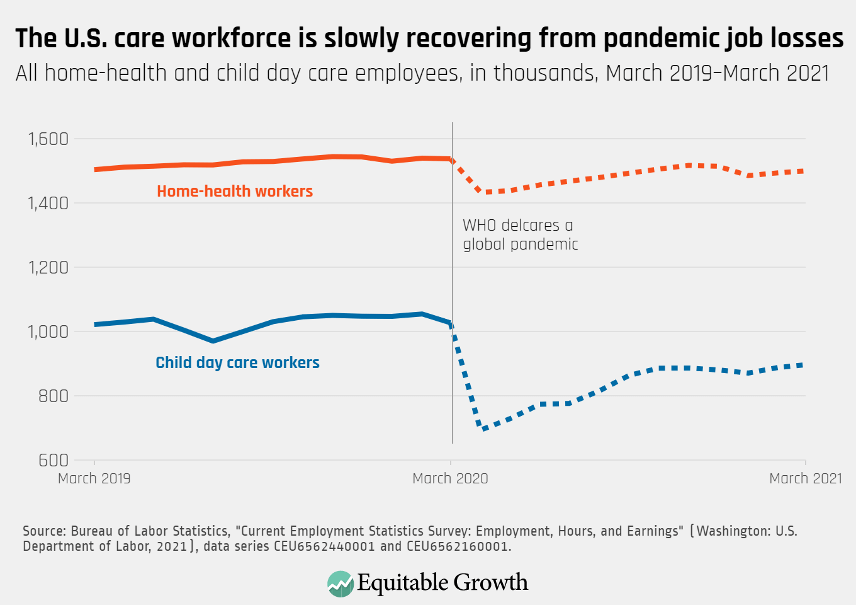
All home-health and child day care employees, in thousands, March 2019-March 2021
Insufficient care infrastructure constrains the U.S. economy and worker well-being

  • Paid caregivers earn less than workers in noncare jobs with comparable skills, employment characteristics, and demographics. Research demonstrates that professionals in the caregiving industry receive wages that are 20 percent lower than comparable professionals in other industries. Managers face a similar 14 percent penalty. These penalties translate to higher turnover (opens in a new tab), lower consumer spending, a smaller tax base, and reduced economic security than if care workers were valued the same as comparable noncare employees.213
  • Turnover and disruptions in paid caregiving arrangements are burdensome for family caregivers. Recent research finds that the COVID-19 pandemic disrupted more than half of family caregiving arrangements. Family caregivers who face a caregiving disruption demonstrate increased anxiety and depression, and are 13.9 percentage points more likely to also experience permanent job separation or furloughs during the pandemic, compared with noncaregivers.214
  • Informal caregiving may constrain the economy through lost productivity, wages, and benefits. In data collected (opens in a new tab) by Gallup Inc., 24 percent of family caregivers report that caregiving keeps them from working more, and 30 percent report missing 6 or more days of work in the prior year due to caregiving duties. These productivity losses are estimated to cost the U.S. economy more than $25 billion per year. A 2011 study (opens in a new tab) by the Metlife Mature Market Institute estimates that aggregate cost to the U.S. economy from lost wages, pensions, and Social Security benefits for these family caregivers is nearly $3 trillion.215
  • Caregiving concerns may have driven millions of women out of the workforce in the COVID-19 pandemic. Research (opens in a new tab) shows that caregiving concerns contributed to more than 2.3 million women (opens in a new tab) exiting the labor force between February 2020 and February 2021. By March 2021, the labor force participation rate for women was 56.1 percent (opens in a new tab), the lowest rate since May 1988. The gap between men’s and women’s labor force participation widened (opens in a new tab) in communities where school closures exacerbated caregiving needs. Time out of the workforce has long-term implications: Research shows (opens in a new tab) that 13 percent of the gender pay gap can be ascribed to time spent outside of the labor force caring for others.216

Investments in care infrastructure boost economic growth, labor force participation, and worker well-being

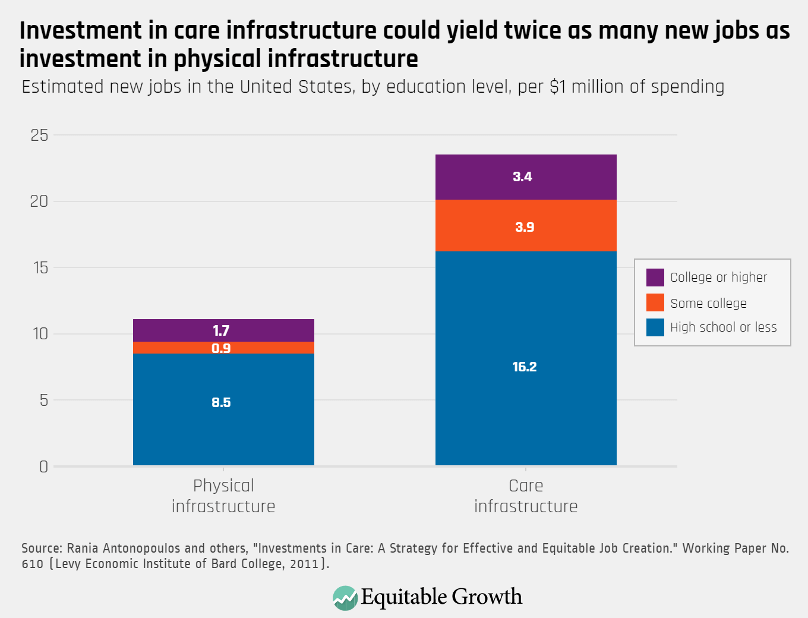
  • Investments in care infrastructure have the potential to create twice as many new jobs as investments in physical infrastructure alone. In the wake of the Great Recession a decade ago, researchers (opens in a new tab) estimate that investment in early childhood development and home-based healthcare could have created 23.5 new jobs per $1 million spent, compared to 11.1 jobs from physical infrastructure investments. Approximately 85 percent of new jobs from both care and physical infrastructure investments would reach workers with lower levels of educational attainment.217 (See Figure 2.)

Estimated new jobs in the United States, by education level, per $1 million of spending

  • Spending in the care economy would strengthen women’s employment and reduce the gender employment gap. An analysis (opens in a new tab) of care spending in seven OECD countries, including the United States, estimates that an investment in the care economy equal to 2 percent of Gross Domestic Product would raise the employment rate for U.S. women and men by 8.2 percentage points and 4 percentage points, respectively. This would reduce the gender employment divide by 4.2 percentage points.218
  • Accessible and affordable child care can facilitate labor force participation and support economic growth. Research shows that parents’ labor force participation increases when child care is more affordable (opens in a new tab) and accessible (opens in a new tab). In one study, a 100-slot increase in the supply of child care in a community is estimated to raise women’s labor force participation for the entire community by 0.3 percentage points. Conversely, every $100 increase in the price of child care is associated with a 3.7 percentage point decrease in that neighborhood’s labor force participation rate among women.219
    • Meanwhile, high-quality early care and education can lead to long-term improvements in a child’s human capital. Children in high-quality programs demonstrate better education, economic, health, and social outcomes and fewer negative outcomes—such as involvement in the criminal justice system. These high-quality programs can help pay for themselves, generating up to a 13 percent return on investment (opens in a new tab) per-child, per-year.220
  • Much of the research evidence shows paid leave has a range of positive outcomes for caregivers and care recipients. A growing body of research suggests that paid parental leave can improve a range of childhood outcomes, including infant mortality, low birth weight, preterm birth, breastfeeding rates (opens in a new tab), and pediatric head trauma (opens in a new tab), as well as later-in-life outcomes (opens in a new tab), including lower rates of attention deficit disorder and obesity. Additionally, evidence from California suggests paid caregiving leave can reduce nursing home occupancy (opens in a new tab) among the elderly patients, likely due to enhanced access to family caregivers. And while research on paid medical leave is still comparatively scant, research on related programs indicates such leave can lead to positive health and economic outcomes, as employees have more time and resources to focus on their own well-being.221
    • Paid leave may also improve labor market outcomes for caregivers. The bulk of the research finds positive associations between paid leave and women’s labor force participation, though the relationship remains nuanced. Evidence (opens in a new tab) from California indicates that under the state’s paid leave law, new mothers are 18 percentage points more likely to be working the year after the birth of their child, compared to mothers without paid leave access. Recent research corroborates these findings, indicating an approximately 20 percent increase in the probability of labor force participation during the year of a child’s birth. This increase remains significant up to 5 years later.222
  • Patients transitioning from institutions to lower-cost home- and community-based services experience better quality of life and fewer unmet needs. Research shows (opens in a new tab) that patients who transition from institutional care to home-based care express greater life satisfaction (66 percent compared to 83 percent) and fewer unmet care needs (18.3 percent compared to 7.6 percent), compared to their time in institutions. In the same analysis, patients transitioning from nursing home facilities demonstrate 18 percent to 24 percent declines in healthcare spending in their first year in home- and community-based care.223
    • Home-based care may be particularly valuable for patients without access to family caregivers. Research demonstrates (opens in a new tab) that higher levels of state home-health spending is associated with a significant reduction in the risk of nursing home admission among childless patients.224

Conclusion

Inefficiencies in the nation’s current care infrastructure—paid family and medical leave, child care, and home-based services and supports—constrain economic growth, and leave families and businesses vulnerable to unexpected health and caregiving shocks. Caregiving work is undervalued, and many U.S. workers across the economy face a financial penalty for engaging in care work, which can lead to high turnover and caregiving instability. When care workers are not available or not affordable, family members take on new caregiving responsibilities, exacerbating work-life challenges. If family caregivers cannot resolve these challenges, then many are forced out of the workforce—costing the economy trillions of dollars in lost productivity and compensation.

Alternatively, research suggests that investments in care infrastructure could create significantly more new jobs than investments in physical infrastructure alone, boosting GDP growth and reducing the gender employment divide. Research on the individual components of the care economy likewise support further investment.

Accessible, affordable, and high-quality child care is associated with employment gains for parents in the short term and human capital improvements for children in the long term. Likewise, a preponderance of the evidence on paid leave indicates positive labor market outcomes for caregivers and health and well-being outcomes for care recipients. Finally, patients who transition out of institution-based long-term care report better quality of life, fewer unmet care needs, and lower healthcare costs.

Altogether, the bulk of the research and evidence suggests investments in care infrastructure are a promising tool to boost U.S. economic growth, productivity, and well-being. Policymakers looking to jumpstart the U.S. economic recovery from the coronavirus recession, ensure broad-based future economic growth, and provide much-needed support to U.S. workers and their families must prioritize investment in both physical and care infrastructure.

Related

Your Direct Line to Cutting-Edge Research

Get updates on our latest research, event announcements, and policy insights delivered straight to your inbox. Stay connected with the leading voices on equitable growth.