




Policy
What Work Does Generative AI Do?
Essays SEP 8, 2026
By: Alexander Bick, Adam Blandin, David Deming, Tyler Schumacher
AI, Tech & Energy
Labor, Wages & Worker Power
 Browse All Resources
OCT 26, 2020
The United States is one of three high-income nations (opens in a new tab) that does not guarantee paid sick leave for workers.323 As of March 2020, 25 percent of private-sector workers had no access to paid sick leave (opens in a new tab). This number is higher for part-time workers (55 percent) and low-income workers (69 percent).324
Without access to paid sick leave, employees who are financially constrained may show up to work sick. When that happens, they risk passing their illness to others and impose costs on employers through lost productivity.325 Several studies demonstrate how paid sick leave guarantees at the state and local level can benefit public health and improve worker productivity, with one recent study (opens in a new tab) finding an 11 percent decline in flu-like illnesses in the first year after such a guarantee was enacted into law.326
When the coronavirus pandemic hit the United States, the U.S. Congress recognized that paid sick leave supports public health and economic well-being, and passed the Families First Coronavirus Response Act on March 18, 2020. The new law, part of several measures to support the economy and health of the nation against the coronavirus and COVID-19, the disease caused by the virus, allows qualified workers across the country who are affected by COVID-19 to take up to 2 weeks of sick leave at full pay (opens in a new tab).327
Now, a new study published in Health Affairs (opens in a new tab) shows that the law was successful in “flattening the curve” of COVID-19 transmissions and was associated with approximately 400 fewer cases of COVID-19 per day in states where the law gave workers new access to guaranteed sick leave.328 While no one study is definitive, it offers some of the first evidence of the law’s efficacy in supporting public health.
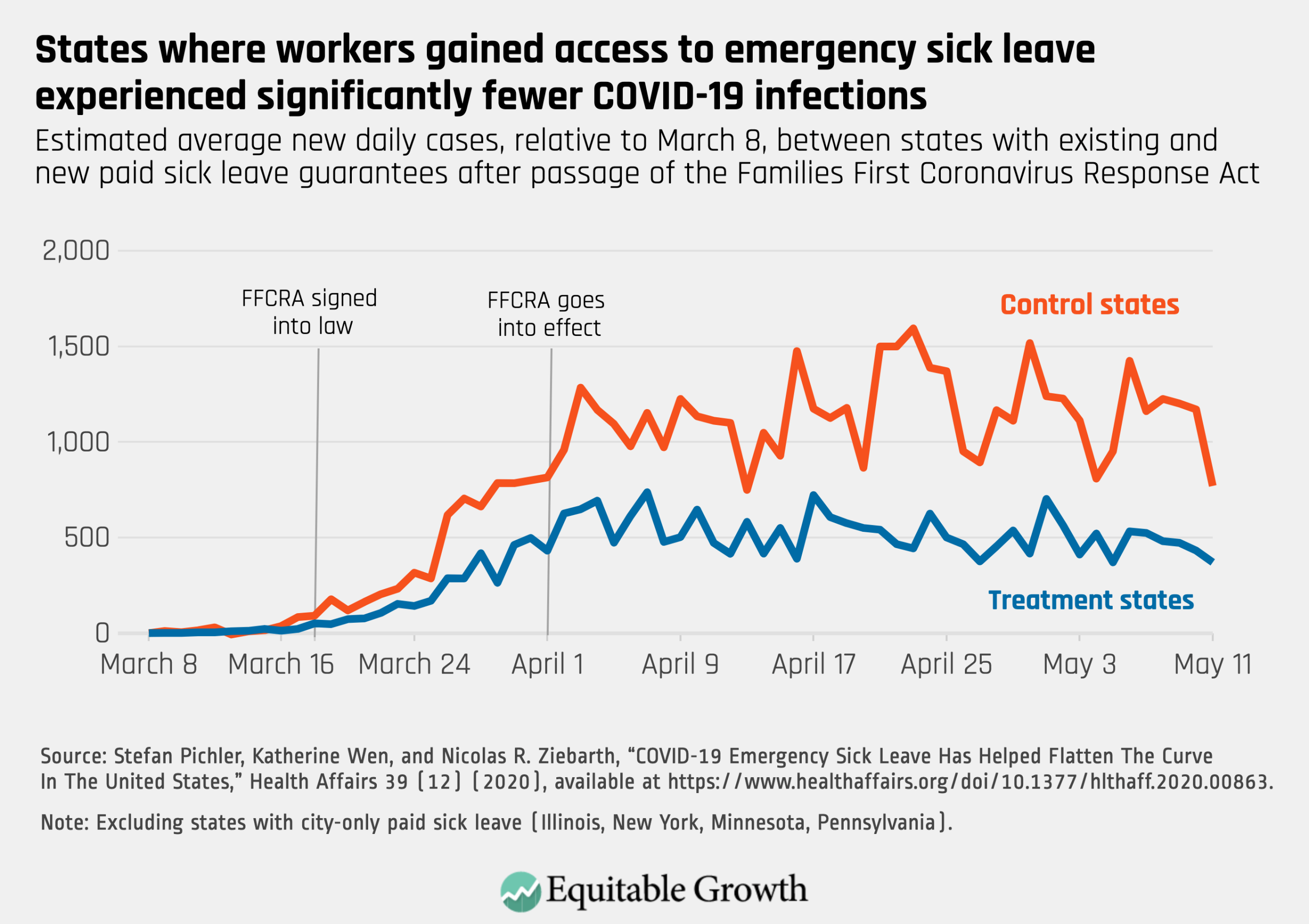
Estimated average new daily cases, relative to March 8m between states with existing and new paid sick leave guarantees after passage of the Families First Coronavirus Response Act
Building on prior research on the public health and economic benefits of paid leave, this new study demonstrates that sick leave through the Families First Coronavirus Response Act played an important role in flattening the curve of COVID-19 transmissions in the early months of the coronavirus pandemic.336 Expanding and extending access to these benefits could have critical public health implications in 2021 and beyond.
The Health Affairs study presents early insight into how paid leave is supporting public health in the COVID-19 pandemic, and new data-driven evidence of the importance of paid leave, with support from the Washington Center for Equitable Growth, will enable researchers to continue studying how paid sick leave and paid family and medical leave can support workers, public health, and the economy in years to come.337
Essays SEP 8, 2026
By: Alexander Bick, Adam Blandin, David Deming, Tyler Schumacher
Working Papers SEP 8, 2026
By: Alexander Bick, Adam Blandin, David Deming, Tyler Schumacher

Essays SEP 2, 2026
By: Megan Rivera
Get updates on our latest research, event announcements, and policy insights delivered straight to your inbox. Stay connected with the leading voices on equitable growth.


