
Skip to content
Browse All Resources
Factsheets

OCT 3, 2017

Fact sheet: Occupational segregation in the United States

Abstract

Occupational segregation occurs when one demographic group is overrepresented or underrepresented among different kinds of work or different types of jobs. In 2015, for example, men were 53 percent of the U.S. labor force362, but held less than 30 percent of the jobs in education and more than 98 percent of the jobs in construction.363

Read the full PDF in your browser (opens in a new tab)

The evidence shows that occupational segregation based on gender occurs more because of assumptions about what kinds of work different genders are best suited for than because of an efficient allocation of innate talent. To the extent to which that is true, occupational segregation hurts economic growth because:

  • It depresses productivity and growth by limiting the economically optimal matching of workers’ skills with jobs.
  • It depresses the labor force participation rate because workers are less apt to adapt to changes in the economy by taking jobs in growing sectors due to perceptions about which occupations correspond to which gender identifications.
  • It depresses aggregate demand in the economy by substantially depressing female wages, contributing to the gender wage gap, and therefore reducing families’ incomes.

Key takeaways

    • Occupations with more men tend to be paid better regardless of skill or education level.364 This is because if work is done predominantly by women, then it is valued less in the labor market. As the rate of women working in a given occupation increases, the pay in that occupation declines—even when controlling for education and skills.365
    • This trend is also highly racialized: Women of color at all education levels are segregated into jobs with lower wages than their white female peers of similar skill levels.366
    • Occupational integration since 1960 was responsible for 60 percent of real wage growth (after accounting for inflation) for black women, 40 percent for white women, and 45 percent for black men.367
    • Half of the gender wage gap since 1980 can be attributed to women working in different occupations and industries than men, making it the single largest factor. Discrimination accounts for another 38 percent.368
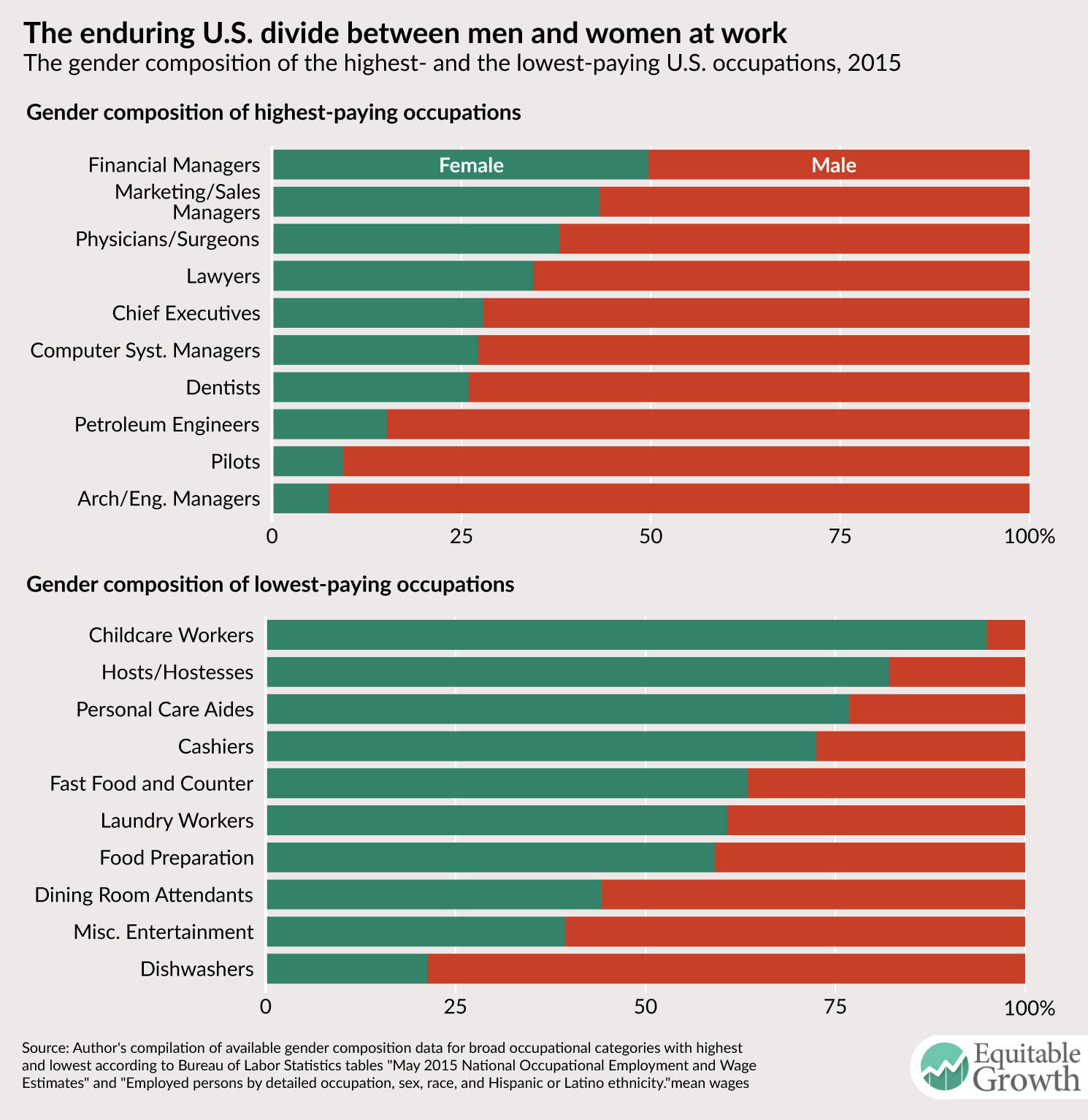
  • While the prevalence of women in low-paid occupations is due to negative biases about the market value of “women’s work,” the prevalence of men in highly paid occupations is often due to workplace cultures that demand long hours and facetime in the office, which does not accommodate flexibility for caregiving.370 (See Figure 1.)
  • Many of the occupations that will add the most jobs by 2024, including health care support, administrative assistance, early childhood care and education, and food preparation and services, are composed of more than 60 percent women.371
  • The shift in the economy from occupations that have traditionally been male-dominated—namely manufacturing—to ones that are female-dominated and low-paid has implications for the structure and strength of U.S. families. As men’s economic position declines relative to women’s, the prevalence of marriage declines and the fraction of children born to poor single-parent households increases.372

To learn more on this subject from the Washington Center for Equitable Growth

Gender segregation at work: ‘separate but equal’ or ‘inefficient and unfair’ (opens in a new tab)
Will McGrew, August 2016

Do U.S. women choose low-paid occupations, or do low-paid occupations choose them? (opens in a new tab)
Bridget Ansel, April 2017

Local economic decline affects marriage and fertility rates, but in a surprising way (opens in a new tab)
Bridget Ansel, February 2017

Many of the fastest growing jobs in the United States are missing men (opens in a new tab)
Bridget Ansel, December 2016

Related

Your Direct Line to Cutting-Edge Research

Get updates on our latest research, event announcements, and policy insights delivered straight to your inbox. Stay connected with the leading voices on equitable growth.