


What happens to U.S. workers without access to Unemployment Insurance amid economic downturns or disruptions related to AI?
Essays SEP 2, 2026
By: Megan Rivera
MAR 3, 2021
The rise of economic inequality over the past four decades has changed the U.S. economy in fundamental ways. Unfortunately, the data that our federal statistical agencies produce to measure the nation’s economic progress has not kept up with these structural changes. At the same time, historical racial economic disparities persist, and federal government data has failed to give policymakers the tools to close these gaps.
Our statistical infrastructure must adapt to fit the present shape of the U.S. economy and the current needs of policymakers.
Aggregate GDP growth, for example, is increasingly disconnected from the fortunes of lower and middle-class Americans as more and more growth accrues only to those at the top of the income distribution. But the media continues to focus on aggregate growth because that is what government agencies report. Consequently, economic news perversely reflects only the fortunes of the rich and policies are assessed similarly. The resulting press coverage may actually reward politicians for increasing economic inequality.
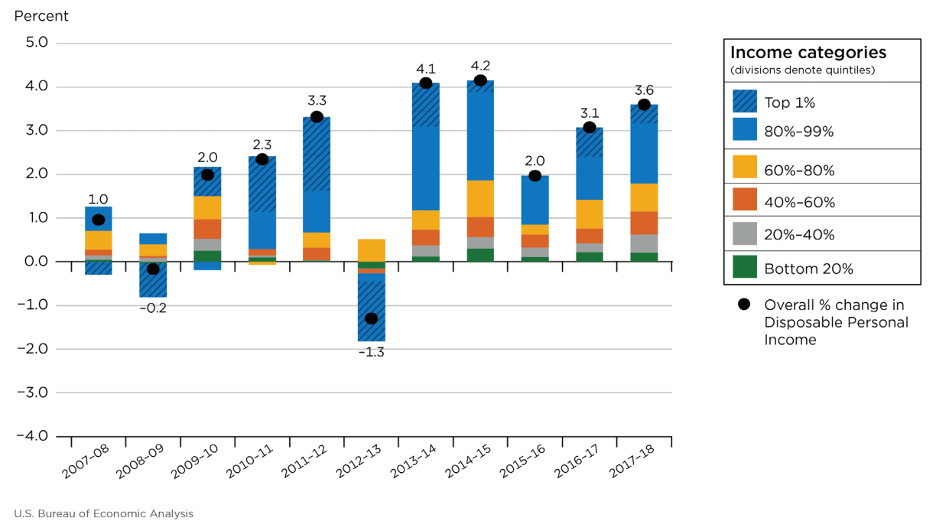
The answer: Growth should not be reported as a single aggregate number, but rather broken out for Americans in different income brackets. We call this measure GDP 2.0. In 2020, the U.S. Department of Commerce’s Bureau of Economic Analysis, began producing, at Congress’ behest, a prototype of what this would look like. (See Figure 1.)
Figure 1
U.S. Gross Domestic Product disaggregated by income levels, 2007–2018
Disaggregation by income is meant to reflect a changing economy. It is also important to disaggregate by race and ethnicity to reveal more clearly the manifestations of long-standing discrimination. The two issues are not unrelated. Racial discrimination in employment and other areas is both an issue of justice and a drag on the entire economy (opens in a new tab).
There are two ways the federal statistical agencies can contribute to advancing economic research into racial economic disparities, which ultimately can help ensure more equitable economic treatment.
First, federal surveys often have insufficiently large samples to allow data users to analyze subsections of populations by race. Sample sizes are generally sufficient to look at male Hispanics versus female Hispanics, for example. But if we wanted to look at Hispanic females who have obtained a college degree, the level of precision of the estimate or margins of error, may be inadequate for analyses.
Here’s just one case in point. Analyses frequently discuss issues of the “white working class (opens in a new tab),” but policymakers are limited in their understanding of working class Hispanics, for instance, because federal statistics do not provide the tools to do so.
Second, there are few data releases that focus the attention of policymakers and the media on racial differences in earnings inequality and subsequent economic outcomes. Consider the annual poverty report (opens in a new tab), which is published every September by the U.S. Census Bureau. Its release serves as a news hook that engages the national (opens in a new tab) and local (opens in a new tab) press, policymakers and researchers (opens in a new tab) in a dialogue about policies around poverty (opens in a new tab) in the United States. This is a model for how economic data on inequality and racial differences can help drive conversations about addressing these problems
The Bureau of Economic Analysis should produce distributional growth statistics concurrently with regular GDP reports. The agency’s prototype is promising, but BEA currently plans to produce statistics just once per year, and on a considerable lag of at least two years, limiting their usefulness to Congress and the Executive Branch.
To produce these statistics more quickly and frequently, the Bureau of Economic Analysis will need the resources to devote more people to this effort. In addition, access to IRS tax return data would help BEA construct higher-quality baseline estimates. This access can only be given by Congress, but agencies should signal their support of this move.
Steps the Biden administration could take to support GDP 2.0 include:
In order to better describe the experiences of workers of color and their families in the United States and equip researchers, agencies, and Congress with the data tools necessary to advance racial equity, agencies should take the following steps:
Essays SEP 2, 2026
By: Megan Rivera
Essays AUG 31, 2026
By: Christopher Bangert-Drowns
Essays AUG 14, 2026
By: Carlos Fernando Avenancio-Leon
Get updates on our latest research, event announcements, and policy insights delivered straight to your inbox. Stay connected with the leading voices on equitable growth.