
What happens to U.S. workers without access to Unemployment Insurance amid economic downturns or disruptions related to AI?
Essays SEP 2, 2026
By: Megan Rivera
MAR 13, 2017
By: Kavya Vaghul
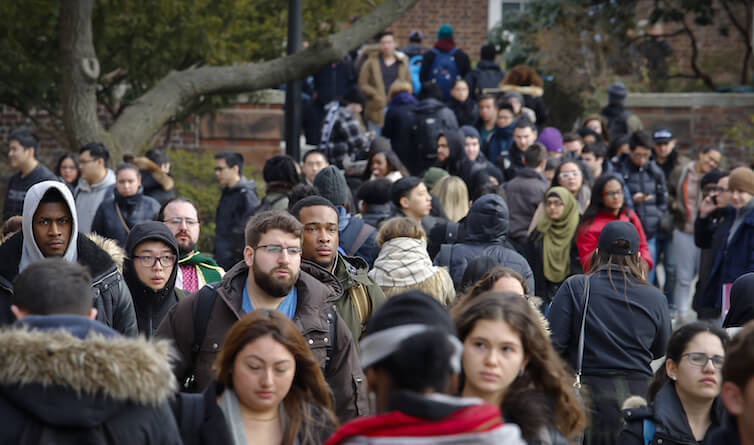
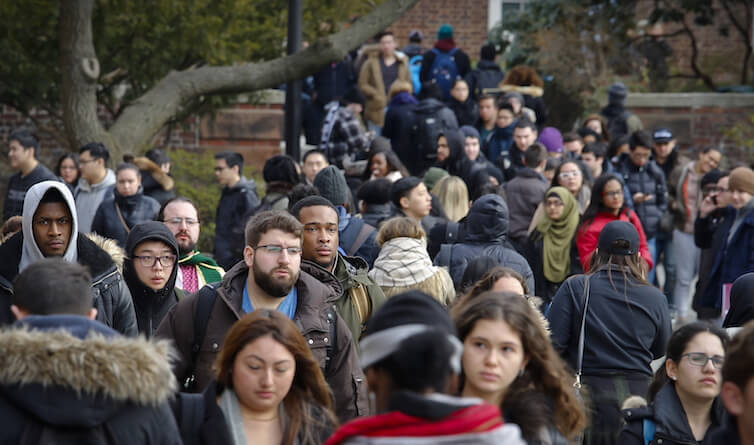
<img loading="lazy" decoding="async" data-caption="Brooklyn College students walk between classes on campus in New York." alt="Brooklyn College students walk between classes on campus in New York." class="wp-photo size-full wp-image-33547 (AP Photo/Bebeto Matthews)
There’s a common perception that college is the great equalizer in the United States, a pathway to leveling the playing field between students from different socioeconomic groups. But the jury’s still out on whether that’s actually the case, at least according to two new papers. Amid conflicting answers to this question, research on the matter has often left out an equally important dimension: race and ethnicity.
There are many (opens in a new tab) studies (opens in a new tab) that previously explored the relationship between parents’ socioeconomic status and their children’s financial success post-college graduation. Adding to this literature, a recent working paper (opens in a new tab) by Raj Chetty (opens in a new tab) of Stanford University, John Friedman of Brown University, Emmanuel Saez (opens in a new tab) and Danny Yagan (opens in a new tab) of University of California, Berkeley, and Nicholas Turner of the U.S. Treasury Department makes the case that college may help equalize opportunities for students up and down the income ladder. The researchers find that while a student’s access to higher education depends on parental income, students from the same college have very similar earnings outcomes after graduation, regardless of their parents’ income.
Another recent study (opens in a new tab) argues otherwise. Dirk Witteveen and Paul Attewell from the City University of New York show that four years and 10 years after graduation—even after controlling for college selectivity, major choice, and academic performance—there are substantial earnings gaps between students from lower-income families and students from the top.
The contradictory results between Chetty and his coauthors and Witteveen and Attewell surely complicates the debate on whether higher education is fulfilling its promise for students across the income spectrum. But both studies overlook a very important piece of the puzzle by leaving out race and ethnicity.
A new research brief (opens in a new tab) published by the Federal Reserve Bank of St. Louis picks up at this exact intersection. Researchers William Emmons and Lowell Rickets highlight that trends in access to college and post-graduation outcomes vary tremendously by race. While college enrollment gaps between African American and Latino students and their white counterparts are narrowing (opens in a new tab), the researchers show that the four-year-college completion rate gaps are not. They refer to these differences as “quantity gaps.”
After college, the researchers find that “quality gaps” begin to appear. Specifically, Emmons and Rickets find that African Americans and Latinos with a college degree earn 80 percent and 70 percent, respectively, of the median income of a white family, and 10 percent and 13 percent, respectively, of the median net worth of a white family. Across race and ethnicity, college doesn’t have equal financial returns. In an extended version (opens in a new tab) of Emmons and Rickets’ analysis, they assert that college’s promise is going unfulfilled for people of color primarily because of longstanding discrimination in higher education (opens in a new tab) and the workforce (opens in a new tab).
All this is not to say that higher education isn’t valuable. On the contrary, it is well-established that a college degree generally affords better economic outcomes for every demographic group than a high school degree alone. Yet skepticism about whether college is the great equalizer begets questions about not only the U.S. higher education system but also the labor market’s shortcomings (opens in a new tab) and structural racism’s role in it all.
Essays SEP 2, 2026
By: Megan Rivera
Essays AUG 31, 2026
By: Christopher Bangert-Drowns
Essays AUG 14, 2026
By: Carlos Fernando Avenancio-Leon
Get updates on our latest research, event announcements, and policy insights delivered straight to your inbox. Stay connected with the leading voices on equitable growth.