



Policy
What Work Does Generative AI Do?
Essays SEP 8, 2026
By: Alexander Bick, Adam Blandin, David Deming, Tyler Schumacher
AI, Tech & Energy
Labor, Wages & Worker Power
 Browse All Resources
JUN 12, 2018
By: Brad DeLong

Nick Bunker has a very nice piece from late last month on wage growth and employment, as it bears on the question of whether the United States is at “full employment.” My take is that the U.S. economy probably is because at current unemployment and employment rates, if no additional shocks were to hit the economy, inflation would probably start creeping up very slowly, if things continued as they are as far as unemployment and employment rates. But we do not know. And the costs of getting this wrong and judging the economy at “full employment” prematurely are high, while the costs of getting this wrong and failing to judge the economy at “full employment” are small, notes Nick Bunker in his column “Puzzling over U.S. wage growth (opens in a new tab).” Bunker writes:
What’s happening in the labor market as a whole? … It’s not clear that the prime employment rate is fully stationary. There’s some suggestive evidence that this may be true, but more research and thinking on this issue is needed. Analysis of the data shows a weak relationship between the unemployment rate and a good measure of wage growth. The prime employment rate has a much stronger relationship and has done a good job predicting wage growth out of the sample it draws from. The relationship is holding up in practice. Economists and analysts may just need to figure out how it works in theory.
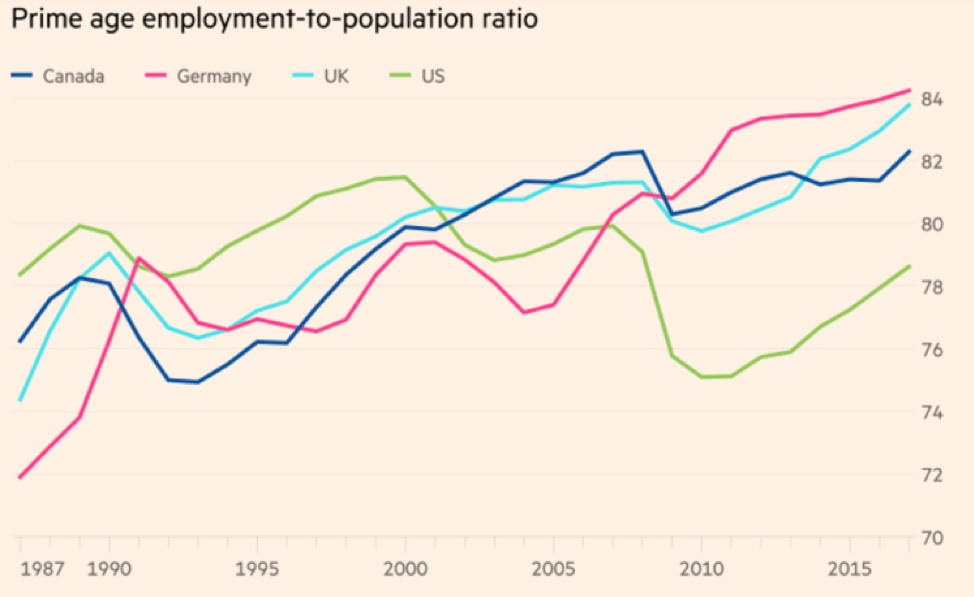
Indeed, in the late 1990s, Canada’s prime-age employment rate was 2 percentage points below the U.S. rate. Today, Canada’s prime-age employment rate is 4 percentage points above the U.S. rate. That suggests an awful lot of U.S. prime-age workers could be brought into employment. You are not going to convince me that Canada is a different place on a different continent. And you would have a very difficult time convincing me that the U.S. shortfall is “structural” in the sense that large chunks of it would not melt away in a higher-pressure economy. This graph below from Neel Kashkari of the Minneapolis Fed makes the point:
Essays SEP 8, 2026
By: Alexander Bick, Adam Blandin, David Deming, Tyler Schumacher
Working Papers SEP 8, 2026
By: Alexander Bick, Adam Blandin, David Deming, Tyler Schumacher

Essays SEP 2, 2026
By: Megan Rivera
Get updates on our latest research, event announcements, and policy insights delivered straight to your inbox. Stay connected with the leading voices on equitable growth.


