



Policy
What Work Does Generative AI Do?
Essays SEP 8, 2026
By: Alexander Bick, Adam Blandin, David Deming, Tyler Schumacher
AI, Tech & Energy
Labor, Wages & Worker Power
 Browse All Resources
OCT 8, 2021

This is a post we publish each Friday with links to articles that touch on economic inequality and growth. The first section is a round-up of what Equitable Growth published this week and the second is relevant and interesting articles we’re highlighting from elsewhere. We won’t be the first to share these articles, but we hope by taking a look back at the whole week, we can put them in context.
The U.S. Bureau of Labor Statistics released data on employment and the U.S. labor force in September today, revealing only 194,000 jobs were added to the struggling job market recovery. Carmen Sanchez Cumming and Kathryn Zickuhr detail the implications of the still uneven employment recovery for women of color, focusing in particular on U.S. care workers. This sector provides health, education, and social services to workers, families, and communities—services that took it on the chin anew with the surge the delta variant of the coronavirus. Then there are the longstanding challenges for workers in the care sector of the U.S. economy, including low pay and lack of paid leave, that pre-date the pandemic. The co-authors explain that because women in general and women of color in particular are overrepresented in care occupations, care work is undervalued and thus is both a driver and a reflection of racial and gender economic inequality and now a drag on a broadly shared economic recovery.
Ahead of this week’s EconCon 2021 (opens in a new tab) session on redefining economic measurement, Austin Clemens put together a list of resources for those interested in advancing new methods of tracking how the economy is working for all Americans. The list covers Equitable Growth’s work on GDP 2.0—our project (opens in a new tab) on the value of disaggregating Gross Domestic Product data by income—as well as why policymakers should work to disaggregate data along race and ethnicity lines to better understand the role and impact of systemic racism in the United States.
Check out Brad DeLong’s latest Worthy Reads column (opens in a new tab) for his takes on must-read content from Equitable Growth and around the web.
As eviction moratoriums lapse in states across the United States, millions of families face losing their homes. This crisis is worse for Black families, writes (opens in a new tab) USA Today’s Jessica Guynn in a feature appearing on yahoo!finance, thanks in part to historical systemic racism that has prevented many of these families from becoming homeowners and building wealth. As rents rise and available housing options become scarce, fears of eviction are rising, with Black households more likely to be behind on rent payments and facing higher unemployment rates, and thus more likely to be displaced. Guynn details (opens in a new tab) the implications for exacerbating existing inequality and racial disparities in the United States as well as the difficulties many families have had in accessing federal rental assistance programs during the pandemic.
The U.S. employment situation and economic recovery is also disproportionately more difficult for Black workers, with rates of joblessness still much higher for Black workers than their peers. This is not a new phenomenon and hardly surprising to many economists, reports (opens in a new tab) NBC News’ Bracey Harris (opens in a new tab), but it has gotten worse amid the pandemic. The persistence of these disparities has led to questions about whether racial bias and discrimination as well as occupational segregation are playing a role. Many Black workers are in occupations and industries in which working from home is not an option and in which minimum wages and unpredictability are common. Harris tells the story (opens in a new tab) of two Black women in Mississippi who lost their jobs during the pandemic and how they have experienced the labor market recovery.
Friday figure
View FullscreenFriday figure — opens in a new tab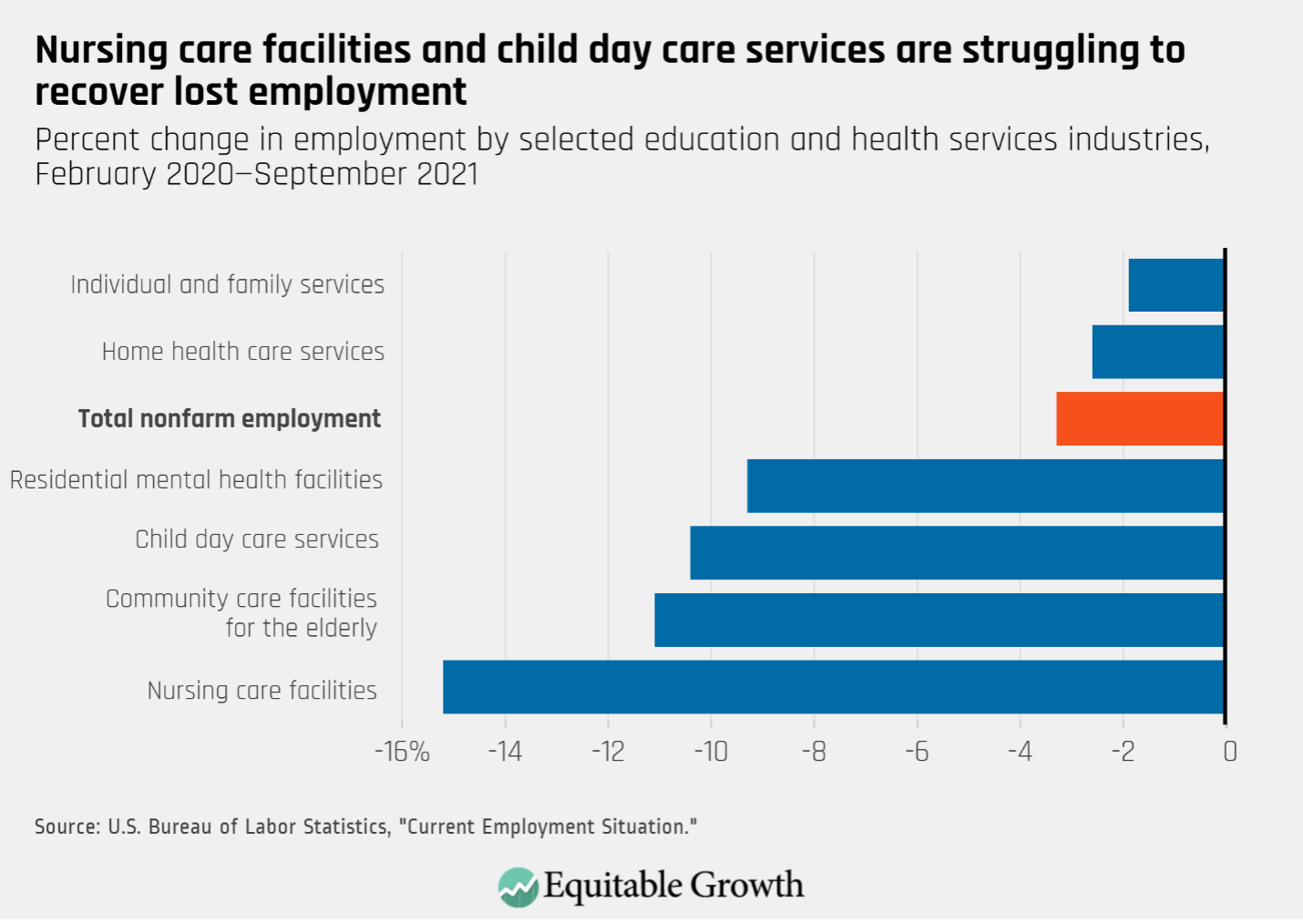
Percent change in employment by selected education and health services industries, February 2020-September 2021
Figure is from “Problems in the U.S. care sectors risk holding back the economic recovery amid another month of disappointing job gains,” by Carmen Sanchez Cumming and Kathryn Zickuhr.
Essays SEP 8, 2026
By: Alexander Bick, Adam Blandin, David Deming, Tyler Schumacher

Essays SEP 2, 2026
By: Megan Rivera

Essays AUG 31, 2026
By: Christopher Bangert-Drowns
Get updates on our latest research, event announcements, and policy insights delivered straight to your inbox. Stay connected with the leading voices on equitable growth.


