


Policy Resources
From in-depth analysis to practical policy insights, find research that helps explain how economic policy shapes outcomes for workers, families, and long-term growth.
Our Policy Areas of Focus
The Washington Center for Equitable Growth connects economic evidence and policy to promote shared prosperity and growth by funding policy-relevant research, elevating scholars and their work, and translating evidence for policymakers.

How Ideas Move Into Policy Decisions
AI, Tech & Energy
Equitable Growth supports research and policy analysis on how artificial intelligence, emerging technologies, and the energy transition affect workers, inequality, and broad-based economic growth.

To equip leaders to guide AI toward shared prosperity, our work examines:
- The impact of AI on employment levels, wages, and job content
- How AI drives macroeconomic impacts such as growth and productivity
- Market competition implications of AI use
- The use of algorithms in labor management
Macroeconomics & Economic Measurement
Equitable Growth supports research and policy analysis on how macroeconomic policies and better economic measurement can promote stable and broad-based economic growth.
To reduce volatility and strengthen individual and macroeconomic resilience for broad-based growth, we focus on:
- Automatic stabilizers that cushion downturns and promote more even recoveries
- Tools to respond to recessions that quickly stabilize households, boost the economy, and limit scarring
- Ways to encourage private investment and job growth
- Wealth inequality using novel data and analysis
- Policies to strengthen supply chains and support the energy transition
Political Economy & Democracy
Equitable Growth supports research and policy analysis on how economic inequality shapes political power and democratic institutions, and how that in turn affects broad-based economic growth.

Taxation
Equitable Growth supports research and policy analysis on how tax policies can promote stable and broad-based economic growth.

To provide evidence to policymakers on what effective reform entails, we focus on:
- Distributional analysis, including distributional weighting of benefit-cost analysis
- Pass-through and other business taxation
- Tax enforcement, especially related to large, complex partnerships
- Taxing wealth, including capital taxes on new forms of wealth such as artificial intelligence and cryptocurrency
Competition & Economic Dynamism
Equitable Growth supports research and policy analysis on how strong competition among U.S. businesses affects inequality and broad-based economic growth.

Household Economic Security
Equitable Growth supports research and policy analysis on how unequal access to care, 21st century work-life policies, and education undermines stable, broad-based economic growth.

We focus on:
- The efficacy of public benefit and social insurance programs
- Income security and access to wealth-building
- Policy effects on economic mobility
- The value of economic inclusion
- The impacts on workforce outcomes through policies such as schedule stability and childcare
Economic Equity & Opportunity
Equitable Growth supports research and policy analysis on how trends in economic inequality and mobility and changes in the economy have affected the concentration of wealth, income, and earnings, and how these distributional shifts have affected the promise of economic security and opportunity.

Labor, Wages & Worker Power
Equitable Growth supports research and policy analysis on how inequalities in wages, bargaining power, and the evolving labor market affect workers’ economic security and opportunity as well as broad-based economic growth.

We focus on:
- Unemployment and wage growth
- Bargaining power and union coverage
- Gender and race pay equity
- Nonwage amenities, job quality, and upward job mobility
How Ideas Move Into Policy Decisions

Disseminate research and policy guidance
Identify policy areas and issues
Conduct original research and identify spaces for effective policy interventions
Identify policy relevant and academically rigorous research questions


Progress depends on a continuous exchange between ideas and action.
Research helps define the questions that matter, while policy challenges shape the direction of inquiry. When these two stay connected, evidence becomes more than insight—it becomes a tool for better decisions.

That connection is powered by people.
At the center of this work is a network of more than 400 researchers focusing on real policy questions—helping explain economic trends, evaluate solutions, and inform decision-making.
1,765 Results

What Work Does Generative AI Do? (opens in a new tab)
Essays SEP 8, 2026
Since August 2024, our Real-Time Population Survey (RPS), a nationally representative survey of U.S. adults ages 18 to 64, has tracked how many Americans use generative artificial intelligence (AI). The adoption…
By: Alexander Bick (opens in a new tab), Adam Blandin (opens in a new tab), David Deming (opens in a new tab), Tyler Schumacher (opens in a new tab)

What happens to U.S. workers without access to Unemployment Insurance amid economic downturns or disruptions related to AI? (opens in a new tab)
Essays SEP 2, 2026
The adoption of artificial intelligence in the workplace has led to predictions of U.S. labor market disruptions. In response, policymakers have increased attention on the fitness of the nation’s social…
By: Megan Rivera (opens in a new tab)

Economic research shows immigration is good for U.S. workers, the economy, and affordability (opens in a new tab)
Essays AUG 31, 2026
When President Donald Trump returned to the White House in 2025, mass deportations and immigration restrictions were renewed as one of the political priorities of his second administration. Since then,…
By: Christopher Bangert-Drowns (opens in a new tab)
 View Chart
(opens in a new tab)
View Chart
(opens in a new tab)
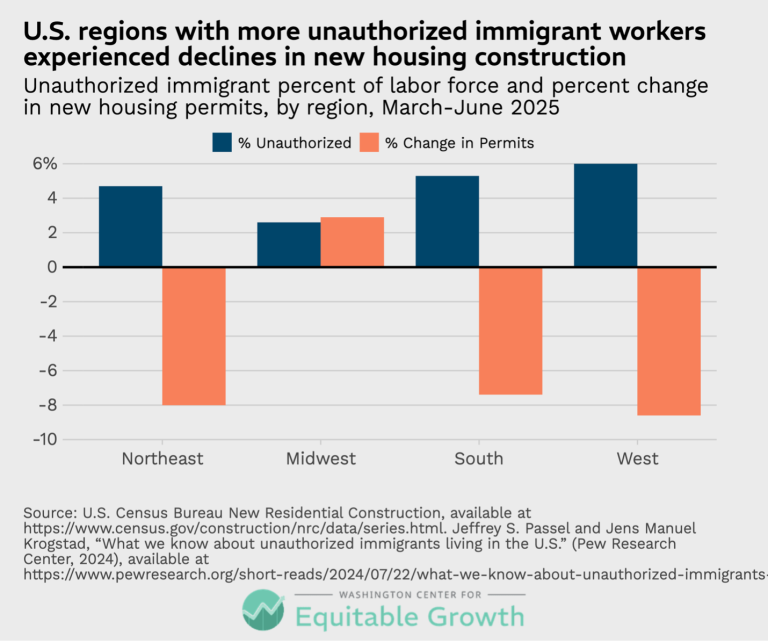
U.S. regions with more unauthorized immigrant workers experienced declines in new housing construction (opens in a new tab)
Visualizations AUG 31, 2026
 View Chart
(opens in a new tab)
View Chart
(opens in a new tab)
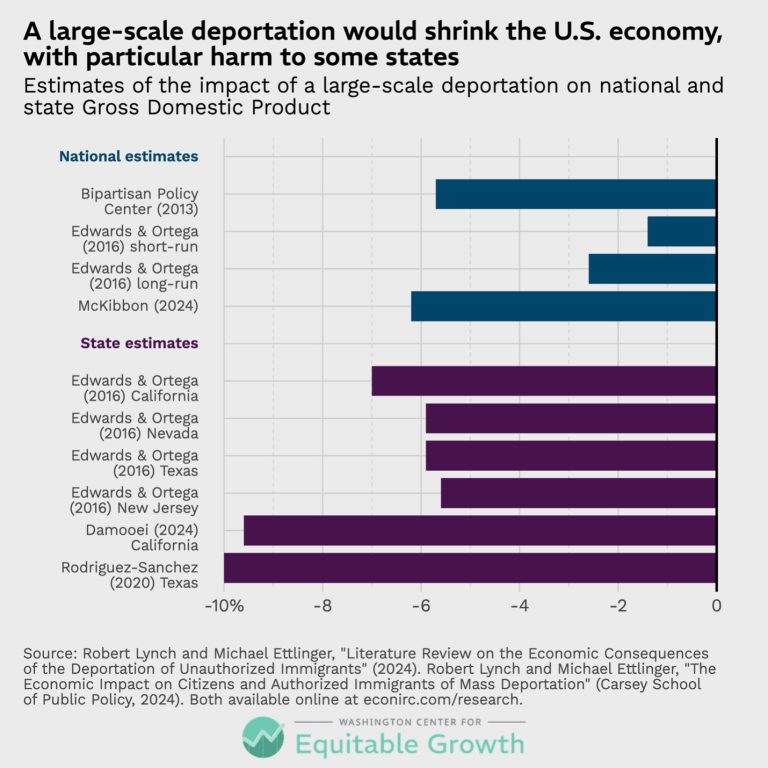
A large-scale deportation would shrink the U.S. economy, with particular harm to some states (opens in a new tab)
Visualizations AUG 31, 2026
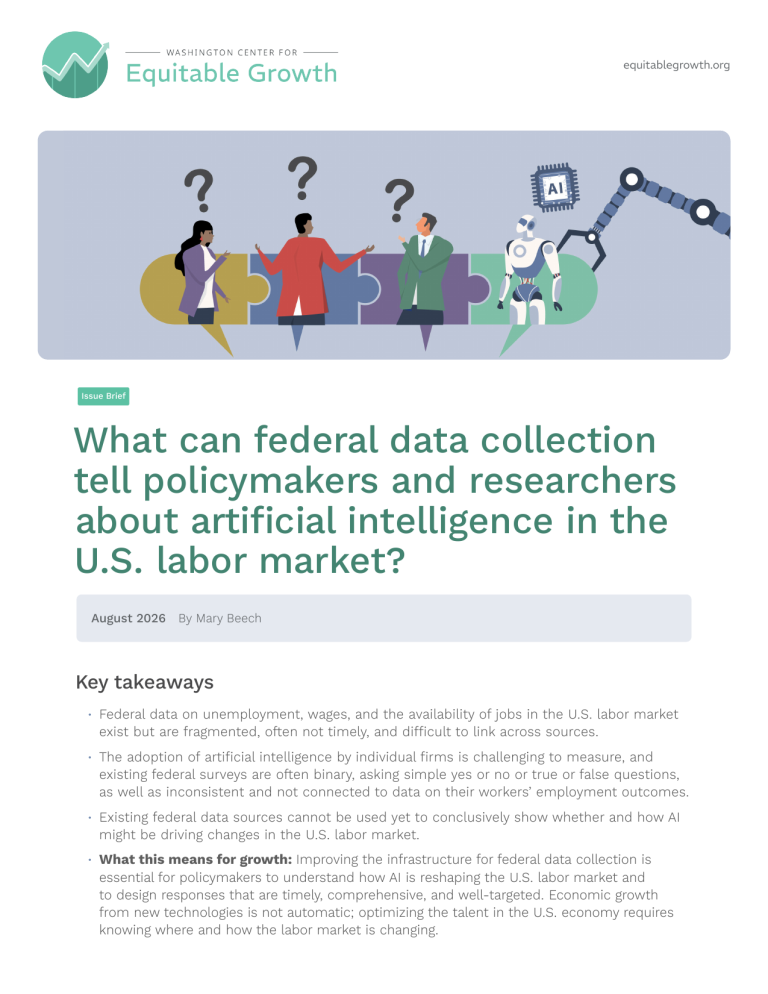
What can federal data collection tell policymakers and researchers about artificial intelligence in the U.S. labor market? (opens in a new tab)
Issue Briefs AUG 24, 2026
It is impossible to perfectly predict how artificial intelligence will affect the U.S. labor market. Policymakers and researchers are grappling with important questions around this topic, including what new opportunities…
By: Mary Beech (opens in a new tab)
Terms and conditions for generative AI users outline a new legal framework that puts U.S. consumers at risk (opens in a new tab)
Essays AUG 20, 2026
Generative AI, or genAI, is a form of artificial intelligence that produces content in response to prompts and includes large language model chatbots such as OpenAI’s ChatGPT or Anthropic’s Claude.…
By: Chiara Chanoi (opens in a new tab)
Estimating AI exposure is useful for research but cannot yet tell policymakers the whole story of AI’s impact on the labor market (opens in a new tab)
Essays AUG 7, 2026
Artificial intelligence has the potential to substantially change the nature and availability of work. To effectively manage the transitions this technology might bring to the U.S. economy, policymakers need information…
By: Chiara Chanoi (opens in a new tab)

Tracking new research on artificial intelligence and its impact on the U.S. labor market (opens in a new tab)
Essays AUG 5, 2026
Headlines often paint extreme and dissonant pictures of the future impact of AI on the U.S. economy and labor market, with workers themselves echoing the conflicting feelings of optimism and…
By: Equitable Growth (opens in a new tab)

Why Unemployment Insurance Alone Is Not Enough in the AI Era (opens in a new tab)
Essays JUL 8, 2026
Since the large language model ChatGPT was rolled out in November 2022, artificial intelligence has captured the public’s attention and generated myriad debates over the emerging technology’s potential impacts on…
By: Megan Rivera (opens in a new tab)

Personal Income in the United States nudges up in May but is down 0.76 percent in the past 6 months (opens in a new tab)
Essays JUN 25, 2026
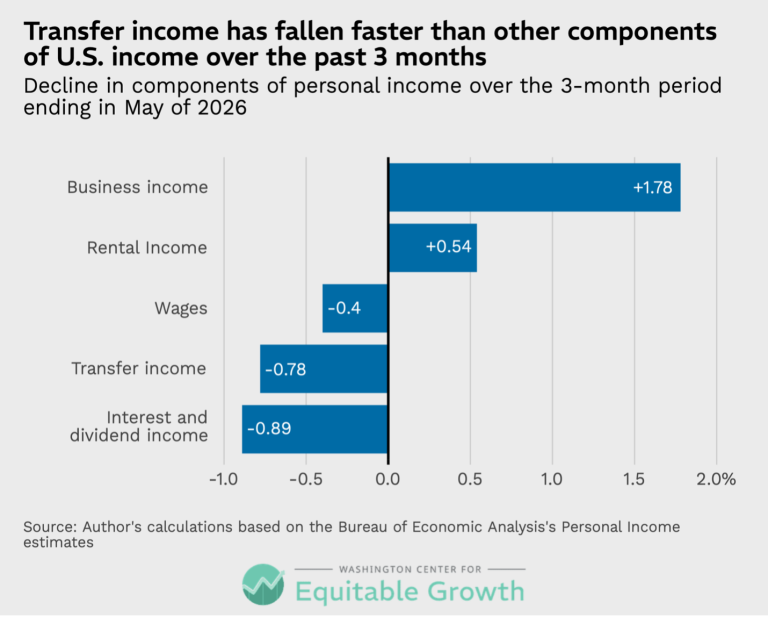
According to today’s release of Personal Income estimates from the U.S. Bureau of Economic Analysis, U.S. household incomes have fallen 0.76 percent in the past 6 months, with month-to-month declines…
By: Austin Clemens (opens in a new tab)
 View Chart
(opens in a new tab)
View Chart
(opens in a new tab)
Transfer income has fallen faster than other components of U.S. income over the past 3 months (opens in a new tab)
Visualizations JUN 25, 2026
 View Chart
(opens in a new tab)
View Chart
(opens in a new tab)
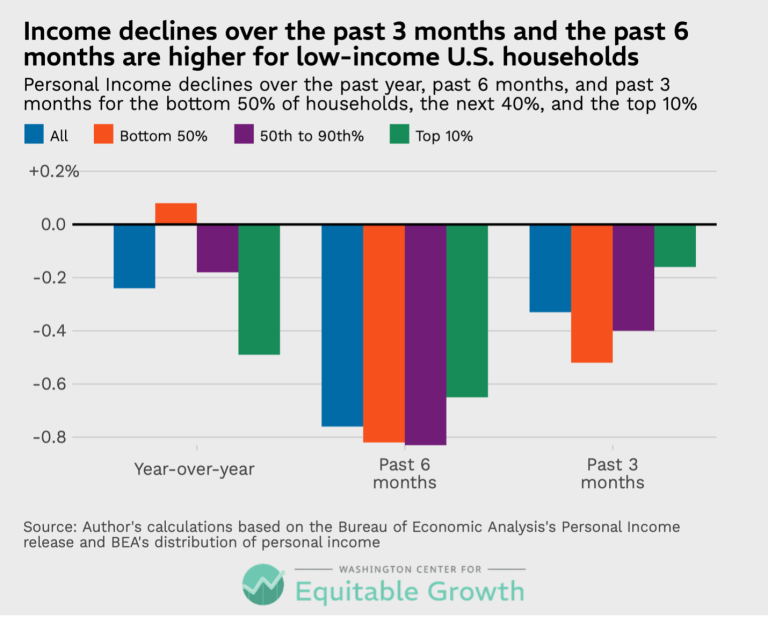
Income declines over the past 3 months and the past 6 months are higher for low-income U.S. households (opens in a new tab)
Visualizations JUN 25, 2026
 View Chart
(opens in a new tab)
View Chart
(opens in a new tab)
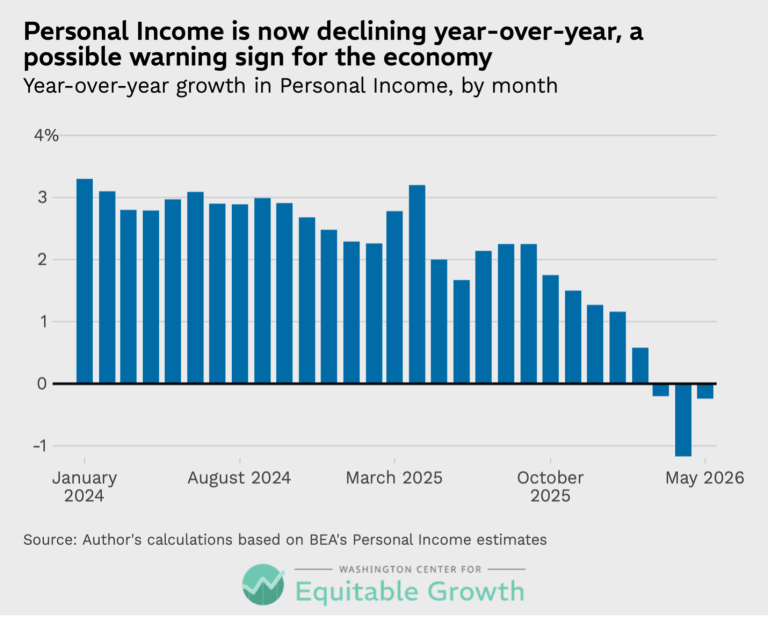
Personal Income is now declining year-over-year, a possible warning sign for the economy (opens in a new tab)
Visualizations JUN 25, 2026
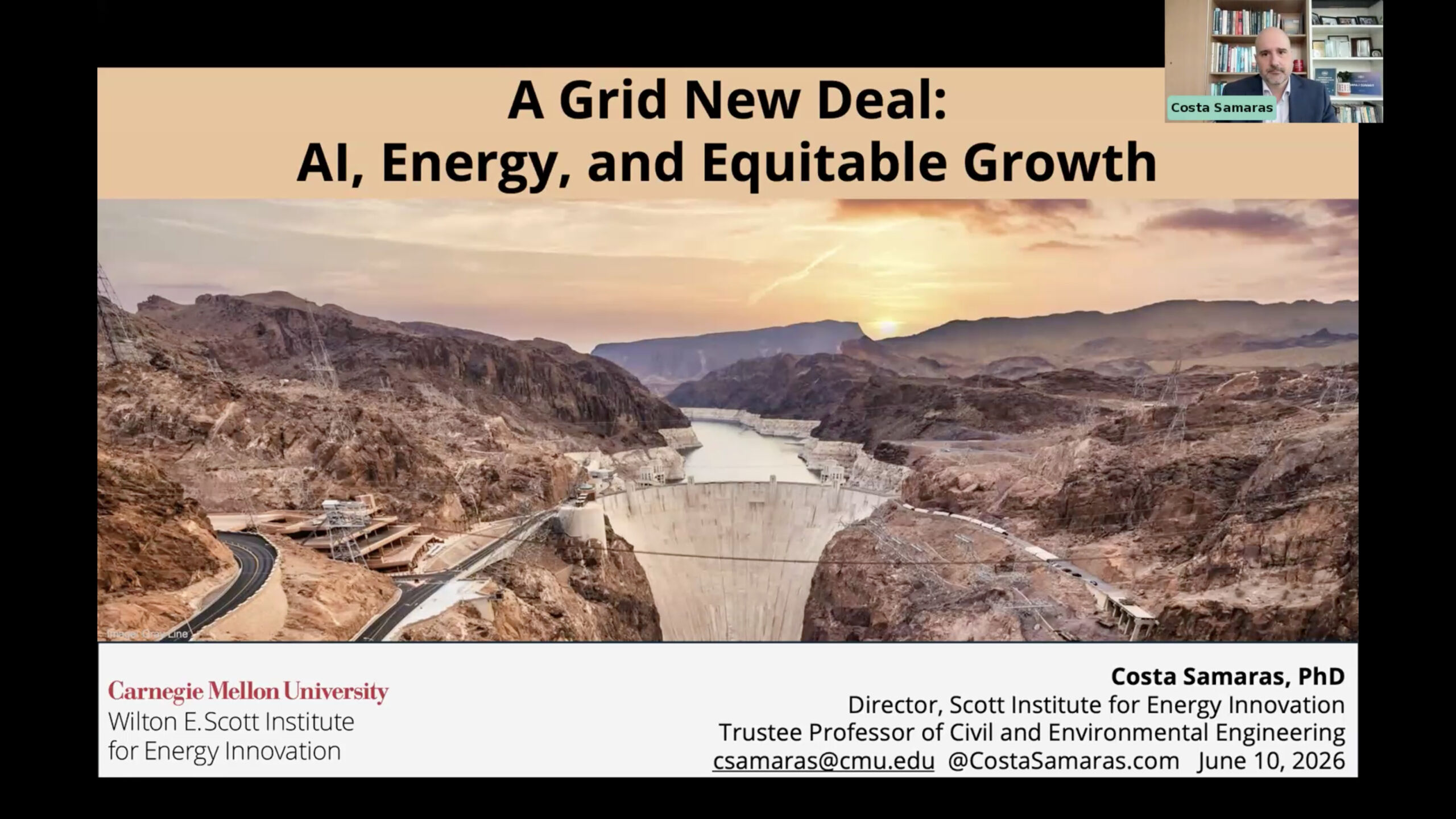
The United States can simultaneously foster an equitable AI boom and a clean energy economy (opens in a new tab)
Videos JUN 12, 2026
The Washington Center for Equitable Growth recently hosted a timely discussion exploring how the rapid expansion of artificial intelligence is colliding with—and reshaping—the clean energy transition. Bringing together researchers and…
By: Equitable Growth (opens in a new tab)

U.S. workers need sectoral bargaining now more than ever (opens in a new tab)
Essays JUN 4, 2026
U.S. union membership and coverage rates have declined for decades, fueled in part by legal barriers to new organizing, including the limiting of collective bargaining to specific workplaces or employers and misclassifying certain groups of workers so they…
By: Christopher Bangert-Drowns (opens in a new tab)
 View Chart
(opens in a new tab)
View Chart
(opens in a new tab)
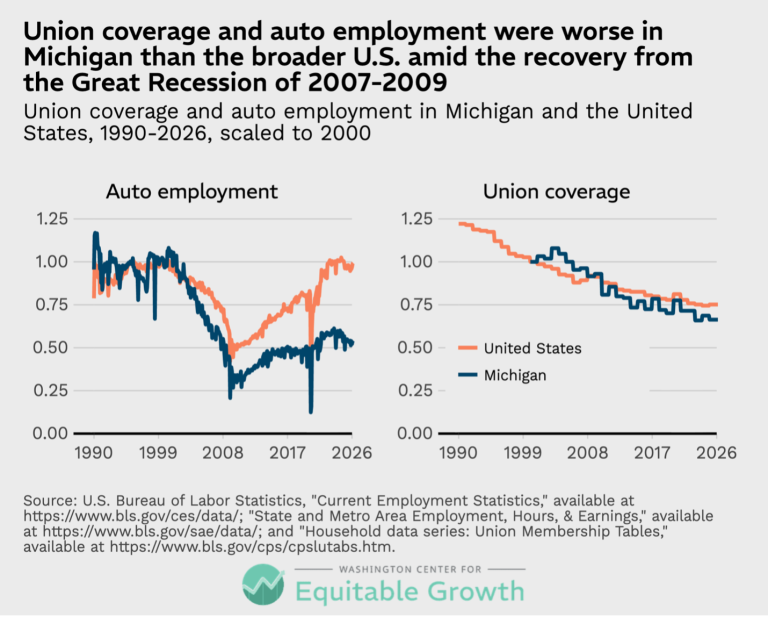
Union coverage and auto employment were worse in Michigan than the broader U.S. amid the recovery from the Great Recession of 2007-2009 (opens in a new tab)
Visualizations JUN 3, 2026
 View Chart
(opens in a new tab)
View Chart
(opens in a new tab)
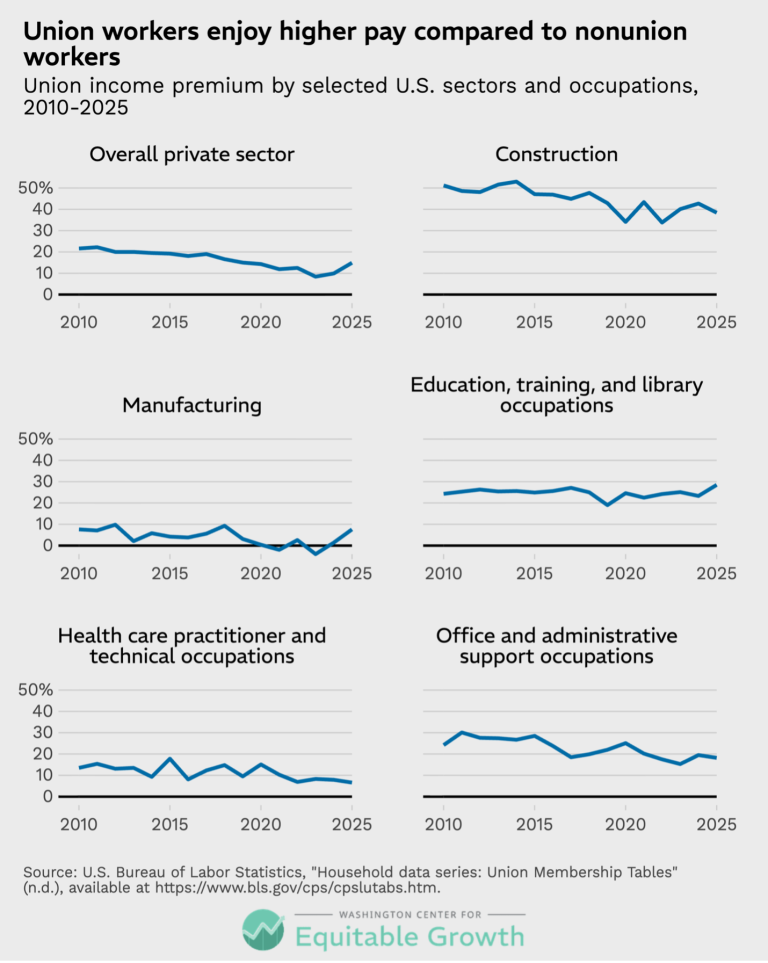
Union workers enjoy higher pay compared to nonunion workers (opens in a new tab)
Visualizations JUN 3, 2026
 View Chart
(opens in a new tab)
View Chart
(opens in a new tab)
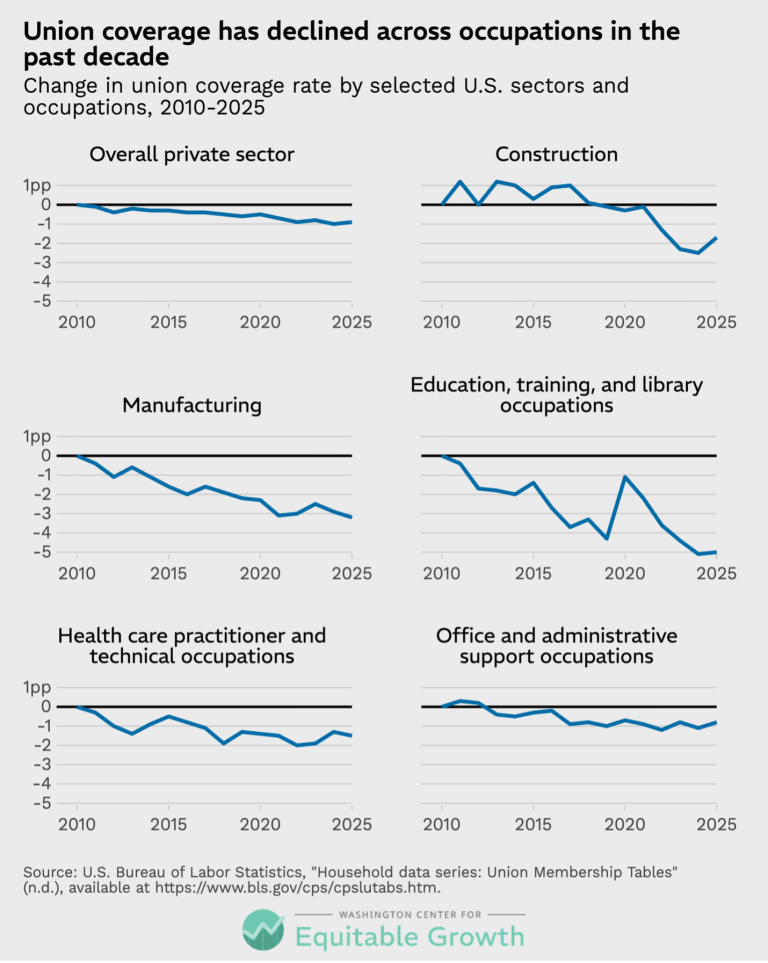
Union coverage has declined across occupations in the past decade (opens in a new tab)
Visualizations JUN 3, 2026

In Conversation with Costa Samaras (opens in a new tab)
In Conversation JUN 2, 2026
Equitable Growth in Conversation is a recurring series where we talk with economists and other academics to help us better understand whether and how economic inequality affects economic growth and…
By: Shayna Strom (opens in a new tab)
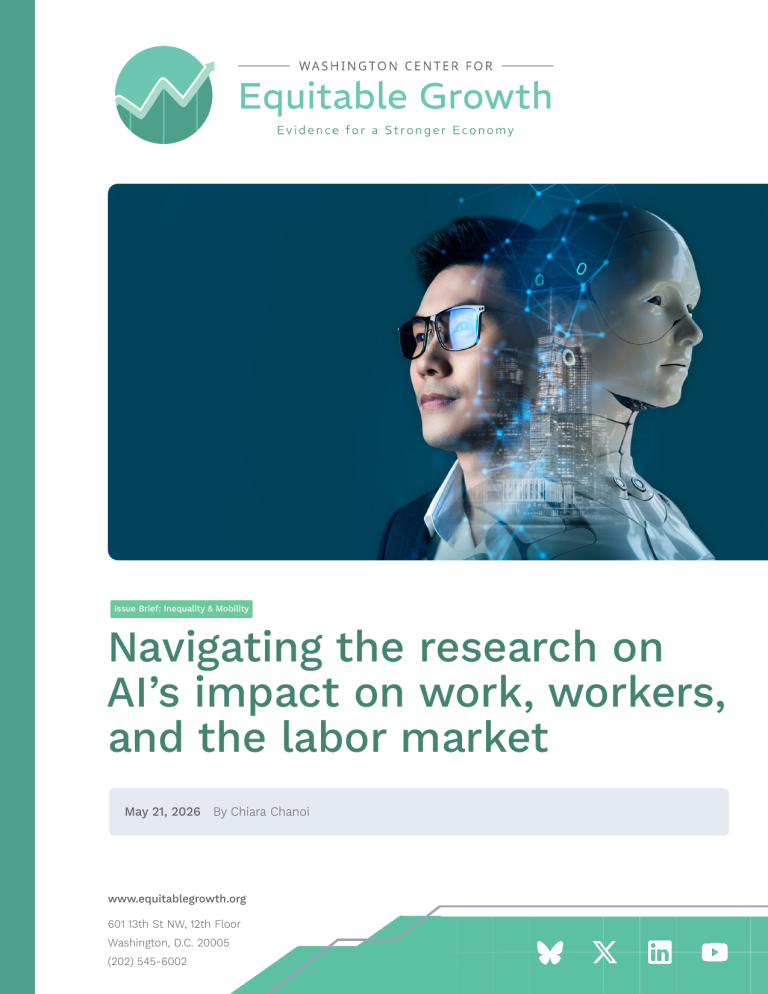
Navigating the research on the impacts of AI on work, workers, and the labor market (opens in a new tab)
Research Databases MAY 21, 2026
Artificial intelligence will have a largely unpredictable but potentially profound effect on the labor market. Individuals have speculated how AI will affect the workforce since its earliest developments. But public…
By: Chiara Chanoi (opens in a new tab)

What is the relationship between inflation, interest rates, and economic growth, and what does it mean for the new Federal Reserve chair? (opens in a new tab)
Issue Briefs MAY 18, 2026
Since regaining the Oval Office in early 2025, President Donald Trump has repeatedly called for lower interest rates and severely criticized former Federal Reserve Board Chair Jerome Powell’s cautious approach…
By: Jacob Robbins (opens in a new tab)

Research shows unions dampen support for right-wing populism and help workers navigate technological transitions (opens in a new tab)
Essays MAY 1, 2026
On May 1, much of the world—though not the United States—celebrates International Workers Day to honor the social and economic contributions of workers and labor unions. The May Day holiday began in large part to mark…
By: Christopher Bangert-Drowns (opens in a new tab)
 View Chart
(opens in a new tab)
View Chart
(opens in a new tab)
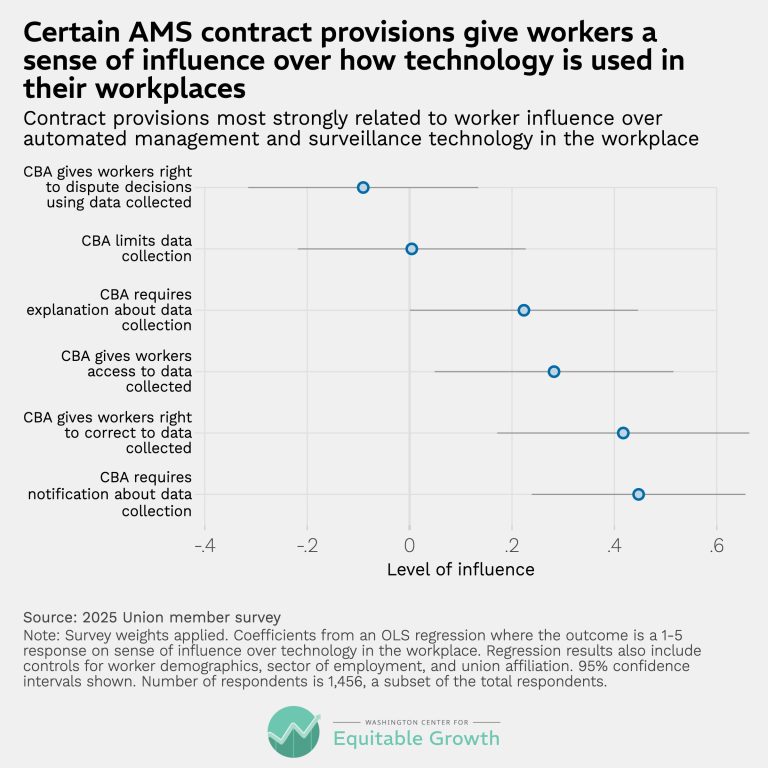
Certain AMS contract provisions give workers a sense of influence over how technology is used in their workplaces (opens in a new tab)
Visualizations MAR 12, 2026