


Policy Resources
From in-depth analysis to practical policy insights, find research that helps explain how economic policy shapes outcomes for workers, families, and long-term growth.
Our Policy Areas of Focus
The Washington Center for Equitable Growth connects economic evidence and policy to promote shared prosperity and growth by funding policy-relevant research, elevating scholars and their work, and translating evidence for policymakers.

How Ideas Move Into Policy Decisions
AI, Tech & Energy
Equitable Growth supports research and policy analysis on how artificial intelligence, emerging technologies, and the energy transition affect workers, inequality, and broad-based economic growth.

To equip leaders to guide AI toward shared prosperity, our work examines:
- The impact of AI on employment levels, wages, and job content
- How AI drives macroeconomic impacts such as growth and productivity
- Market competition implications of AI use
- The use of algorithms in labor management
Macroeconomics & Economic Measurement
Equitable Growth supports research and policy analysis on how macroeconomic policies and better economic measurement can promote stable and broad-based economic growth.

To reduce volatility and strengthen individual and macroeconomic resilience for broad-based growth, we focus on:
- Automatic stabilizers that cushion downturns and promote more even recoveries
- Tools to respond to recessions that quickly stabilize households, boost the economy, and limit scarring
- Ways to encourage private investment and job growth
- Wealth inequality using novel data and analysis
- Policies to strengthen supply chains and support the energy transition
Political Economy & Democracy
Equitable Growth supports research and policy analysis on how economic inequality shapes political power and democratic institutions, and how that in turn affects broad-based economic growth.

Taxation
Equitable Growth supports research and policy analysis on how tax policies can promote stable and broad-based economic growth.

To provide evidence to policymakers on what effective reform entails, we focus on:
- Distributional analysis, including distributional weighting of benefit-cost analysis
- Pass-through and other business taxation
- Tax enforcement, especially related to large, complex partnerships
- Taxing wealth, including capital taxes on new forms of wealth such as artificial intelligence and cryptocurrency
Competition & Economic Dynamism
Equitable Growth supports research and policy analysis on how strong competition among U.S. businesses affects inequality and broad-based economic growth.

Household Economic Security
Equitable Growth supports research and policy analysis on how unequal access to care, 21st century work-life policies, and education undermines stable, broad-based economic growth.

We focus on:
- The efficacy of public benefit and social insurance programs
- Income security and access to wealth-building
- Policy effects on economic mobility
- The value of economic inclusion
- The impacts on workforce outcomes through policies such as schedule stability and childcare
Economic Equity & Opportunity
Equitable Growth supports research and policy analysis on how trends in economic inequality and mobility and changes in the economy have affected the concentration of wealth, income, and earnings, and how these distributional shifts have affected the promise of economic security and opportunity.

Labor, Wages & Worker Power
Equitable Growth supports research and policy analysis on how inequalities in wages, bargaining power, and the evolving labor market affect workers’ economic security and opportunity as well as broad-based economic growth.

We focus on:
- Unemployment and wage growth
- Bargaining power and union coverage
- Gender and race pay equity
- Nonwage amenities, job quality, and upward job mobility
How Ideas Move Into Policy Decisions

Disseminate research and policy guidance
Identify policy areas and issues
Conduct original research and identify spaces for effective policy interventions
Identify policy relevant and academically rigorous research questions


Progress depends on a continuous exchange between ideas and action.
Research helps define the questions that matter, while policy challenges shape the direction of inquiry. When these two stay connected, evidence becomes more than insight—it becomes a tool for better decisions.

That connection is powered by people.
At the center of this work is a network of more than 400 researchers focusing on real policy questions—helping explain economic trends, evaluate solutions, and inform decision-making.
223 Results


Terms and conditions for generative AI users outline a new legal framework that puts U.S. consumers at risk (opens in a new tab)
Essays AUG 20, 2026
Generative AI, or genAI, is a form of artificial intelligence that produces content in response to prompts and includes large language model chatbots such as OpenAI’s ChatGPT or Anthropic’s Claude.…
By: Chiara Chanoi (opens in a new tab)
ASSA 2026 Round-up: Day 3 (opens in a new tab)
Blog JAN 6, 2026
Yesterday was the third and final day of the 2026 annual meeting of the Allied Social Science Associations, which is organized by the American Economic Association. The 3-day conference, held…
By: Equitable Growth (opens in a new tab)
ASSA 2026 Round-up: Day 2 (opens in a new tab)
Blog JAN 5, 2026
Yesterday was the second day of the 2026 annual meeting of the Allied Social Science Associations, which is organized by the American Economic Association. The 3-day conference, held in Philadelphia…
By: Equitable Growth (opens in a new tab)
ASSA 2026 Round-up: Day 1 (opens in a new tab)
Blog JAN 4, 2026
Yesterday was the first day of the 2026 annual meeting of the Allied Social Science Associations, which is organized by the American Economic Association. The 3-day conference, held in Philadelphia…
By: Equitable Growth (opens in a new tab)

What impact is artificial intelligence having on the U.S. labor market and the nation’s economy? (opens in a new tab)
Essays NOV 14, 2025
As new and groundbreaking technologies emerge, they can function as a blank canvas onto which people project both aspirations and anxieties. Artificial intelligence—despite its quick uptake in broader society and…
By: Megan Rivera (opens in a new tab)

Understanding market concentration in the AI supply chain (opens in a new tab)
Blog JAN 28, 2025
Artificial intelligence is more than just the applications we use, such as chatbots and predictive algorithms. Beneath the surface of AI lies a technology stack that is increasingly concentrated at…
By: Tejas Narechania (opens in a new tab)
 View Chart
(opens in a new tab)
View Chart
(opens in a new tab)
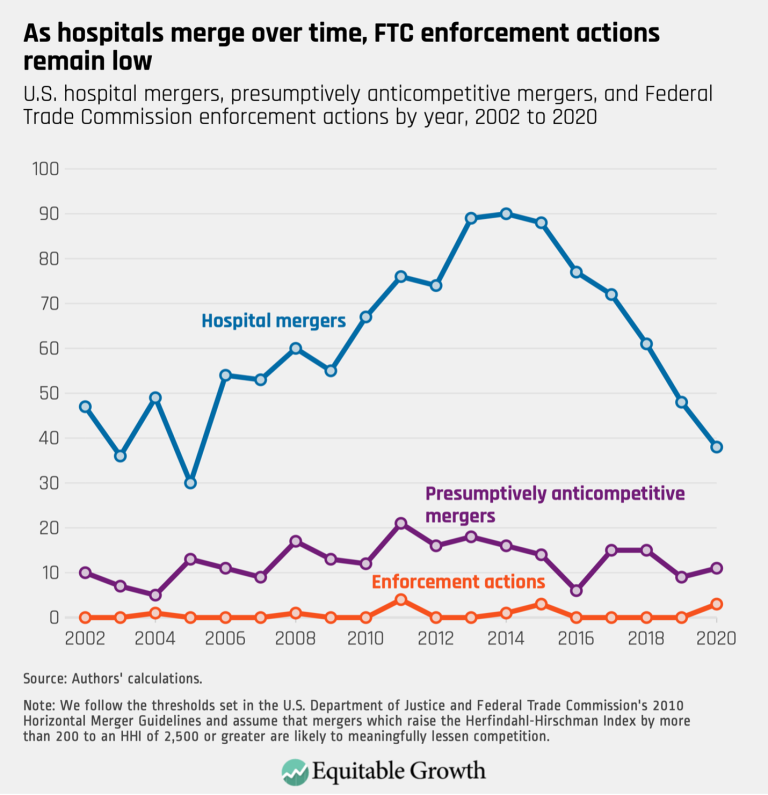
As hospitals merge over time, FTC enforcement actions remain low (opens in a new tab)
Visualizations JUL 25, 2024
 View Chart
(opens in a new tab)
View Chart
(opens in a new tab)
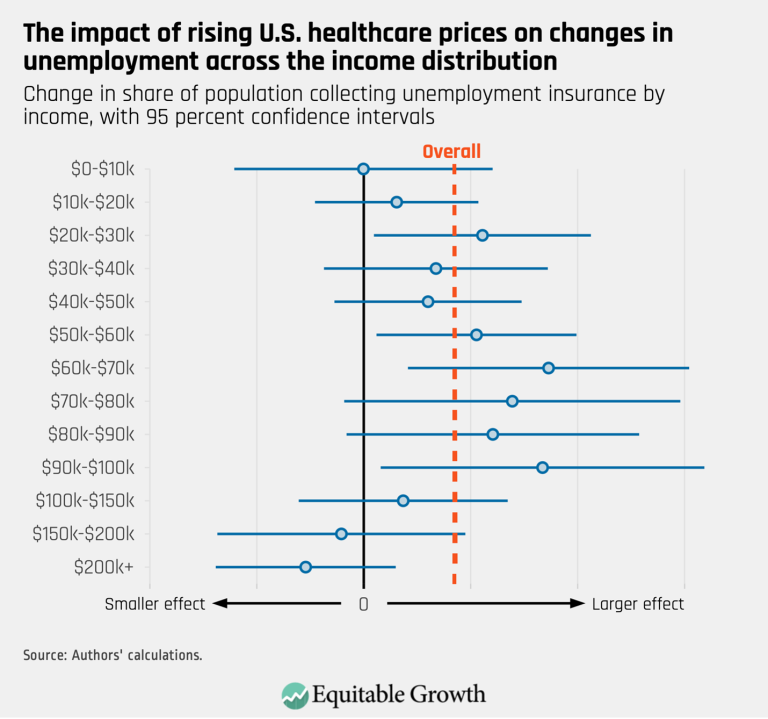
The impact of rising U.S. healthcare prices on changes in unemployment across the income distribution (opens in a new tab)
Visualizations JUL 25, 2024
 View Chart
(opens in a new tab)
View Chart
(opens in a new tab)
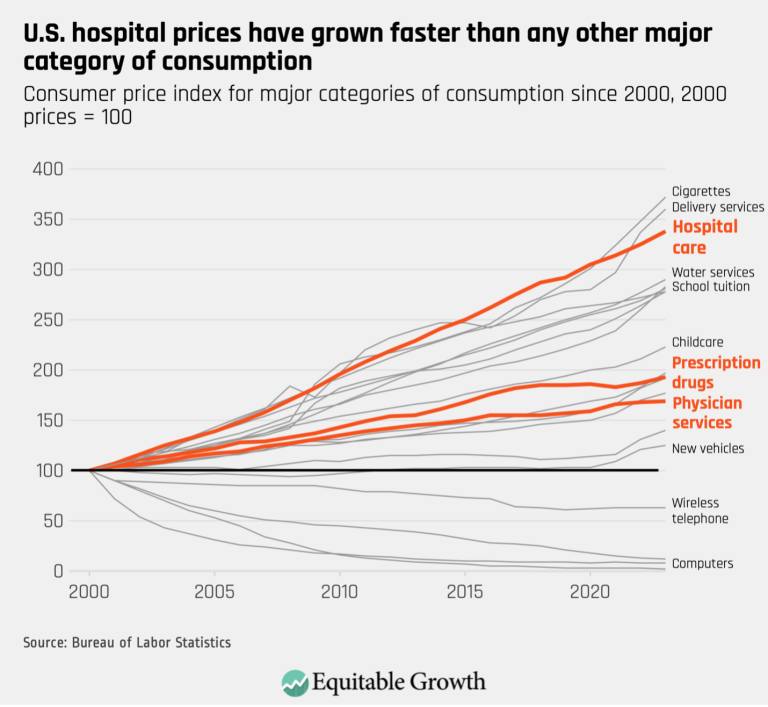
U.S. hospital prices have grown faster than any other major category of consumption (opens in a new tab)
Visualizations JUL 25, 2024
Hospital consolidation and rising health care prices lead to job losses for U.S. workers (opens in a new tab)
Issue Briefs JUL 25, 2024
The majority of working-age adults in the United States have health insurance via their employers. Theory and a growing body of research suggest that when the cost of workers’ benefits…
By: Zarek Brot-Goldberg (opens in a new tab), Zack Cooper (opens in a new tab), Stuart Craig (opens in a new tab), Lev Klarnet (opens in a new tab)

Combating market power through a graduated U.S. corporate income tax (opens in a new tab)
Issue Briefs APR 15, 2024
Editor’s note: This version has been updated from the original publication on April 15, 2024. The update corrects a prior underestimate of the revenue potential from graduated corporate tax rates…
By: Kimberly Clausing (opens in a new tab)

Hospital consolidation matters (opens in a new tab)
Reports APR 4, 2024
The U.S. policy landscape is replete with reports from organizations across the political spectrum decrying the lack of competition in hospital markets around the nation and the resulting high prices,…
By: Equitable Growth (opens in a new tab)

Matching competition policy in the U.S. healthcare industry to address a new generation of challenges in provider markets (opens in a new tab)
Issue Briefs MAR 20, 2024
Antitrust policy in the U.S. healthcare sector is perennially 10 years behind the industry. But at the start of the Biden administration in early 2021, there was hope for a…
By: Barak D. Richman (opens in a new tab)

The impacts of increasing U.S. hospital consolidation on Medicaid recipients (opens in a new tab)
Blog JAN 25, 2024
The U.S. healthcare sector is a consequential part of the overall economy. As of 2021, U.S. healthcare expenditures alone would rank third among the world’s largest economies in terms of…
By: Sunita Desai (opens in a new tab), Kyle Smith (opens in a new tab)

What the research says about the impacts of hospital consolidation across the United States (opens in a new tab)
Blog DEC 6, 2023
When patients in the United States rely on hospitals for care, they are often at their most vulnerable, such as during acute illnesses, when suffering major injuries, or while giving…
By: Amy Phillips (opens in a new tab)

Sameera Fazili and Mary Beth Maxwell join Equitable Growth’s Board of Directors (opens in a new tab)
Blog NOV 15, 2023
The Washington Center for Equitable Growth today announced the addition of two new members to its board of directors: Sameera Fazili, former deputy assistant to the president and deputy director…
By: Equitable Growth (opens in a new tab)

The consequences of U.S. hospital consolidation on local economies, healthcare providers, and patients (opens in a new tab)
Reports NOV 15, 2023
Policymakers, regulators, stakeholders, and academics have yet to grapple with the full cross-sectional impacts of hospital mergers. While the evidence is clear that consolidation leads to higher prices in concentrated…
By: Amy Phillips (opens in a new tab)

U.S. labor market concentration, competition, and worker bargaining power as employment trends shift from manufacturing to services (opens in a new tab)
Blog SEP 6, 2023
Labor market concentration and competition in the United States has received renewed and well-deserved attention over the past several years. Competitive labor markets are critical engines of economic growth, worker…
By: Laura Alexander (opens in a new tab)

New data and analysis suggest private equity takeovers of U.S. medical practices cause anticompetitive harms to patients, insurers, and employers in local markets (opens in a new tab)
Blog JUL 10, 2023
The linked resources and the PDF for this piece were updated on February 20, 2024. Private equity firms are deeply engaged in buying up and consolidating medical practices across the…
By: Laura Alexander (opens in a new tab)

Equitable Growth delivers comment letter responding to the Federal Trade Commission’s Advanced Notice of Proposed Rulemaking on Non-Compete Clauses (opens in a new tab)
Blog APR 20, 2023
The Washington Center for Equitable Growth this week delivered a comment letter responding to the Federal Trade Commission’s Advanced Notice of Proposed Rulemaking on Non-Compete Clauses. In our comment letter,…
By: Equitable Growth (opens in a new tab)

Major federal ‘Big Tech’ antitrust case against Google will test the strength of current U.S. antitrust laws in new digital markets (opens in a new tab)
Blog MAR 13, 2023
A high-profile antitrust enforcement action taken in January by the Antitrust Division of the U.S. Department of Justice against Alphabet Inc.’s Google unit—one of the largest technology companies in the…
By: Laura Alexander (opens in a new tab)

New research suggests connections between market concentration and the exercise of political power in the United States (opens in a new tab)
Blog JAN 12, 2023
Consolidation of markets at the hands of U.S. companies that are actively engaged in mergers and acquisitions raises an important question about the political ramifications of market concentration. Do mergers…
By: Laura Alexander (opens in a new tab)

Supermarket chain Kroger’s takeover of rival Albertsons is a test for U.S. antitrust law on pre-closing dividends (opens in a new tab)
Blog NOV 16, 2022
The recently proposed $24.6 billion takeover of the nation’s fourth-largest supermarket chain, Albertsons Companies Inc., by the second-largest chain, Kroger Co., poses an array of serious and apparent antitrust concerns…
By: Laura Alexander (opens in a new tab)

Equitable Growth names Shayna Strom as interim president and CEO (opens in a new tab)
Blog SEP 8, 2022
The Washington Center for Equitable Growth today announced that Shayna Strom has been named its interim president and CEO. Strom comes to the organization with decades of experience bridging nonprofits,…
By: Equitable Growth (opens in a new tab)