

Skip to content
Browse All Resources
Blog

OCT 23, 2018

What upticks in U.S. economic inequality and incarceration mean for marriage

What upticks in U.S. economic inequality and incarceration mean for marriage

Abstract

Forty-six percent of unmarried Americans hope to someday marry (opens in a new tab), yet falling rates of marriage make their prospects of tying the knot increasingly dim. A large body of research underpins the debate over the causes of this decline, variously identifying women’s increasing economic independence (opens in a new tab), changing attitudes toward marriage (opens in a new tab), and increased use of effective contraception (opens in a new tab) as potential causal factors. Perhaps the most prominent theory in sociology, however, argues that a decrease in the number of “marriageable men” (opens in a new tab) leaves women without partners.

What makes a man “marriageable”? In addition to being a romantic arrangement and a family form, marriage is an economic institution (opens in a new tab). So, when men lack economic resources, they may be less likely to marry. Another factor that could affect marriageability is criminal justice involvement. When men are confined to jail or prison, or when a criminal record trails after them following release, they may become less attractive candidates for marriage.

Interestingly, two trends may have simultaneously depressed rates of marriage in the United States. First, economic well-being has declined for people at the middle and bottom of the income distribution. Second, incarceration has boomed during precisely the same period in which marriage rates have fallen. In 1969, average earnings for men without college diplomas were 14 percent higher than in 2013 (opens in a new tab). In 1969, about 200,000 people were incarcerated, but in 2013, that number was closer to 1.4 million (opens in a new tab).

A 2018 paper (opens in a new tab) in the Journal of Marriage and Family argues persuasively that the decrease in the number of marriageable men—due to economic hardship and incarceration—is a major factor driving the falling rates of marriage. The paper, written by Kristen Harknett of the University of California, San Francisco and Daniel Schneider and Matthew Stimpson of the University of California, Berkeley looks across five decades of data from the Panel Study of Income Dynamics (opens in a new tab) to document and explain the downward trend in marriage among men and women from 1969 to 2013.

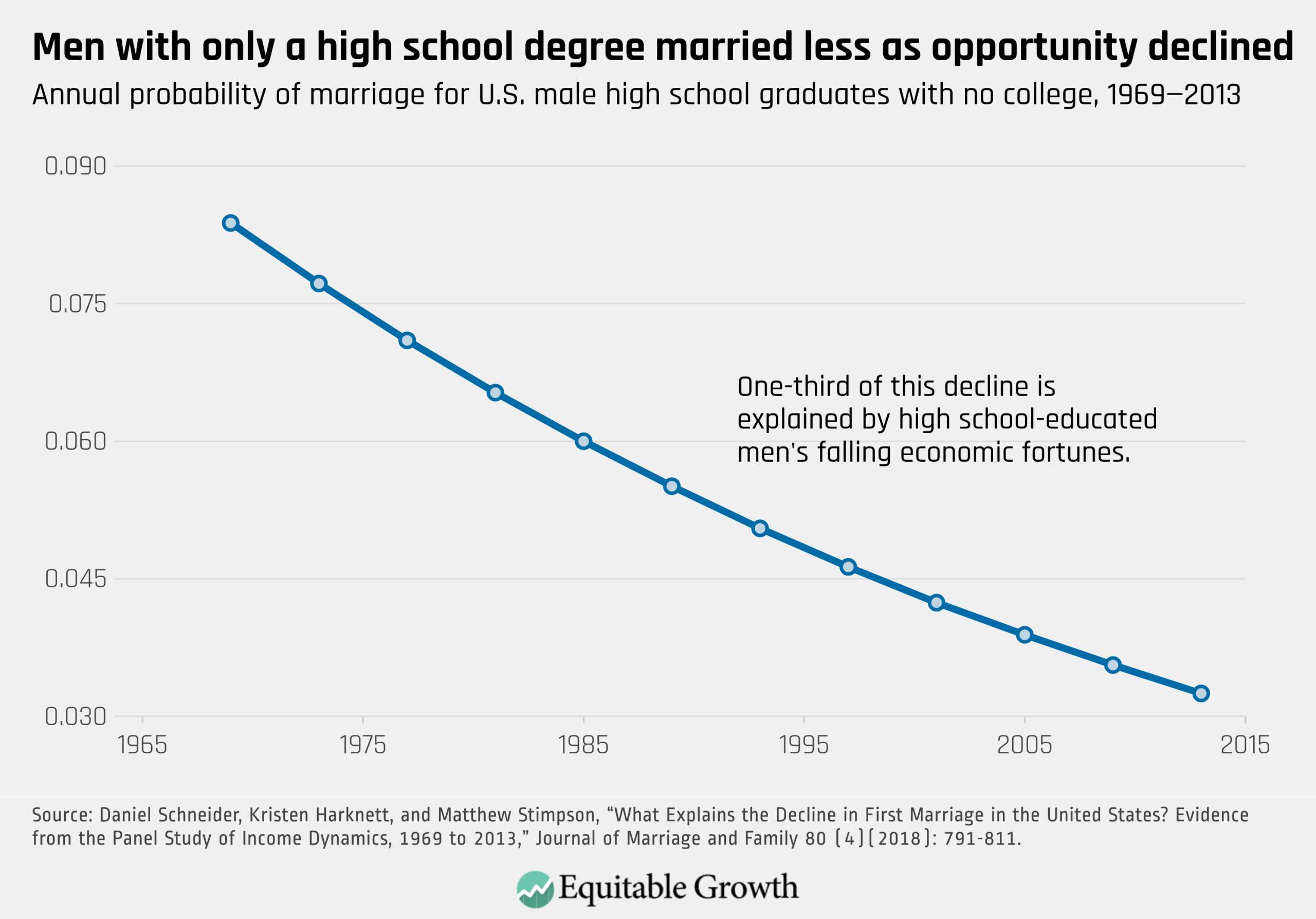
While previous (opens in a new tab) literature has examined single cohorts to show that people are less likely to marry when they face economic hardship, by using a dataset that follows multiple generations across the full period of decline, the authors are able to show just how much of the marriage decline can be accounted for by concurrent changes in the distribution of resources and incarceration levels. For instance, for men who finished high school but did not complete a bachelor’s degree, declining economic fortunes explain at least a third of the marriage decline in this period. (See Figure 1.)

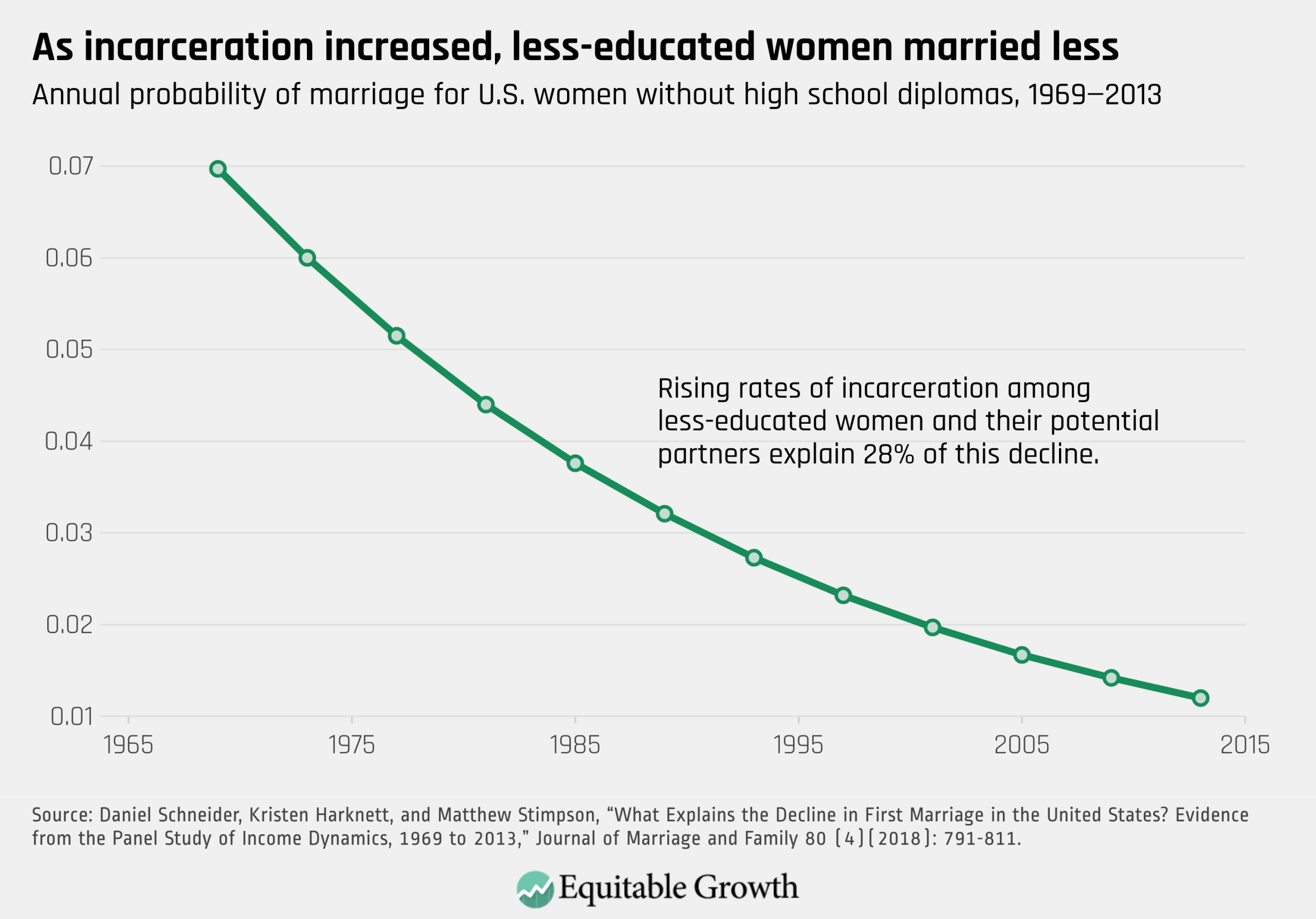
The authors of that paper, Harknett, Schneider, and Stimpson, also demonstrate that mass incarceration appears to have affected rates of marriage in this period by shrinking the pool of marriageable men with whom low-educated women might form relationships. Their research finds that increasing rates of incarceration explain 28 percent of the marriage decline among women without high school diplomas, probably because their potential partners have been incarcerated. (See Figure 2.)

The work of these three researchers indicates that increasing inequality in the United States has consequences beyond the material circumstances of those at the bottom of the income distribution. Lower bank account balances, for example, affect people’s romantic lives and family composition. What does this mean for policy? Because other research (opens in a new tab) shows that married people have higher rates of economic security, some experts (opens in a new tab) call for the promotion of marriage. Schneider and his co-authors’ work suggests that these policy proposals may be putting the cart before the horse. If policymakers instead start by improving economic circumstances, rates of marriage are likely to increase. This could lead to a virtuous circle, in which people have the resources they need to form the families they desire, which, in many cases, may further bolster their economic circumstances or insulate them from economic hardship.

Schneider and his co-authors also show that incarceration has effects that ripple beyond the immediate impact on the confinement of and concomitant declines in well-being among incarcerated people. Incarceration affects not only the family relationships (opens in a new tab) of African American and low-educated men who are most likely (opens in a new tab) to be incarcerated but also the family formation of low-educated women. While much literature (opens in a new tab) investigates whether marriage is a protective factor against justice involvement, policymakers may again wish to move the proverbial cart and focus on the long-reaching benefits that reducing incarceration may have for families.

Related

Your Direct Line to Cutting-Edge Research

Get updates on our latest research, event announcements, and policy insights delivered straight to your inbox. Stay connected with the leading voices on equitable growth.