




Policy
Workplace surveillance is becoming the new normal for U.S. workers
Reports AUG 18, 2021
By: Kathryn Zickuhr
AI, Tech & Energy
Labor, Wages & Worker Power
 Browse All Resources
FEB 2, 2022
As more and more job-seekers in the United States went online to look for work in the late 1990s and early 2000s, several scholars wrote about the potential of the internet (opens in a new tab) to change the process by which workers search and find jobs. By allowing candidates and recruiters to access an unprecedented amount of information (opens in a new tab) about each other, technologies such as online job boards could lower barriers that make it difficult for workers and employers to meet and establish valuable employment relationships.
Moreover, if these new job-search methods led to the creation of more and better worker-employer matches, then their widespread use also could have implications for economywide dynamics. The impact of these new technologies could affect, for example, the aggregate level of unemployment, wage inequality, and U.S. economic growth.
Fast-forward to today. Online job searches are the main way (opens in a new tab) in which U.S. workers look for jobs. The effect of this search method on workers’ economic outcomes and on broader labor market dynamics, however, continues to be considered and discussed. On the one hand, online job searches shorten the amount of time it takes job-seekers to find work, and it appears to make job switching easier and more likely. On the other hand, advertising job openings and applying for open vacancies is much faster and cheaper now than it was two decades ago, creating new frictions in the U.S. labor market, including barriers that make it difficult for job-seekers and employers to find each other and create good matches.
Focusing on the perspective of job-seekers, this issue brief examines how online job boards and other information technologies change the job-search process, affecting workers’ labor market outcomes and influencing other dynamics, such as aggregate unemployment and wage inequality. We also examine how online job-search experiences are changing and the obstacles job-seekers face when looking for work, including racial and gender discrimination, information asymmetries, and the lack of transparency in and around the job-search process.
We close the issue brief with an overview of policies that could render online job searches and application processes more effective, more equitable, and more capable of matching the best workers to the best jobs by, for example, more effectively protecting workers against discrimination in the hiring process and ensuring all U.S. households have access to high-quality internet services. These key social infrastructure investments and more efficient enforcement of labor standards in the United States would help boost more broad-based, and thus more sustainable, U.S. economic growth.
In a hypothetical perfectly competitive labor market, workers seamlessly match into open vacancies when wage offers are higher than their reservation wage—economic parlance forthe lowest wage at which any given worker will be willing to accept a job. In turn, the theory is that the wages that employers offer are determined by economywide competitive forces of supply and demand for labor. The sum of these dynamics leads to market clearing, where all workers have jobs at wages equivalent to the value they contribute to production.
This way of understanding the labor market relies on the obviously spurious assumption that both workers and employers have perfect information. In this theoretical framework, unemployment ostensibly only exists inasmuch as it is a temporary phenomenon while workers are switching jobs.
Because of the clear limitations to this framework, in the 1960s and 1970s, several economists started to develop a “job search theory (opens in a new tab)” to model a more realistic labor market—one in which workers may search for jobs and not immediately find them. Along with the insight that in virtually all markets, buyers and sellers incur costs due to searching to find one another (opens in a new tab), one of the key contributions of job-search theory is that it takes time and effort to find an employment opportunity that is a good fit because, among other obstacles, workers have imperfect information about jobs and wages.
By incorporating these barriers into their analyses of the labor market—obstacles that social scientists call “search frictions (opens in a new tab)”—researchers are able to account for the often costly and time-consuming processes in looking for a job, as well as looking for workers. Information asymmetry, lack of information, and belated information are all examples of search frictions (opens in a new tab).
Workers, for instance, might not realize a workplace environment is hostile when looking or applying for positions, might not have the know-how on looking for good employment opportunities, or might be unsure if a vacancy is a good fit for their interests, skills, and desired compensation. Some groups of workers also can be especially likely to face obstacles during their job searches due to discrimination, hostility, or social norms.
A recent study using French labor market data finds (opens in a new tab) that even in the absence of outside options—other job opportunities that are available and appropriate for a given worker—women are more likely to quit their jobs due to sexual harassment, resulting in differences in labor market flows between women and men. Similarly, circumstances that impact the supply of labor also may reduce workers’ ability to look for work. Research shows, for instance, that the combination of caregiving responsibilities and transportation costs mean low-income workers tend to face big time constraints (opens in a new tab) that limit their abilities to search for jobs.
Search frictions also have important implications for workers’ wage outcomes. Workers who look for new opportunities while employed, for example, have greater wage bargaining (opens in a new tab) power with their current employers and other employers’ offers. In contrast, significant search frictions lower workers’ so-called labor supply elasticity—the extent to which they will respond to a wage change by leaving jobs with diminishing value of wages or going into jobs with better pay. When workers face a hard time finding new jobs and are less responsive to lower wages or deteriorating working conditions, those dynamics, in turn, give individual employers the power to undercut pay.
These barriers in the U.S. labor market also have implications for economywide trends and dynamics. While standard economic theory proposes that aggregate levels of employment and unemployment are determined exclusively by the supply and demand of labor, incorporating search-and-match frictions (opens in a new tab) into analyses of the labor market helps address questions, such as:
Search theory also is applied as a tool to model dynamic monopsony in an imperfectly competitive labor market (opens in a new tab) by giving economists the measurement tools for the mechanisms that reduce competition for workers and give space for employers to undercut wages without losing their entire labor supply.
Even with modern internet technologies, all of these search frictions are present in the dominant way in which workers now seek new jobs in the U.S. labor market—through online job searches. For instance, over the past decade or so, the proliferation of online job searches also created new types of informational frictions, including phantom vacancies (opens in a new tab)—job advertisements that remain posted online even after the position is filled. This new development makes it difficult for workers to know which listing is a true vacancy and which is a phantom, turning job searching into a less efficient process.
In the early 2000s, many economists wrote about the potential of the internet to smooth search frictions and allow more workers and firms to meet and establish productive employment relationships. Compared to the “help wanted” ads in newspapers, online job posts are easier to search for, may contain more information about a position (especially for those job-seekers who previously did not have access to job information through their networks), and can be found by a far larger pool of candidates.
For employers (opens in a new tab), too, the benefits of the internet seemed promising. Posting a job opening online offers more tools to screen candidates, is much cheaper than advertising a vacancy in print, and makes it possible to edit and update ads as needed. Compared to referrals, job-matching technologies could be an equalizing force, given that there is evidence that searches based on who employees or employers know can exacerbate racial (opens in a new tab) and income (opens in a new tab) disparities.
The widespread use of the internet, therefore, was expected to smooth search frictions and allow more workers to land positions that were a good fit for their interests and skills. As both the search and recruiting processes became faster, cheaper, and more efficient, the rise of online job search also was expected to have implications for broader labor market dynamics and possibly reduce economic inequality. In the early 2000s, a number of economists argued that online job search had the potential to drive greater productivity (opens in a new tab), lower frictional unemployment (opens in a new tab), and aggregate wage gains (opens in a new tab).
In a 2001 essay (opens in a new tab), for instance, economist David Autor at the Massachusetts Institute of Technology proposes that online job search should—in theory—make the process by which workers and job openings match more efficient:
Job boards and other Internet labor market connections should increase the efficiency with which workers are matched to jobs … Because workers and firms can consider more potential matches more rapidly, their reservation match quality—the minimum productivity an employer will tolerate, or equivalently, the minimum wage a worker will accept—both rise. Higher match quality raises output, and worker earnings and firm profits rise accordingly. In general, lower search costs will also reduce unemployment. (See page 27.)
Autor and other scholars also point out, however, that the rise of online job searches could create a new set of frictions and inefficiencies in the labor market, including greater wage inequality and an excess of low-quality information. If online job searches led to more valuable employee-employer matches, then the disparities in internet use and access (opens in a new tab) along the lines of race, income, and formal educational attainment could create further disadvantages for already-marginalized U.S. workers and households. In addition, if the cost of applying for jobs and advertising vacancies fell, then more information could come at the expense of its quality.
Indeed, in the early 2000s, some employers were already reporting (opens in a new tab) receiving a large—and often unsustainable—number of job applications. At the same time, job-seekers began to encounter screening and tracking technologies (opens in a new tab) that arbitrarily remove many candidates from the hiring process. Those looking for work also started running into a new set of barriers in their job search. For instance, the aforementioned phantom vacancies (opens in a new tab) make the job-search process more costly, discouraging, and difficult to figure out.
Over the past two decades, there has been a massive increase in the share of workers using the internet for job-seeking purposes. Online search is now the most widely used job-search method (opens in a new tab) in the United States. While only 26 percent of unemployed job-seekers and 11 percent of employed job-seekers reported using the internet to look for work (opens in a new tab) in 2000, by 2011, those numbers had climbed to 76 percent and 38 percent, respectively. More recently, a 2015 survey (opens in a new tab) by the Pew Research Center finds that 54 percent of all U.S. adults had used the internet to look for job information and 45 percent had applied for a vacancy online. When narrowing respondents to those who had looked for work over the previous 2 years, 84 percent reported having applied for a job opening online.
While online job searches are much more common now than in the early 2000s, there are important differences in the likelihood of using the internet to look for work across demographic groups. For instance, the same Pew Research Center survey (opens in a new tab) shows that younger adults, Black adults, adults with higher levels of formal education, and adults with higher incomes are all especially likely to use online resources for job hunting. (See Figure 1.)
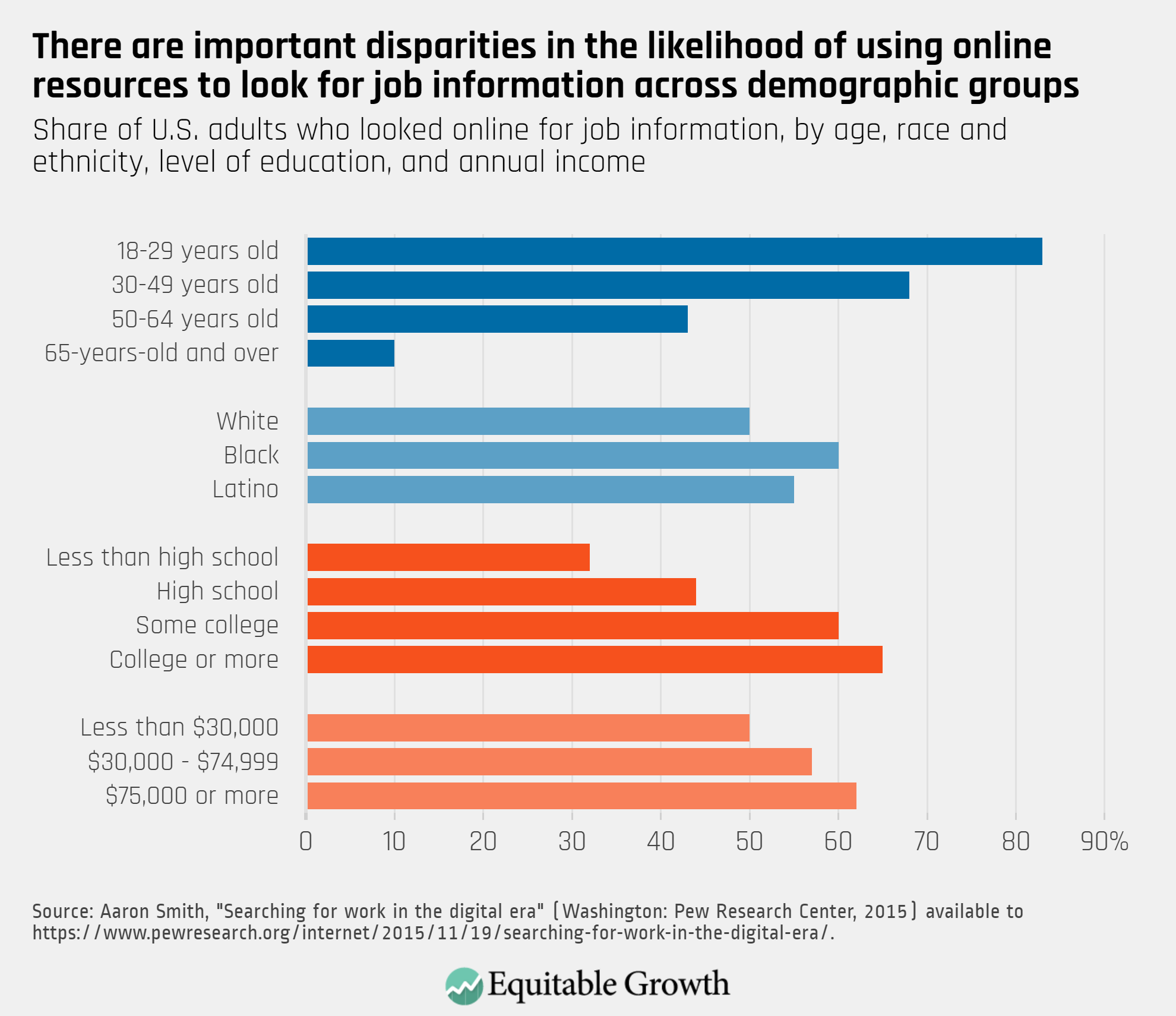
Share of U.S. adults who looked online for job information, by age, race and ethnicity, level of education, and annual income
Some of these differences are driven by disparities in access to high-speed internet since job-seekers without broadband are much less likely (opens in a new tab)to go online as part of their search. According to a recent study (opens in a new tab), in 2018, almost 45 percent of U.S. households with children and an annual income of less than $25,000 did not have high-speed internet at home. About a third of households with an income between $25,000 and $50,000 lacked access to high-speed internet. Conversely, only 8 percent of households with an annual income of more than $150,000 lacked this service. Across race and ethnicity, disparities are also stark, with American Indian and Alaska Native households experiencing the lowest rates of high-speed internet access. (See Figure 2.)
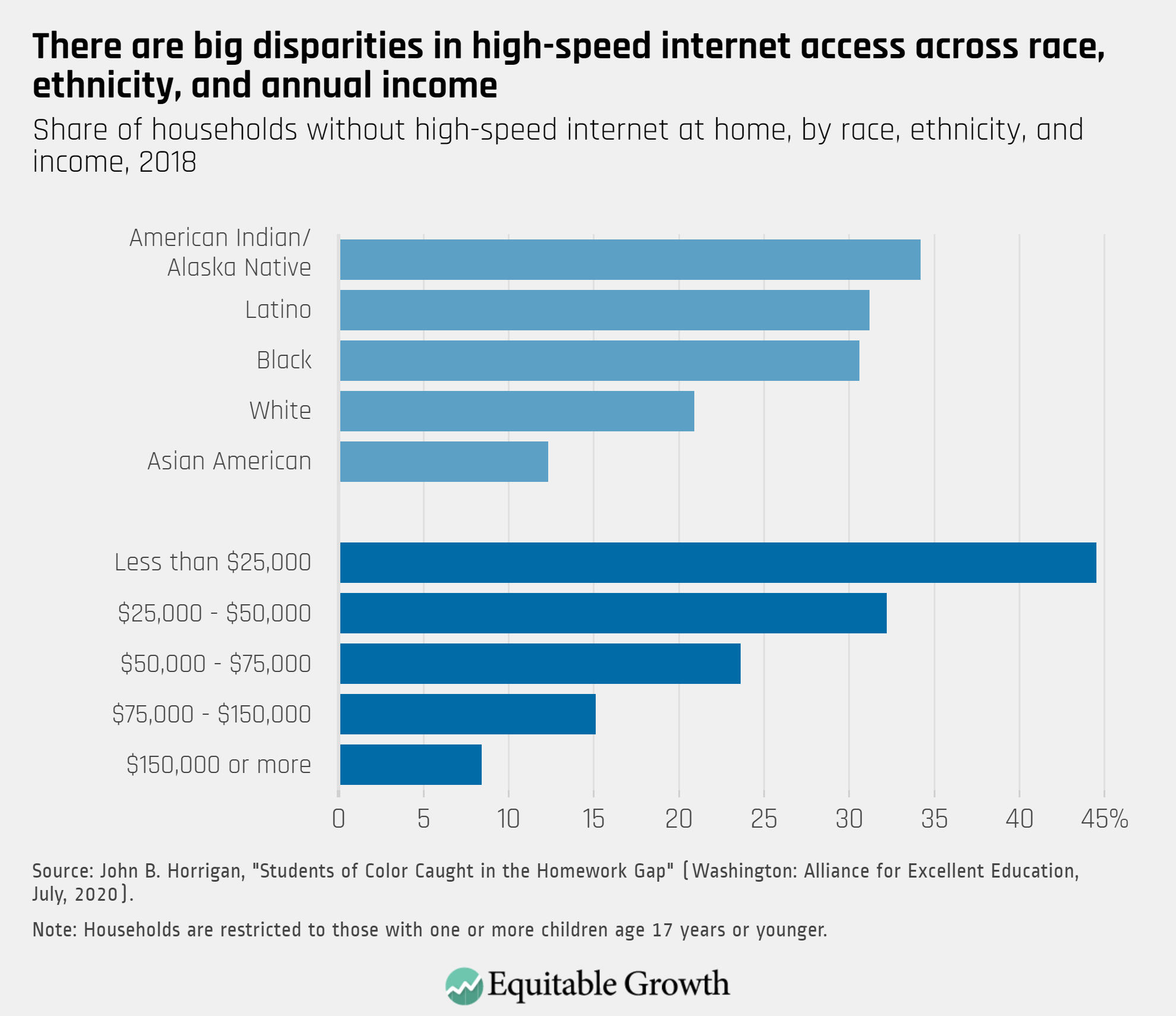
Share of households without high-speed internet at home, by race, ethnicity, and income, 2018
But job-seekers do not necessarily need either high-speed internet or even a desktop or laptop computer to go online to look for work. In 2015, more than a quarter (opens in a new tab) of U.S. adults had used their smartphones for job-seeking purposes. Of those smartphone job-seekers, 94 percent said they had used their phone to search for job listings, and at least 74 percent had used it to connect with a potential employer.
In addition, a substantial share of adults also reported using their phone for more complicated tasks. Among job-seekers using their smartphone, 50 percent had used it to complete a job application online, and 23 percent had used it to create a resume or write a cover letter.
Adults with lower levels of formal education were more likely (opens in a new tab) to rely on their smartphone for these more intricate steps in the job-search and application processes—a finding that reflects a disadvantage for job-seekers with lower levels of education since smartphone job-seekers are likely to run into problems, such as trying to access online content that is not smartphone-friendly or having trouble uploading supporting documents for a job application.
As internet use rose and online job search became an increasingly popular method to look for work across the United States, a quickly rising number of job-seekers believed that online job searching was a good way to find and apply for employment opportunities. An early survey finds (opens in a new tab) that the share of employed workers reporting that the internet was the primary method they used to get their current job skyrocketed from 6 percent in 2000 to 22 percent in 2002, lowering job-seekers’ reliance on more traditional search methods. As such, over those 2 years, the share of workers pointing to personal referrals as their main job-search method dropped from 56 percent to 44 percent, while reliance on newspaper ads fell from 27 percent to 24 percent.
While early studies generally find that online job searches did not improve (opens in a new tab) unemployed workers’ chances of landing a job, there is evidence that it was an effective job-search method for at least some candidates. In a study (opens in a new tab) using data from the early 2000s, economist Betsey Stevenson at the University of Michigan finds that internet use may have reduced the cost of searching for other opportunities for already-employed workers, thus making job switching more likely, reducing the probability of experiencing unemployment in the first place, and increasing their bargaining power.
Further, more recent research generally finds that those who use the internet for job-seeking purposes have higher job-finding rates than those who do not. Peter Kuhn at the University of California, Santa Barbara and Hani Mansour at the University of Colorado Denver find (opens in a new tab) that the effectiveness of online job search increased between 1998–2000 and 2008–2009. While internet job searches appeared to be counterproductive in the former period, the authors show that by 2008–2009, young jobless workers using the internet to look for opportunities experienced unemployment spells 25 percent shorter than otherwise-similar workers using more traditional search methods.
Similarly, research (opens in a new tab) using 2011 data by Jason Faberman and Mariana Kudlyak at the Federal Reserve Bank of Chicago finds that internet job search increased unemployed workers’ chances of finding a job within a year by 25 percent, compared to jobless workers who did not use the internet in their job searches.
The effectiveness of the internet as a job-search method that seemingly increased throughout the 2000s and early 2010s could be associated with improvements in the design of job boards, as well as with what economists and other social scientists call “network externalities” or “network effects (opens in a new tab).” In other words, a greater number and a wider variety of job ads got posted online and the user-experience of job-matching sites improved internet job searches such that they became a more valuable and efficient method (opens in a new tab) to look for work.
As online job searches became an increasingly prevalent way to look for work, scholars also wrote about the potential of the internet to have an effect on overall labor market trends and dynamics, such as aggregate unemployment and inequality in earnings and employment. Let’s look at each of these in turn.
By reducing search frictions and making it less costly for workers and firms to find each other, online job searches also were expected to influence economywide dynamics, such as the aggregate unemployment rate. For example, in 2000, UC Santa Barbara economist Kuhn writes (opens in a new tab):
Unless the increased efficiency of an Internet search draws large numbers of new workers into unemployment to look for new jobs, and unless both firms’ hiring standards and workers’ reservation wages rise by so much as to completely eliminate this first-order effect, the equilibrium unemployment rate should fall. (See page 43.)
In other words, by reducing search frictions and making it less costly for workers and firms to find each other, online job searches also were expected to influence economywide dynamics, such as the aggregate unemployment rate. Surprisingly, however, over the past 20 years or so, researchers have not found evidence (opens in a new tab) that job boards or other improvements in information technologies have had an effect on overall U.S. joblessness.
At least not yet. Research examining the internet’s effect on the Norwegian labor market (opens in a new tab), for example, finds that the roll-out of broadband infrastructure lowered the average duration of vacancies and lowered the percent of establishments with unfilled positions. It also led to higher job-finding rates and starting wages, and to a decline in the country’s unemployment rate.
Still, evidence points to U.S. unemployment rates not being particularly affected by online job searches. In one of the first studies analyzing the effect of online job search on local labor markets, Kory Kroft at the University of Toronto and Devin Pope at the University of Chicago examine (opens in a new tab) whether the expansion of Craigslist—a website in which users advertise jobs, apartment rentals, and items for sale—made the matching process in the job and apartment-rental markets more efficient. The authors find that as Craigslist was introduced into a city, there was a substantial decline in the number of vacant rental units.
This decline, Kroft and Pope propose, reflects that the introduction of the website led to an improvement in the matching process in the apartment rental market. In contrast, the expansion of Craigslist did not affect the labor market. While the website caused a shift away from print and toward online job ads, it did not have a meaningful effect on local unemployment rates.
There are a few potential reasons why online job search may lead to fewer unemployment episodes and shorter unemployment spells but not to a decline in aggregate joblessness. A team of researchers finds (opens in a new tab), for example, that use of broadband at home or at public locations, such as libraries, reduces the likelihood that unemployed workers become discouraged and drop out of the labor force altogether. As such, information obtained online could keep unemployed job-seekers from believing there are no employment opportunities available.
As a potential reason why Craigslist led to greater matching efficiency in the apartment and housing rental market but not in the labor market, Kroft and Pope propose that while online job posts are less expensive than posting a vacancy in print, online job ads might not substantially improve the information available for job-seekers. The reason, the authors suggest, is that the most valuable information about a vacancy—specific details about the position, such as salary level, benefits, company culture, and opportunities for growth—tends to be communicated during interviews or in other stages of the hiring process. Alternatively, any reduction in the unemployment rate could be offset if Craigslist led to greater competition for any given job opening by reducing the time and effort needed to search and apply for open positions.
Another potential explanation is that if there is not much frictional unemployment (opens in a new tab) in the economy to begin with, then the effects of the internet on the jobless rate will be limited. Then, there are the findings by Christine Fountain at Fordham University, who proposes (opens in a new tab) that while the proliferation of online job boards makes it easier for employers to reach more candidates and for workers to find more vacancies, the proliferation of information may come at the expense of its quality.
Contrary to UC Santa Barbara’s Kuhn and U-Colorado’s Mansour, Fountain argues that as more U.S. workers went online to look for work, online search became less effective as a job-search method. She argues that online search lost its usefulness among job candidates to signal their technological literacy to potential employers. Further, she posits that as the use of the internet for job-search purposes jumped, it created a potential problem for firms hoping to hire—too many applicants.
There are a few ways in which researchers had expected online job searches to either ameliorate or exacerbate economic inequality. First, if using the internet to look for work resulted in higher rates of workers finding new jobs and in more valuable employee-employer matches, then disparities in access to the internet would create further disadvantages for job-seekers who did not have access to high-quality online resources.
In addition, if more and better information made it cheaper for workers to switch jobs, then some researchers expected firms might have to increase pay for “star” workers in order to keep them from moving on to other jobs. Employers would therefore need to tie pay more closely to each worker’s productivity—a dynamic that would drive greater wage inequality (opens in a new tab). Or, if online job ads led to either an under- or over-qualified pool of candidates, then employers might have to rely more on personal referrals to hire, exacerbating the disparities (opens in a new tab) associated with using personal networks to look for and find work opportunities.
Conversely, other researchers proposed that internet search could ameliorate disparities in economic outcomes if online job platforms and other websites encouraged more employers to post wage and salary information for their open positions. Through greater pay transparency, the internet could lead to greater wage compression (opens in a new tab) since there is evidence that policies that encourage or mandate salary disclosure can lead to narrower gender pay divides (opens in a new tab), and can pressure employers into increasing pay (opens in a new tab) for workers who are unfairly undercompensated.
Currently, there is little empirical evidence on the relationship between inequality and online job searches specifically. But over the past few years, some studies have examined whether the expansion of internet services has an effect on labor market disparities. In a 2021 paper, for example, economist George Zuo at the RAND Corporation examines (opens in a new tab) how access to broadband affects low-income families. Zuo studies the roll-out of Comcast Corporation’s Internet Essentials (opens in a new tab)—a service that offers subsidized broadband to low-income households—finding that in places where the service is available, eligible individuals saw an increase in earnings and employment rates.
Similarly, a study by Hilal Atasoy at Rutgers Business School finds (opens in a new tab) that during the late 1990s and early 2000s, federal policy programs aimed at expanding broadband internet access led to a substantial increase in the employment rate, especially in rural areas. An important chunk—about 40 percent—of the estimated employment gains were driven by greater labor force participation, suggesting that a decline in job-search costs was one of the drivers of the increase in employment.
New research also suggests, however, that the returns to internet access can be unequal. In the same study (opens in a new tab), Atasoy finds that, all else being equal, the positive effect of broadband on employment was greater in counties and industries in which a larger share of the workforce had a college degree. Similarly, in a recent paper, Paolo Martellini at the University of Wisconsin-Madison and Guido Menzio at New York University propose (opens in a new tab) that search frictions have declined due to advances in communication and information technologies, leading to higher-quality worker-employer matches and greater labor productivity.
Yet Martellini and Menzio argue that the now-lower barriers to finding an appropriate job have benefited some workers more than others. Specifically, they find that:
For workers who are specialists—in the sense that their productivity varies a great deal across different jobs in their labor market—the decline in search frictions leads to high productivity and wage growth. For workers who are generalists—in the sense that their productivity is similar across different jobs—the decline in search frictions leads to minimal productivity and wage growth. Thus, declining search frictions leads to lower growth for “jacks of all trades” (the generalist workers) and higher growth for “masters of one trade” (the specialized workers). (See page 1.)
Prior to the passage of the Civil Rights Act of 1964 and other landmark anti-discrimination laws, such as the Age Discrimination in Employment Act of 1967, employers could—and often did (opens in a new tab)—overtly discriminate against candidates by specifying the age, race, gender, national origin, and other demographic characteristics required of job applicants. While U.S. law now bans employers (opens in a new tab) from posting job ads that either discourage or show preference for candidates due to their race, gender, or another protected characteristic, hiring discrimination remains a pervasive feature of the U.S. labor market. In addition, job-search platforms and other hiring intermediaries create new avenues for employers to discriminate (opens in a new tab) when advertising job openings online.
Social media platforms, for example, have a wealth of information about individuals and their online activities, and can enable hiring discrimination by either highlighting or hiding job ads from different groups of workers. A 2017 investigation by The New York Times and ProPublica finds (opens in a new tab) that big employers, such as Verizon Communications, Inc., The Goldman Sachs Group, Inc., and Target Corporation, used Facebook to promote job advertisings only in the feeds of younger users, excluding potential candidates age 40 or older.
Similarly, a recent analysis by The Brookings Institution finds (opens in a new tab) that while Facebook’s online ad service no longer allows for the targeting of members of specific affinity groups, the platform allows advertisers to target ads according to users’ online behavior and other interests. For instance, the social media platform offers the option to target “people who have expressed interest in or like pages related to African-American culture (opens in a new tab),” which the analysis found could be even more accurate in targeting African American users than previous demographic-based targeting options.
As the volume of online job postings grows, job-search platforms also play a more active role in the job-search and application processes, shifting from more passive job boards to providing more dynamic matching and recruiting services. Specifically, online job platforms actively mediate the job-search process (opens in a new tab) by recommending postings to candidates based on their resume or other attributes, suggesting recruitment targets to employers, and selecting which applicants to show or recommend to the company that is hiring. At each of these steps, the use of artificial intelligence and other predictive technologies can reproduce, exacerbate, or introduce (opens in a new tab) algorithmically based discrimination and bias (opens in a new tab) by race, ethnicity, gender, age, disability, or other characteristics throughout the search and application process (opens in a new tab).
While this issue brief focuses on the use of third-party job-search platforms and is limited to the job-search stage (as opposed to the application, interview, and hiring processes), the issues discussed here are also present in employer-developed recruitment (opens in a new tab) and hiring (opens in a new tab) processes. Indeed, exclusionary practices by employers, whether algorithmically driven or not, are likely reducing the likelihood of quality job matches and exacerbating harmful credentialism.
A recent report (opens in a new tab) by Joseph Fuller and Manjari Raman at Harvard Business School and Eva Sage-Gavin and Kristen Hines at Accenture suggests that automating recruiting and hiring systems that screen out qualified candidates is a widespread issue among middle- and large-sized companies. The authors note that such automated systems were designed to sort through large numbers of potential candidates quickly and efficiently, reducing costs and recruiter time, and often filter out or ignore qualified job-seekers based on overly restrictive, unrelated, or inflexible criteria.
The need to self-market on online job boards also can lead to the exclusion of and discrimination against some groups of workers. A report (opens in a new tab) by Data & Society finds that platforms such as Care.com, Handy, UrbanSitter.com, and Uber—platforms that serve as intermediaries between clients and workers—require that job-seekers have self-branding and social media skills in order to be visible to potential clients, creating challenges and barriers for workers who might not be as digitally fluent. These workers are disproportionately likely to be older workers, lower-income workers, Black or Latino workers, and workers who do not speak English as a first language. As such, the skills, tools, and resources needed to navigate online platforms can exacerbate disparities in the job-search process.
As recently as 2015, the McKinsey Global Institute, the research arm of the business consulting firm McKinsey, released a report (opens in a new tab) claiming that online job-search platforms, such as LinkedIn and Monster.com, had the potential to boost economic growth by allowing for more and better employee-employer matches, faster job creation, and by drawing more people into the labor force. Both because U.S. workers tend to switch jobs more often than workers in other high-income countries and because online “talent” platforms give job-seekers tools to search for opportunities more efficiently, the report argues, the productivity gains of online job search could be especially large for the United States.
So far, however, there is no clear evidence that either online job search or the internet more generally have made the worker-employer matching process more efficient or led to more competitive, better-functioning labor markets. The widespread use of online job search therefore seems to have ameliorated only some of the obstacles that make it difficult, costly, and time-consuming for workers to look for work while exacerbating other barriers.
That being said, most job-seekers in the United States now go online to look for work. Even when jobs do not require computer skills, the job-search and job application processes likely do. Because internet and computer access are now central to finding a job, guaranteeing access to affordable, high-speed internet (opens in a new tab) for all workers and families is essential for ensuring more equitable access to employment opportunities. It is especially important to ensure that low-income (opens in a new tab) households and households of color (opens in a new tab) have access to high-quality internet services. The Infrastructure Investment and Jobs Act, which was signed into law in late 2021, is an important step in the right direction, with billions of dollars in funds appropriated for broadband infrastructure (opens in a new tab).
In addition, the enforcement of anti-discrimination laws needs to account for recent developments in the job search, application, and recruiting processes. The greater volume of online job ads and applications has led to the increasing use of algorithms and artificial intelligence tools, allowing, in turn, for practices that both replicate existing discriminatory and exclusionary practices and introduce new ones. The federal Equal Employment Opportunity Commission—the country’s most important anti-discrimination enforcement agency—is taking essential first steps by, for example, launching initiatives (opens in a new tab) that look to educate employers, offer technical assistance, and identify promising practices to tackle algorithmic discrimination (opens in a new tab).
Beyond policies designed to improve technological integration into job-search processes, research also shows that a variety of other factors related to a worker’s bargaining power and economic security can lead to higher-quality matches and more equitable outcomes. In addition to increasing worker power and updating laws and regulations (opens in a new tab) to account for recent technological developments, social infrastructure remains one of the most effective tools for improving job searches in the presence of persistent frictions.
These social infrastructure programs should include Medicaid expansion (opens in a new tab), unemployment benefits, and other income support for those on the lower end of the income distribution. All of these programs—alongside child care, paid leave, and paid family and medical leave—enable U.S. workers to have the time and financial wherewithal to find the jobs that best suit their skills at the best pay scale—an important factor in building broad-based and sustained U.S. economic growth.
The broader structural frictions in the U.S. labor market that hinder competition also need to be addressed. Collective actions, such as strikes, and labor unions improve efficiency and social welfare in the U.S. labor market by reducing firms’ ability to set wages. But collective actions need the support of legislation and institutions, such as the National Labor Relations Board, in order to be most effective in leveling the playing field between workers and employers. Collective action also needs to be matched with antitrust enforcement and a pro-competition policy agenda to push back against labor market monopsony, alongside policies that enable the rebuilding of an inclusive labor union movement. Only then will advances in job-search technologies deliver gains for workers and the U.S. economy writ-large.
Reports AUG 18, 2021
By: Kathryn Zickuhr

Blog NOV 15, 2018
By: Will McGrew
Get updates on our latest research, event announcements, and policy insights delivered straight to your inbox. Stay connected with the leading voices on equitable growth.


