
Skip to content
Browse All Resources
Issue Briefs

SEP 16, 2021

Factsheet: What the research says about the economics of income support programs

Abstract

Sufficient income is one of the most important components of a stable and healthy household budget. Income support programs help ensure that U.S. households have the income they need to cover the basic expenses of daily life. Some income support is delivered through direct cash transfers, including in programs such as Temporary Assistance to Needy Families, Supplemental Security Income, Social Security Disability Income, and Unemployment Insurance, while others provide essential goods such as food or housing to families, thus freeing up existing household income to be used for other purposes.

Yet the COVID-19 crisis demonstrates that existing income support infrastructure in the United States is wholly insufficient in providing relief to those who needed it.85 Pandemic-specific income supports delivered through the Coronavirus Aid, Relief, and Economic Security, or CARES, Act and related programs successfully (opens in a new tab) blunted some of the worst pain of the coronavirus recession, but they failed to deliver for all who needed (opens in a new tab) income support due to sustained underinvestment in these vital programs over the past half-century.86

While both common sense and a robust body of literature (opens in a new tab) make clear that income support improves the economic well-being of the people who access it, it’s important not to overlook the effects these programs also have on the U.S. economy as a whole.87 This factsheet discusses the economic impacts of income support programs, who they reach, how racism prevents them from serving their economic function, and what policymakers can do about it, starting with the upcoming 2022 budget reconciliation negotiations.

The immediate economic impact of income support programs

  • During recessions, income support ensures people are still able to purchase goods and services, which softens the aggregate impact (opens in a new tab) of economic downturns on the U.S. economy.88 For every dollar spent on UI benefits during the Great Recession, there was an additional $1.61 (opens in a new tab) in economic activity, and for every dollar spent on the Supplemental Nutrition Assistance Program, there was an additional $1.74 (opens in a new tab) in economic activity.89
  • Most studies find that income support from state paid leave programs increases labor force participation among mothers. Under California’s paid leave law, for example, new mothers are estimated to be 18 percentage points (opens in a new tab) more likely to be working a year after the birth of their child.90
  • Other income support programs for families with children also boost labor force participation among mothers. A research review (opens in a new tab) by Taryn Morrissey of American University finds that providing income support to cover 10 percent of a household’s child care costs results in a 0.5 percent to 2.5 percent increase in mothers’ employment.91 Likewise, a study (opens in a new tab) of the 1986 Earned Income Tax Credit expansion finds that this expanded income support resulted in a 2.8 percentage point increase in the labor force participation rate of single women with children.92
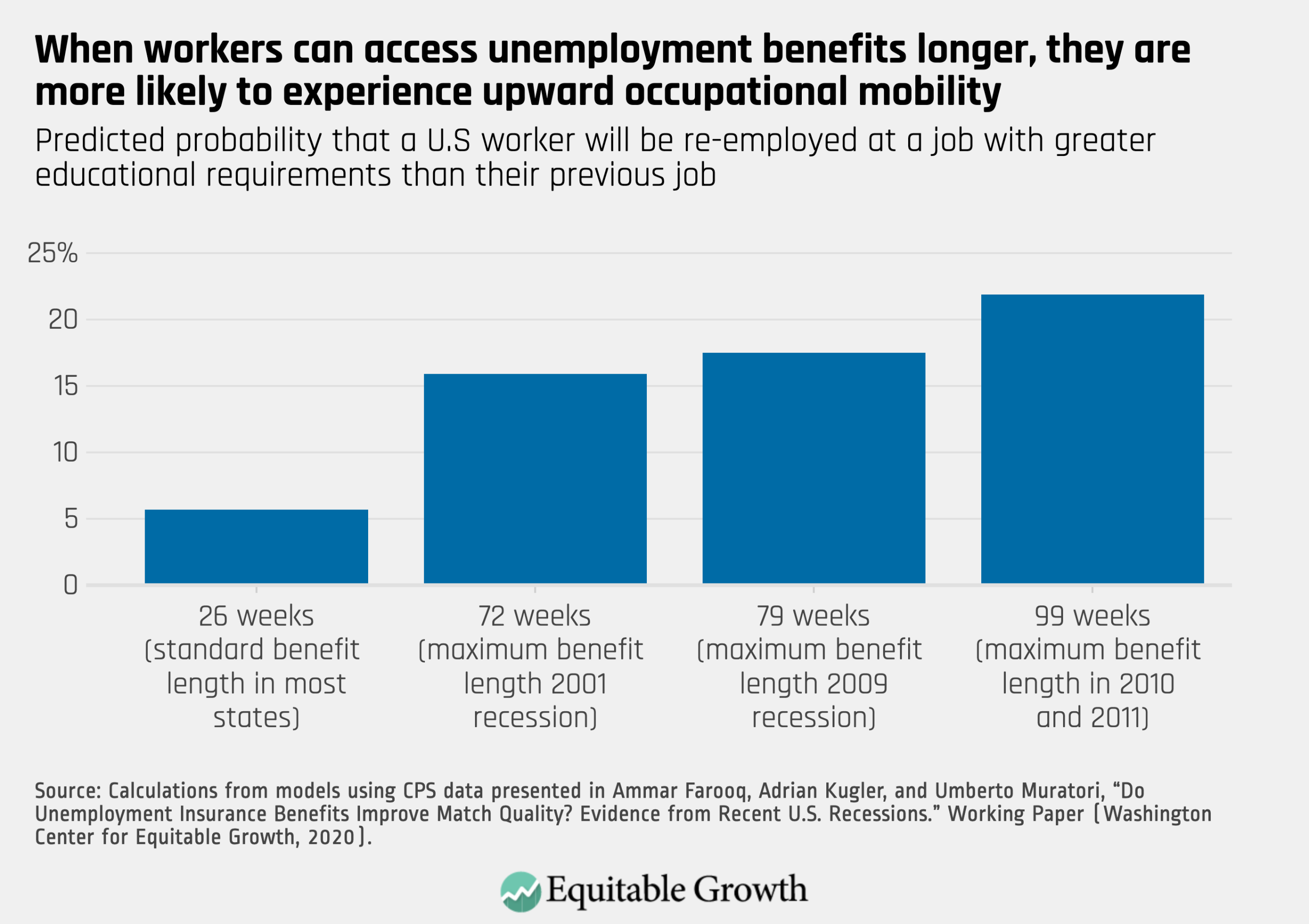
  • Income supports facilitate job matching, benefitting workers who find higher-paying jobs and firms that hire workers with the right skills for the job. Recent research finds that when U.S. workers have the income they need to meet their basic needs, they can take the time to find the right job for them, rather than taking the first work opportunity that comes along. For each additional week that a worker receives Unemployment Insurance, for example, the likelihood increases that they will be re-employed at a job that requires a higher level of education than their previous job.93 (See Figure 1.)

Predicted probability that a U.S. worker will be re-employed at a job with greater educational requirements than their previous job

  • These benefits extend to those who relocate because of a partner’s job, with one study finding a $4,500 annual wage difference between female “trailing spouses”—those who relocate because of a partner’s job—who live in a state that provides income support and similar women who live in states without the policy.94 This suggests that income supports help female trailing spouses match with jobs that will use their most highly compensated skills.

The benefits of income support programs for long-run economic growth

  • Income support programs develop the human capital of the next generation. For instance, an extra $1,000 from the Earned Income Tax Credit reduces the chance of a baby being born with low birth-weight (opens in a new tab)—a factor hindering brain development and overall health—which, in turn, translates into better educational outcomes later in life.95 Likewise, a study (opens in a new tab) on the mental and physical health outcomes of elementary school students whose parents had access to a state paid leave in California finds lower rates of attention deficit/hyperactivity disorder, obesity, ear infections, and hearing problems.96
  • Investing in children’s human capital development today means more educated and higher-earning workers in the future, spurring economic growth. In adulthood, people who accessed income support from the Supplemental Nutrition Assistance Program as children have statistically significantly higher scores on the human capital index, a measure that looks at years of schooling, degrees completed, and occupation type.97

Income support programs must be strengthened to realize their full economic potential

  • Strict eligibility requirements limit who is eligible for income support programs, limiting their reach. People can lose program eligibility because they get married, maintain a modest rainy day fund, or keep a reliable car. Additionally, many income support programs require a person to be employed in order to be eligible—despite the lack of income being a possible factor that is preventing (opens in a new tab) a person from maintaining employment.98 
  • Income support benefits are difficult to access even for those who are eligible, dampening their economic impact. Many people struggle to navigate state Unemployment Insurance websites, travel to Social Security Administration field offices (opens in a new tab) to complete disability applications, complete the paperwork necessary to recertify (opens in a new tab) for the Supplemental Nutrition Assistance Program, and correctly document (opens in a new tab) their work participation to remain eligible for the Temporary Assistance for Needy Families program.99
  • When access to income support is gained, benefits amounts are often very low, preventing them from serving as effective economic stabilizers. The income support provided by the Temporary Assistance to Needy Families program, for example, leaves a family of three (opens in a new tab) below half of the poverty line in almost every state and is time-limited, as its name suggests.100 Combined with eligibility and access limitations, this prevents (opens in a new tab) the use of this income support from increasing during recessions.101

Structural racism drives the weaknesses in U.S. income support programs

  • While some assume that the U.S. income support system is weak because few people need it, most people need income support at some point in their lives. Americans have a 54 percent chance (opens in a new tab) of experiencing poverty at least once during adulthood—more than the chance of having appendicitis (opens in a new tab) or getting divorced (opens in a new tab) over the course of a lifetime.102
  • In fact, almost everyone in every racial category uses income supports at some point. An Urban Institute study (opens in a new tab) finds that in any given month, nearly 1 in 5 people benefit from SNAP benefits, Supplemental Security Income, the TANF program, public or subsidized housing, the Women, Infants, and Children, or WIC, program, or the Child Care and Development Fund. A U.S. Treasury Department analysis also finds that nearly every single U.S. household (opens in a new tab) receives some form of income support, when one considers Medicare and Social Security.103
  • A large body of academic work (opens in a new tab) shows that racism weakens income support programs.104 Research (opens in a new tab) that compares social infrastructure in European countries with that of the United States finds that racism is a major reason why the United States spends less on income support than peer nations.105
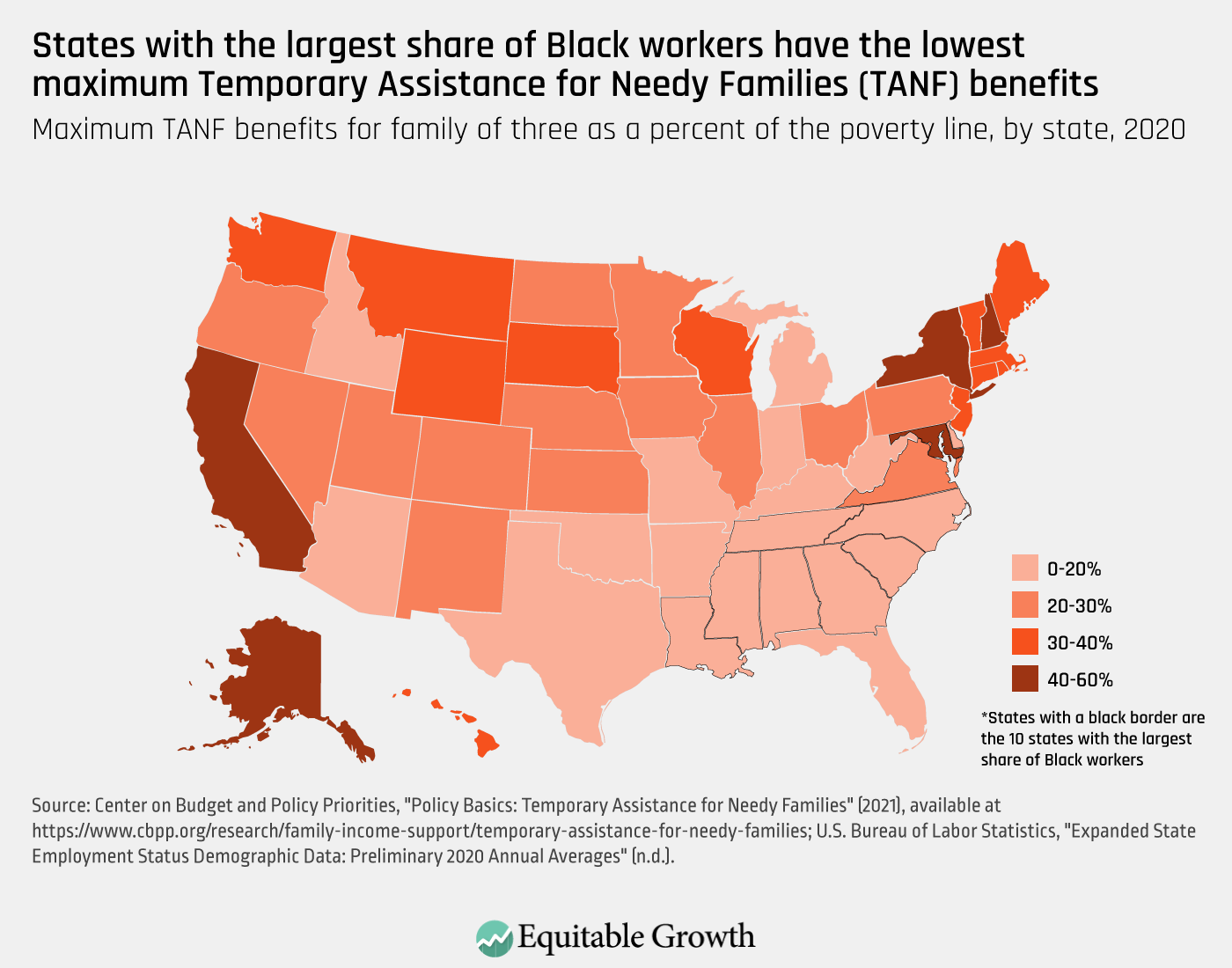
  • Within the United States, states with higher proportions of Black residents also provide less income support than other states. Research that compares U.S. states finds that states with a greater share of Black residents provide lower levels of income support through the Temporary Assistance to Needy Families program than states with fewer Black residents.106 (See Figure 2.)

Maximum TANF benefits for family of three as a percent of the poverty line, by state, 2020

Weaknesses in the U.S. system of income supports constrain and limit the overall strength of the U.S. economy, unnecessarily deepening recessions, depressing labor force participation, and harming future growth potential by underinvesting in the human capital of the next generation of workers. The inability to access income support programs to weather unexpected storms has serious consequences, especially for many workers of color, women, and their families. Indeed, the coronavirus recession exposed already-deep inequalities (opens in a new tab) in access to income supports along lines of race and gender.107

Policy solutions

There are several options for policymakers who want to remedy these weaknesses and build a system of income supports that will fulfill its potential to help the economy grow, including:

  • Enact a comprehensive paid family and medical leave program.
  • Extend the monthly, fully refundable Child Tax Credit.
  • Reform our Unemployment Insurance system (opens in a new tab) so that all workers can receive adequate benefits regardless of the state in which they live.108
  • Strengthen food, housing, and child care assistance programs.

The upcoming budget reconciliation negotiations offer a promising opportunity to enact these and other reforms to U.S. social infrastructure, including income support programs. These actions would not only benefit those U.S. workers and their families who need help the most, but also bolster the overall U.S. economy as it continues to recover from the coronavirus recession.

For more information, see Equitable Growth’s issue brief, “Weak income support infrastructure harms U.S. workers and their families and constrains economic growth.”

Related

Your Direct Line to Cutting-Edge Research

Get updates on our latest research, event announcements, and policy insights delivered straight to your inbox. Stay connected with the leading voices on equitable growth.