


Academic
Inequality of educational opportunity? Schools as mediators of the intergenerational transmission of income
Working Papers APR 23, 2018
By: Jesse Rothstein
Household Economic Security
 Browse All Resources
APR 19, 2023
By: Tyler Whittenberg and Jessica Alcantara
This column is the third in a series by guest authors examining systemic racial, ethnic, and gender inequities in the U.S. economy and in access to government social infrastructure and income support programs—inequities that hinder the full growth potential of our economy and the well-being of our society.
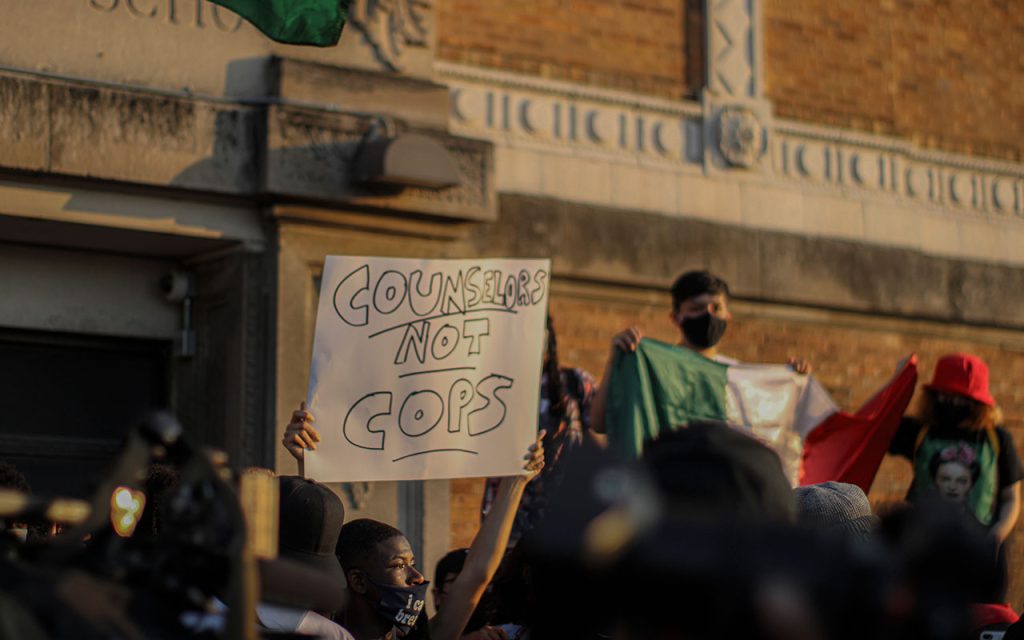
Assigning local police forces to U.S. public schools harms students economically, academically, and socially—especially Black students and other students of color. A large and growing body of data-driven research demonstrates that the misperceived benefits of what is essentially school security theater masks the far-reaching, long-term harmful consequences of empowering police in educational settings.
Such school policing is both ineffective at making schools safer, and is a primary driver of the school-to-prison pipeline—a web of policies and practices that directly and indirectly push students out of school and onto a pathway to the youth and adult criminal legal systems. School policing compounds the systemic underinvestment in other areas of public school education in disadvantaged communities.151 Recent research details how placing police in schools increases exclusionary (opens in a new tab) discipline (opens in a new tab).152 School policing also leads to more student arrests for minor behaviors (opens in a new tab) 153 while reducing instructional time (opens in a new tab),154 lowering student attendance (opens in a new tab)155 and impacting on-time graduation rates (opens in a new tab).156
This body of research more specifically demonstrates that students who are arrested at school face a series of collateral consequences (opens in a new tab) that harm their futures, their families, and their communities, including:
This body of research also demonstrates these economic, social, and educational disruptions make it more likely that students in schools where police are present will enter the criminal legal system as an adult (opens in a new tab).158 That likelihood, in turn, helps uphold the socioeconomic inequities determined by race and ethnicity (opens in a new tab) and the status quo harms of mass incarceration across the United States.159 This school-to-prison pipeline is a feature of the U.S. criminal legal system, and helps explain part of the growth in incarceration and its deleterious impact on people of color.160
Our column details the research on these thoroughly preventable outcomes and the misplaced idea that law enforcement has a role to play in our nation’s public schools. In fact, there are actionable evidence-based practices conducted by trained professionals who can help students with the support and care they need to navigate both adolescence and an unprecedented global health crisis.
School policing also disproportionately targets Black students (opens in a new tab).161 Research continues to demonstrate that Black students are arrested at higher rates when police are present in schools (opens in a new tab).162 Research in the area of office referrals, suspensions, and expulsions in public schools shows that Black students are not receiving disproportionate school disciplinary consequences due to higher rates of misbehavior. On the contrary, Black students do not misbehave (opens in a new tab) more than their White peers.163
Outcomes are even worse for Black girls in public schools. Research (opens in a new tab) by the U.S. Department of Education shows that Black girls are four times more likely than their White peers to be arrested, three times more likely to be referred to police, and two times more likely to be physically restrained.164
Moreover, policing students at school is ineffective and costly. Research (opens in a new tab) by the National Institutes of Health’s National Library of Medicine demonstrates that school police neither make schools safer nor avert school shootings.165 Instead, police in schools negatively affects (opens in a new tab) these schools’ climate and student safety.166 Heavily policed school atmospheres (opens in a new tab) can alienate and increase anxiety in students, create a sense of mistrust between peers, and result in adversarial relationships between students and school officials.167
Nonetheless, local and state governments, as well as the federal government, continue to spend millions of dollars on the school policing infrastructure. This includes school police officer salaries and benefits, weapons, surveillance technology, and expensive monetary settlements following instances of excessive force and abuse perpetrated on students by police in schools. Between 1999 and 2019, state and federal governments invested close to $2 billion on school police (opens in a new tab).168
Since the 2018 mass shooting at Stoneman Douglas High School in Parkland, Florida and the passing of the federal STOP School Violence Act, many states have begun their own school police grant programs to the tune of hundreds of millions more dollars for school police (opens in a new tab).169 This allocation of funding toward police comes in contrast to years of budget cuts to education spending in school districts across the country.
Placing police officers in schools also creates a significant threat to the physical and emotional safety of Black students and students with disabilities. A new study (opens in a new tab) by one of the authors of this column and his co-authors finds that of the 285 instances of school police officers physically and sexually assaulting students between the years 2011 and 2021, more than 80 percent of the victims of police assaults at school were Black students. Additionally, more than 25 percent of police assaults were on students with disabilities or students with reported mental health concerns.170
Black girls in particular were vastly overrepresented at nearly a third (30.7 percent) of all reported police assaults against students. Similar to the lack of police accountability that sparked protests following the murders (opens in a new tab) of Mike Brown, Breonna Taylor, and many others, this study also finds (opens in a new tab) that the offending officers suffered no consequences in well over half of the incidents. (See Figure 1.)
Figure 1
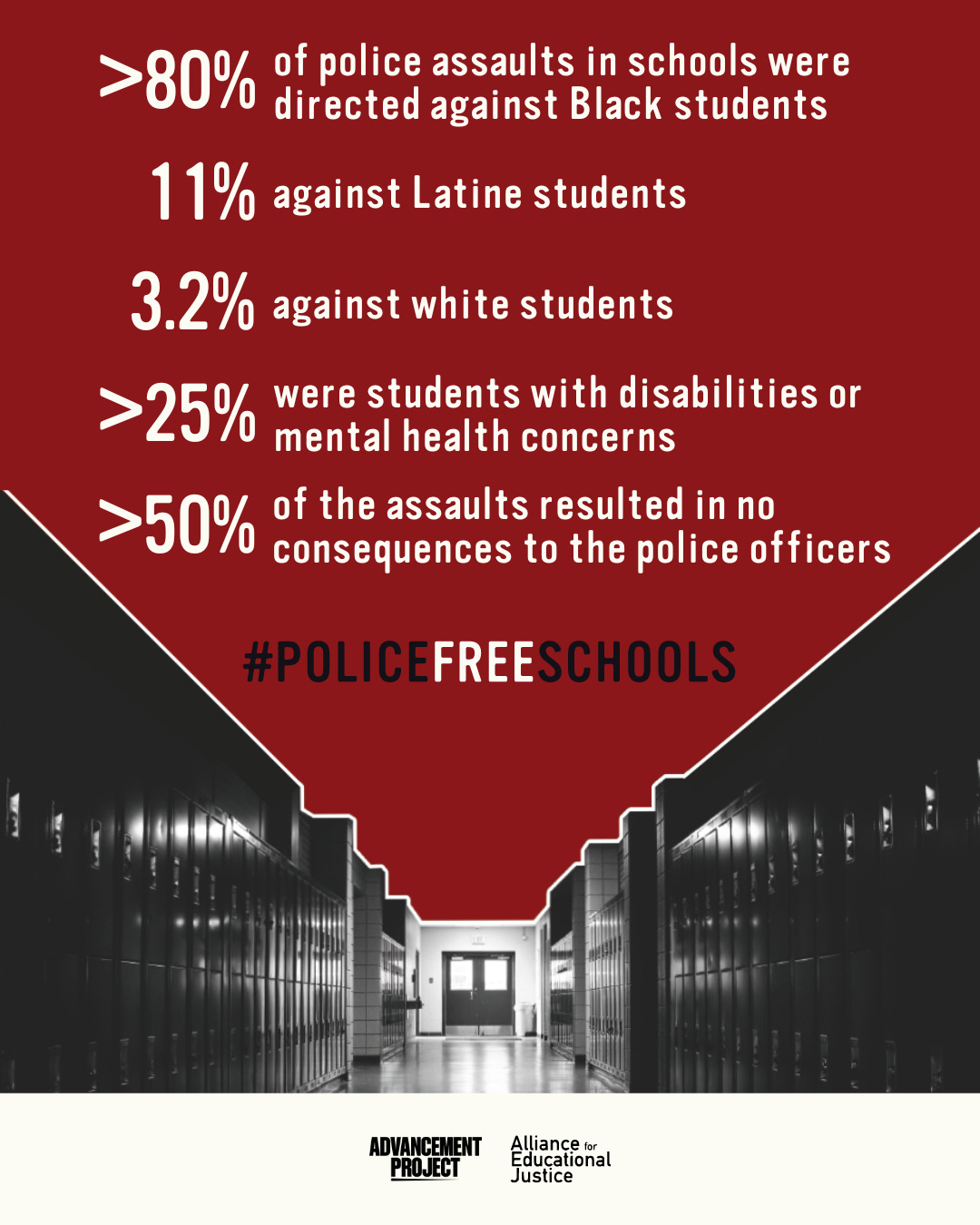
Assault At Infographic
Placing police in school and the growing trend of student surveillance merely creates the illusion of safety and security. There is no actual peer-reviewed evidence on the efficacy of surveillance measures being implemented in schools, including student device and social media monitoring, facial recognition, and weapons abatement technology. Instead, studies show that these technologies are flawed (opens in a new tab), and in many (opens in a new tab) cases (opens in a new tab), simply do not work (opens in a new tab).171
What’s more, government surveillance chills free speech (opens in a new tab) in public schools.172 Similar to the disproportionate impact of police in schools, these new surveillance technologies (opens in a new tab) place students of color, students with disabilities, and LGBTQ+ students at greater risk of harm, including exclusionary discipline and increased contact with law enforcement.173
Students need support and care as they attempt to navigate both adolescence and an unprecedented global health crisis. School police are incapable and ill equipped to meet students’ social, emotional, and mental health needs in this moment.
Instead, students’ needs should be met by implementing proven, evidence-based practices performed by individuals trained to support young people. These trained individuals include restorative justice practitioners, counselors, mental health practitioners, and other qualified support personnel who are regularly trained in trauma-informed, youth-centered practices.
In short, the treatment of student trauma requires holistic student support services that address the root causes of the issues students are facing, not policing or criminalization.
Ultimately, to achieve school safety and foster nurturing learning environments, school leaders and policymakers must implement strategies that create cultures of care that seek to prevent and repair harms, while also teaching students and staff how to be accountable for their actions.
—Tyler Whittenberg (opens in a new tab) is deputy director of the Opportunity to Learn Program at the Advancement Project. Jessica Alcantara (opens in a new tab) is senior staff attorney for the Opportunity to Learn Program at the Advancement Project. For more information about the national campaign to remove police from schools, visit www.policefreeschools.org.
Working Papers APR 23, 2018
By: Jesse Rothstein
Reports OCT 27, 2020
By: Robert Lynch
Get updates on our latest research, event announcements, and policy insights delivered straight to your inbox. Stay connected with the leading voices on equitable growth.


