
What happens to U.S. workers without access to Unemployment Insurance amid economic downturns or disruptions related to AI?
Essays SEP 2, 2026
By: Megan Rivera
APR 16, 2020
By: Sam Abbott
The current public health and economic crisis caused by the coronavirus pandemic is reshaping society and the U.S. labor force in ways not experienced since World War II. (opens in a new tab) Factories that previously made luxury products are being repurposed (opens in a new tab) to produce medical and sanitation supplies. Retired doctors and nurses are re-enlisting (opens in a new tab) in the fight against COVID-19, the disease spread by the new coronavirus. Meanwhile, hundreds of millions (opens in a new tab) of U.S. workers have been told to remain at home under public health ordinances, drawing comparisons to London during the blitz (opens in a new tab).
This rapid restructuring of the U.S. workforce is posing another challenge reminiscent of World War II: the need to provide essential workers with the childcare services required to efficiently protect and support families. These frontline workers, including all the nurses and doctors, grocery store and pharmacy workers, food processing and restaurant carry-out staff, truck delivery and taxicab drivers, transit workers, and first responders who are keeping the rest of us safe, fed, and transported need childcare support more than ever. Bold, wartime thinking was required to meet the childcare needs of the 1940s. Similar efforts may be warranted today.
The nation’s childcare system is undergoing simultaneous supply- and demand-side shocks. On the supply side, several states have ordered the vast majority of childcare centers closed (opens in a new tab) while some advocates are calling for further shutdowns (opens in a new tab) to help slow the spread of the new coronavirus. Even prior to the pandemic, the childcare industry was in a crisis (opens in a new tab) with dire economic implications. Most childcare businesses are very small, with 44 percent (opens in a new tab) of providers either self-employed or working for a private household. Profit margins in the industry are often razor thin, and the median wage for caregivers is only $11 an hour. (opens in a new tab) These types of low-wage workers are at particularly high economic risk (opens in a new tab) during the coronavirus recession.
On the demand side, parents who are still employed are now telecommuting and trying to juggle childcare, homeschooling, and their own day jobs. The role of the childcare industry in supporting the U.S. economy by freeing up parents’ time to engage in work has rarely been clearer. While many frontline workers still need access to childcare, the millions of Americans working from home or unemployed and looking for work have caused demand for childcare services, and the ability to pay for them, to rapidly decline.
As access, demand, and money for childcare has plummeted in recent weeks, there is significant concern as to whether the industry can weather the ongoing crisis. A recent member survey (opens in a new tab) by the National Association for the Education of Young Children finds that 30 percent of childcare providers could not survive a closure any longer than two weeks, and 49 percent are already losing income because families cannot afford care. This survey was conducted before the recent jaw-dropping spike in unemployment—further signs of a demand shock—was fully understood.
Just as the stability of the childcare industry is most precarious, first responders and other essential workers fighting COVID-19 need it more than ever. A recent analysis (opens in a new tab) by the Center for Economic and Policy Research shows that more than one-third of essential workers—those employed by grocery, convenience, and drug stores; public transit; shipping and logistics; cleaning services; healthcare; and childcare and social services—have a child at home. Nearly one-quarter earn less than 200 percent of the poverty line, meaning any childcare they could find would be difficult to afford without assistance.
Nationally, nearly 100,000 public schools (opens in a new tab)—a massive source of free care (and education) for children during the day—are closed, further complicating essential workers’ childcare needs. While the Families First Coronavirus Response Act—the second congressional action signed into law by President Donald Trump early last month—provides emergency caregiving leave for some parents dealing with these school closures, healthcare providers and first responders were excluded from this benefit.
Unfortunately, recent U.S. Department of Labor regulations (opens in a new tab) adopt a very broad definition (opens in a new tab) of workers who belong in these categories. The new rules carve out of the coverage many parents who should reasonably access these leave benefits.
There is no direct historical comparison for this rapid, complex shift in America’s caregiving needs. The closest may be the sudden expansion of women’s labor force participation in the 1940s as part of the nation’s WWII effort. Among women whose husbands were in the U.S. armed forces, labor force participation shot from 15.6 percent in 1940 to 52.5 percent in 1944. (opens in a new tab) This sudden shift in the labor force required a reorganization of home life and childcare arrangements when the modern childcare industry was still in its infancy.
The public response, as described in historian William M. Tuttle Jr.’s review of 1940s childcare policy (opens in a new tab), was a mix of moral panic and uncertainty (opens in a new tab) in the country’s ability to meet this need. For the first time, “latchkey” or “door key” kids (opens in a new tab) were part of the national conversation. Stories filled newspapers and congressional hearing rooms of children locked in cars and chained to trailers (opens in a new tab) while mothers went to work with no one home to watch their children. While some of these stories were certainly apocryphal, they spoke to a new source of national anxiety.
In response to these concerns, advocates and organizers engaged in practical, grassroots planning (opens in a new tab) to meet this new need, including calls for a national nursery school system (opens in a new tab). Tuttle Jr.’s review describes how, in the following years, the country embarked on a bold public and private expansion of childcare options to support mothers involved in the war effort.
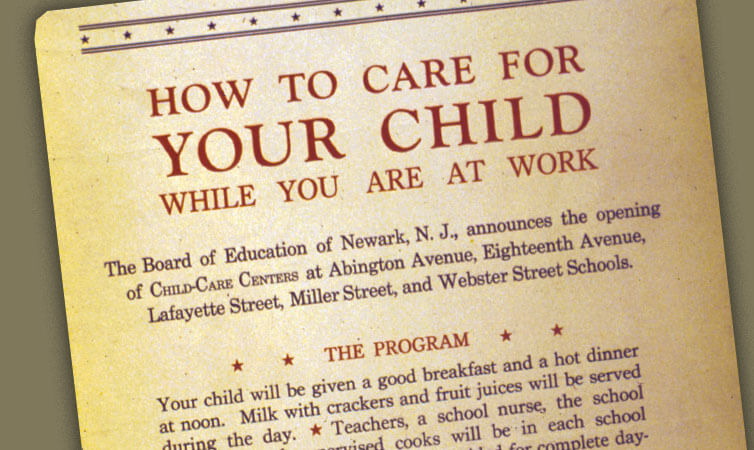
In many respects, the childcare system that emerged in the 1940s looked like the patchwork system of today. Most mothers relied on informal caregiving from family members, and private childcare centers opened across the country—often operated by firms (opens in a new tab) engaged in wartime production seeking to attract new female workers. By 1942, the Children’s Bureau (now under the jurisdiction of the U.S. Department of Health and Human Services) began issuing local grants for Extended School Services (opens in a new tab), which provided afternoon care for school-age children using communities’ existing infrastructure.
But the federal government’s boldest action, and biggest departure from today’s childcare system, was a short-lived experiment with universal, federally funded childcare centers. Using funds from the Defense Housing and Community Facilities and Services Act of 1940—popularly known as the Lanham Act (opens in a new tab)—the U.S. government funded childcare centers in more than 650 communities with defense industries across the country. Families were eligible to send their children to these Lanham Act centers, regardless of income (opens in a new tab), for a small fee. Adjusting for inflation, the cost to families was less than $11 per day.
Lanham Act centers were only widely available from 1943 to 1946, and not every child who needed care had access to a center. When soldiers, sailors, and marines returned home from the war, women were once again pushed out of the workforce, and the perceived need for childcare went with them. Despite the limitations of the program, a 2013 study (opens in a new tab) identified both short- and long-term benefits. Using U.S. census data, Arizona State University researcher Chris Herbst found that communities with access to high levels of Lanham center funding were associated with greater labor force participation for women and improved education and employment outcomes for their children in the decades following the war.
It is important to note that the Lanham Act was not designed as a childcare bill. It was a public works initiative intended to help local communities shore up the housing and infrastructure needs for communities with defense-related industrial production and for those engaged in the national defense. The federal government, however, understood that parents could not productively contribute to the war effort if they did not have someone to care for their children. Childcare was recognized as just as important as a roof overhead or a road connecting homes to factories, and the government responded accordingly.
This wartime commitment to childcare is critical in the current war against COVID-19, particularly at a time when having grandparents babysit is no longer a safe option and school-based care is temporarily closed. While a universal, Lanham-type effort may not be feasible or appropriate during the current pandemic, governments across the country are not out of options.
Essays SEP 2, 2026
By: Megan Rivera
Essays AUG 31, 2026
By: Christopher Bangert-Drowns
Essays AUG 14, 2026
By: Carlos Fernando Avenancio-Leon
Get updates on our latest research, event announcements, and policy insights delivered straight to your inbox. Stay connected with the leading voices on equitable growth.