



Policy
What Work Does Generative AI Do?
Essays SEP 8, 2026
By: Alexander Bick, Adam Blandin, David Deming, Tyler Schumacher
AI, Tech & Energy
Labor, Wages & Worker Power
 Browse All Resources
MAY 1, 2020
Recent worker uprisings across the United States in reaction to unsafe working conditions in factories, warehouses, and stores amid the coronavirus pandemic are drawing new and timely attention to the inadequate labor standards endured by many in the U.S. labor force. This decline in standards—ongoing for decades due to an array of economic, social, and political pressures—steadily eroded job quality, fair pay, and workers’ say in their own workplaces. Many workers have experienced this squeeze, but the effects have been uneven, reflecting longstanding inequalities across race, ethnicity, and gender.
As a result, large segments of the U.S. workforce have been hit particularly hard by the coronavirus pandemic, the COVID-19 disease that the virus spreads, and the economic consequences of the swift descent of the U.S. economy into recession. Today, workers without basic protections against the health and economic risks they now face and without meaningful input into workplace decisions are bearing the brunt of the harm and the dangers in workplaces across the nation.
Some of these essential workers are now staging collective actions to demand hazard pay, greater say in workplace safety standards, and protective gear—building on the large-scale collective action by teachers and other workers over the past 2 years. These actions are becoming more and more frequent, and are expected to be amplified across the country today, on May Day, the traditional International Workers’ Day.
In this issue brief, we explain how these protests demonstrate the continued power of workplace action in the United States. We also explore how those protests reveal longstanding barriers to workers’ voices being heard and workers organizing to improve the safety of their workplaces and the pay they deserve. We conclude by arguing that policymakers should prioritize efforts that more effectively center the voice of workers and rebuild possibilities for workers to organize in response to the ongoing public health and economic crises.
Essential workers are doing the nation a great service. Policymakers should act now to limit the risks to their health and well-being by empowering them to demand what they need to work more safely and earn what they need to take care of themselves and their families.
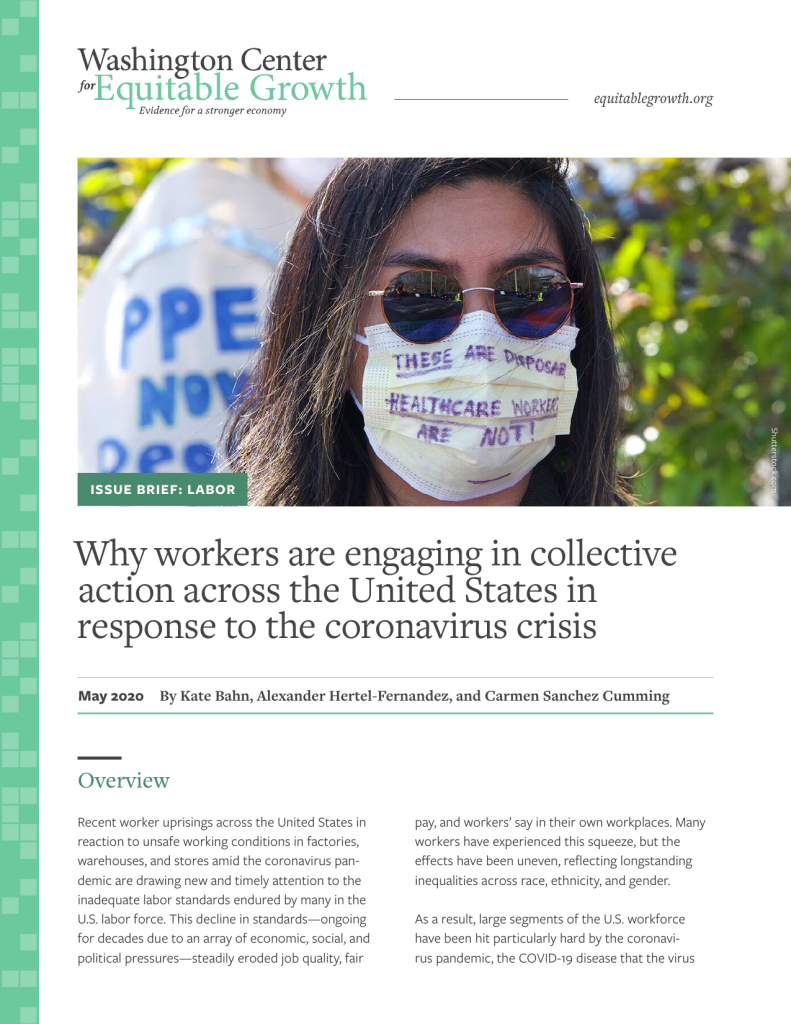
Across the United States (opens in a new tab), essential workers are coming together and organizing collective actions to demand safe working conditions and fair pay. These essential workers are helping to keep us safe in quarantine—from nurses and health aides who care for the sick, to grocery clerks and delivery drivers who make it possible for the rest of us to social distance. Yet far too many of these workers are raising concerns that they do not have the protections they need to do those jobs safely.
In late April, members of National Nurses United—the largest union of registered nurses in the country—held a protest (opens in a new tab) outside the White House over lack of access to protective gear, also known as protective personal equipment, or PPE. The nurses called on the Occupational Health and Safety Administration, the federal agency inside the U.S. Department of Labor tasked with enforcing workplace health and safety rules, to issue a federal emergency safety standard to guarantee their access to PPE.
Similarly, since early March, many grocery store and fast food workers have organized work stoppages (opens in a new tab) over health concerns, pushing for adequate sanitation measures, hazard pay, and access to paid sick leave. So, too, have warehouse workers, who have also gone on strike (opens in a new tab) after learning that their co-workers tested positive for the coronavirus—yet their employers were doing little to shield workers against infection.
These collective actions are producing important gains for U.S. workers. Since walking off the job due to concerns over a lack of social distancing policies in processing plants, workers at Perdue Farms Inc. And Refresco B.V. are now receiving (opens in a new tab) some form of protective equipment and hazard pay. After weeks of discouraging employees from wearing face masks, large retail chains operated by Target Corporation and Walmart Inc. Announced they would start supplying (opens in a new tab) basic protective gear to their workers. Amid a wave of nationwide strikes, Amazon.com temporarily raised pay (opens in a new tab) by $2 per hour and doubled overtime compensation for delivery and warehouse workers. And after a brief strike (opens in a new tab), bus drivers in Detroit got the city government to boost sanitation measures for public transit workers.
The health benefits of these actions often go beyond the protesting workers themselves to protect the public as a whole. When essential workers have adequate equipment and safety protocols in place, they are less likely to transmit the coronavirus within their communities. And in other cases, workers are advocating for changes to public policy that would affect all customers. One case in point: The United Food and Commercial Workers Union is calling (opens in a new tab) on the Centers for Disease Control and Prevention to issue mandatory sanitation standards for grocery stores and food processing plants. These measures would not only protect workers and their families but also the health of consumers while simultaneously maintaining resilient food supply chains (opens in a new tab).
So far, federal guidelines on how businesses should operate during the current pandemic, including safety protocols and enforcement mechanisms, are not mandatory. That leaves coronavirus-related health and safety standards largely up to the discretion of employers (opens in a new tab). In turn, that makes collective pressure by workers all the more important for public safety.
Collective action during the crisis may also be especially important (opens in a new tab) for historically disadvantaged workers. That is because many of the positions classified as essential are disproportionately (opens in a new tab) held by women and workers of color, who are less likely than their white and male counterparts to have the resources to weather a loss (opens in a new tab) of income or have a safety net to fall back on if they get sick.
Some researchers’ estimates find that 52 percent (opens in a new tab) of jobs classified as essential are held by women. More than half (opens in a new tab) of nursing assistants—whose positions are among the lowest paid (opens in a new tab) and most exposed (opens in a new tab) to workplace injuries and illnesses in the healthcare industry—are women of color. As a result of their weak economic position when the coronavirus pandemic upended the U.S. economy, these workers may not be in a position to decline work, even if it is unsafe or risky. Collective action can ensure that these workers do not have to make that decision.
Many factors have contributed to the decline in labor unions over the past half century. But it does not reflect a decline in worker’s demand for unions. If anything, a greater proportion of nonunion workers report wanting a union today than in previous decades. Survey research indicates that nearly half (opens in a new tab) of nonunion workers in 2017 reported wanting a union at their job. Indeed, even larger proportions of workers would be willing to pay dues and join labor organizations that include or go beyond the structure of traditional unions.
Instead, an especially important driver of the decline of unions is our nation’s outdated and poorly enforced labor laws. U.S. labor rules make it increasingly difficult for workers to form unions and easy for employers to oppose union drives, which businesses do aggressively. Recent research by the Economic Policy Institute estimates (opens in a new tab) that private-sector employers have been charged with violating labor law in more than 40 percent of union elections in recent years. Violations include the illegal firing of union organizers and threats, coercion, or retaliation against union supporters.
Indeed, U.S. employers are willing to break the law because penalties for doing so are low and slow to be enforced. Between 1998 and 2008, for example, it generally took the National Labor Relations Board—the federal body responsible for overseeing private-sector union drives—500 days to decide (opens in a new tab) unfair labor practice contested cases, an almost 280 percent increase with respect to the 1960s and 1970s.
U.S. labor laws are also increasingly misaligned with the structure of our current workforce. Unlike other industrialized countries, our labor laws do not (opens in a new tab) establish mechanisms that allow workers to organize or bargain at the industrywide level. That mismatch is relevant because an increasing number of companies engage in domestic outsourcing, whereby workers are employed by a subcontractor or franchisee of a lead firm. Because outsourced workers are legally employed by a franchise owner or subcontractor, workers cannot bargain with the lead business that has ultimate control over working conditions and reaps the largest profits. Outsourced employment additionally shields lead firms from legal liability when labor standards are violated.
Compared to other countries, U.S. labor law also sharply restricts the right of private-sector workers to go on strike. That is significant because strikes have been (opens in a new tab) one of the most powerful tools that workers possess to raise their pay and improve working conditions. One especially important legal limitation, passed as part of the 1947 Taft-Hartley Act (opens in a new tab), prohibits secondary boycotts and picketing. Secondary protests involve worker actions against a business that is not a worker’s direct employer. This provision has proved especially restrictive in the increasingly “fissured” U.S. workplace because more workers are no longer legally employed by the companies that exert ultimate control over working conditions.
Aside from limits on secondary protests, research (opens in a new tab) by economist Mark Stelzner of Connecticut College identifies several other drivers behind declining strike rates in the United States since the 1970s, especially a greater willingness of employers to permanently replace striking workers. This is a practice that was virtually unheard-of until (opens in a new tab) the 1980s. In an Equitable Growth working paper, Mark Stelzner, along with economist Mark Paul of the New College of Florida, demonstrate how reduced governmental support for unions and strikes reduces the potential benefits of engaging in collective action and increases employers’ ability to exercise their monopsony power by exploiting workers.
Against all of these obstacles, strikes have surged in the past 2 years. In both 2018 and 2019, almost half a million workers were involved (opens in a new tab) in large-scale work stoppages—numbers not seen since the late 1980s. This includes the current coronavirus-related protests, but also earlier actions in the Red4Ed teacher strikes that swept the country in early 2019.
Why have we seen this return to mass strikes, even as workers face substantial legal and economic barriers to labor action? One important reason is the way tat workers are increasingly learning from one another about the potential gains from labor action. At a time when only 10 percent of workers are in a union, most Americans do not have much personal exposure to the labor movement. Surveys suggest that only about 30 percent to 40 percent of workers report having a close friend or a family member in a union. That means that unions—and labor collective action in general—are often an abstract concept for many.
It should come as no surprise, then, that only 1 out of every 10 workers not currently in a union say that they would know how to form a union. An important effect of large-scale strikes is to show other workers what labor action looks like—and what collective action might accomplish at their own jobs.
In the case of the 2018–19 teacher strikes, initial actions in West Virginia—the first state with large-scale school strikes—helped spark interest in other states. Teachers in Kentucky, Oklahoma, and Arizona, working under similarly difficult conditions of low pay, meager benefits, and inadequate education spending, saw what West Virginian teachers had accomplished and asked (opens in a new tab) themselves if they could achieve the same. Both interest and strategy flowed quickly across state lines.
Interest in collective action also extended beyond educators. Research (opens in a new tab) on the large-scale teachers strikes from 2018 found that parents with firsthand exposure to the strikes became more interested in collective action themselves at their own jobs. Notably, the effect of the strikes was largest for parents who were least likely to be supportive of unions—conservatives, Republicans, and those without friends or family members in the labor movement.
We are observing something similar with the strikes sparked by the coronavirus pandemic and ensuing economic recession today. Recent polling by one of us (Hertel-Fernandez), conducted with Luke Elliott-Negri at the City University of New York and Columbia University’s Suresh Naidu, Adam Reich, and Patrick Youngblood, suggests that delivery workers who had been following the initial protests and strikes were substantially more likely to say that they were interested in taking collective action themselves.
In a March 29 to April 11 survey of more than 600 platform-based delivery workers recruited from Facebook ads, more than two-thirds of respondents said that they had been following news about coronavirus-related protests. Those workers, in turn, were more than 30 percent more likely to say that they were interested in going on strike, compared to workers who hadn’t been following the strikes. What’s more, workers who had been following the strikes also were more than 50 percent more likely to say that they had already been on strike themselves.
These data cannot say whether media exposure caused greater interest among workers to go on strike. But the data are strongly suggestive of the same pattern from the teacher strikes—initial actions and their subsequent coverage in the media are leading other workers to become interested in collective action themselves. That can help to explain why U.S. workplaces are experiencing the spread of strikes even as U.S. labor laws make it very challenging for workers to exercise collective voice through strikes or unions.
Essays SEP 8, 2026
By: Alexander Bick, Adam Blandin, David Deming, Tyler Schumacher
Working Papers SEP 8, 2026
By: Alexander Bick, Adam Blandin, David Deming, Tyler Schumacher

Essays SEP 2, 2026
By: Megan Rivera
Get updates on our latest research, event announcements, and policy insights delivered straight to your inbox. Stay connected with the leading voices on equitable growth.


