



Policy
What Work Does Generative AI Do?
Essays SEP 8, 2026
By: Alexander Bick, Adam Blandin, David Deming, Tyler Schumacher
AI, Tech & Energy
Labor, Wages & Worker Power
 Browse All Resources
DEC 18, 2020

This is a post we publish each Friday with links to articles that touch on economic inequality and growth. The first section is a round-up of what Equitable Growth published this week and the second is relevant and interesting articles we’re highlighting from elsewhere. We won’t be the first to share these articles, but we hope by taking a look back at the whole week, we can put them in context.
With coronavirus cases on the rise again, it appears the recession caused by the pandemic isn’t going anywhere. What does this mean for workers and their families? New research studies the effects of job losses on economic and psychological well-being, particularly for vulnerable households. One of the working paper’s authors, Ariel Kalil, explains the nuanced findings of the study, which showed the coronavirus having both negative and positive effects for mothers and their children. Essentially, Kalil writes, it boils down to whether mothers lose their income due to the pandemic. Those who lost their jobs—and with it a significant share of household income—are experiencing more stress and depressive symptoms, while those who are able to continue working or who got laid off but have not lost significant household income (thanks to unemployment benefits, stimulus checks, or a partner working more hours to make up for the lost earnings) are reporting better mental health outcomes and more quality time spent with their children. Improving parent-child interactions affects children’s economic, social, and educational outcomes down the road and thus has long-term implications. The study highlights that employment status may not matter as much as loss of income for parents’ well-being, Kalil concludes, as well as the importance for parents of having quality time to spend with children—important findings that U.S. policymakers should keep in mind as they craft solutions to current challenges.
Each month, Equitable Growth highlights scholars in our network who are working to understand how inequality affects economic growth and stability, in a series called Expert Focus. This month, Christian Edlagan and Maria Monroe look at researchers studying market organization and the effects of firms’ behaviors on growth and distribution. From antitrust law and competition policy to market structure and industry organization, these academics are working to explain the relationship between inequality, market power, and economic growth.
Brad DeLong’s latest Worthy Reads (opens in a new tab) highlights must-read content from Equitable Growth and around the web.
In case you missed it, Equitable Growth launched our 2021 Request for Proposals on November 30. For more information on what topics and types of research we are interested in funding, who can apply, and deadlines and instructions for submitting a proposal, head to the RFP page on our website.
It has been months since the U.S. Congress passed a coronavirus relief package, and many of the emergency programs that were included in the previous bill are set to expire this month. Even if policymakers are able to push through another round of relief, at this point, many workers will face a gap in coverage that could have dire consequences. Vox’s Emily Stewart (opens in a new tab) explains (opens in a new tab) that up to 4 million unemployed workers have already had benefits dry up, which means these vulnerable workers are potentially facing eviction, hunger, poverty, or other crises, including mental health issues, in addition to joblessness. Stewart shows (opens in a new tab) why the procrastination of some U.S. policymakers on coronavirus relief has led to this situation and why there will almost certainly be a delay in distribution even if a bill were to pass right now—thanks in part to complicated bureaucracy procedures that put up unnecessary hurdles.
As average U.S. workers and their families struggle to get by and small businesses close their doors, a new analysis (opens in a new tab) in The Washington Post finds that 45 of the 50 largest U.S. companies have turned a profit since March, when the coronavirus pandemic and recession reached the United States. Douglas MacMillan (opens in a new tab), Peter Whoriskey (opens in a new tab), and Jonathan O’Connell (opens in a new tab) detail how these big companies have laid off thousands of workers while raking in profits and making shareholders richer during some of the most volatile months in modern history—and despite many of them making promises to protect workers. Even in hard-hit sectors such as restaurants, travel, and hospitality, the authors write (opens in a new tab), many of the biggest companies were protected from the worst of the virus’ effects as smaller, independent businesses were devastated and shuttered, which has led to troublesome market concentration in many areas and industries. The analysis (opens in a new tab) underscores yet another long-lasting contribution the coronavirus recession will have on ever-growing economic inequality in the United States.
New research (opens in a new tab) shows that tax cuts for wealthy people did not, in fact, promote economic growth for all. Though many trickle-down economists argue that lowering taxes on the highest-income individuals and families has widespread benefits for all, in reality, these cuts are shown to only help those directly affected. Bloomberg’s Craig Stirling (opens in a new tab) looks at a recently published study of the fiscal policies and economic conditions in 18 countries over the past 50 years, revealing (opens in a new tab) that these policies served mostly to make the wealthiest even more wealthy, without boosting economic growth or creating jobs for those further down the economic ladder. As a result, the study’s authors make clear, policymakers needn’t worry about the economic effects of increasing taxes on the rich to cover, for instance, the high costs of the coronavirus pandemic and recession.
Friday figure
View FullscreenFriday figure — opens in a new tab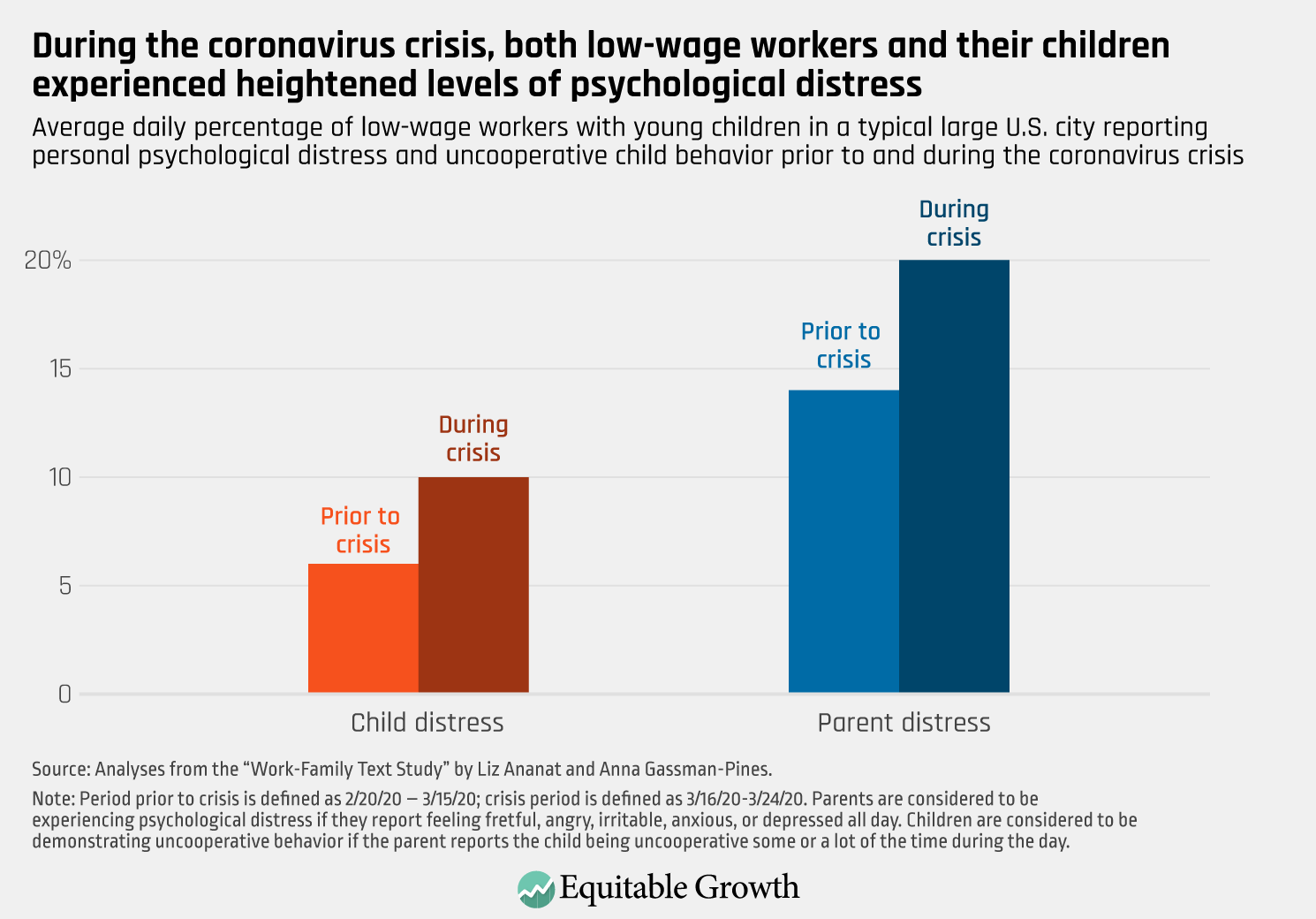
Average daily percentage of low-wage workers with young children in a typical large U.S. city reporting personal psychological distress and uncooperative child behavior prior to and during the coronavirus crisis
Figure is from Equitable Growth’s April 2020 post, “How the coronavirus pandemic is harming family well-being for U.S. low-wage workers” by Alix Gould-Werth and Raksha Kopparam.
Essays SEP 8, 2026
By: Alexander Bick, Adam Blandin, David Deming, Tyler Schumacher

Essays SEP 2, 2026
By: Megan Rivera
Essays AUG 31, 2026
By: Christopher Bangert-Drowns
Get updates on our latest research, event announcements, and policy insights delivered straight to your inbox. Stay connected with the leading voices on equitable growth.


