



Policy
What Work Does Generative AI Do?
Essays SEP 8, 2026
By: Alexander Bick, Adam Blandin, David Deming, Tyler Schumacher
AI, Tech & Energy
Labor, Wages & Worker Power
 Browse All Resources
JAN 28, 2025


Shutterstock
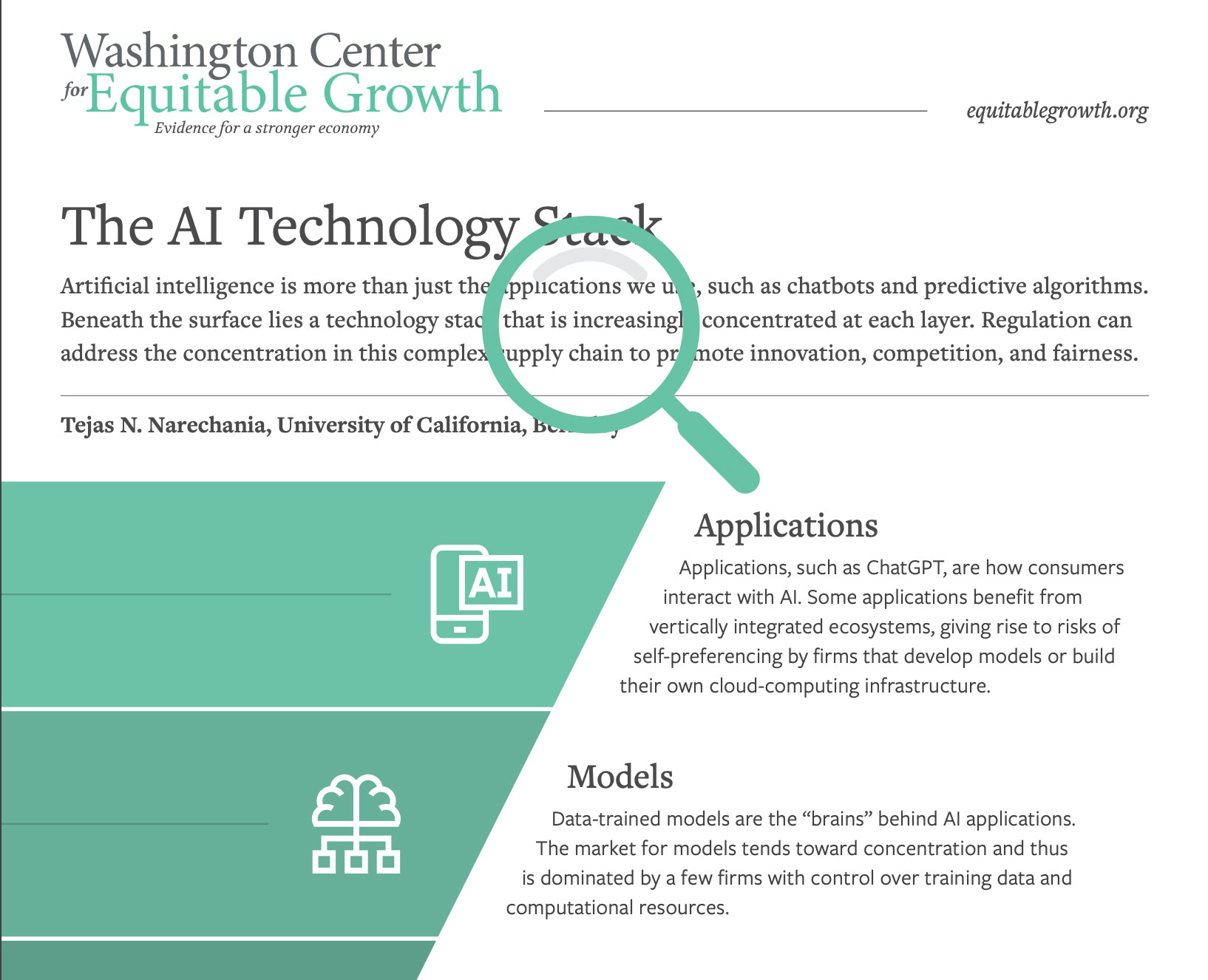
Artificial intelligence is more than just the applications we use, such as chatbots and predictive algorithms. Beneath the surface of AI lies a technology stack that is increasingly concentrated at each layer. (Click on the graphic below (opens in a new tab).)
Government regulation can address the concentration in this complex supply chain to promote innovation, competition, and fairness. Key considerations for policymakers include:
Tejas N. Narechania is a professor of law at the University of California, Berkeley, School of Law and a faculty co-director of the Berkeley Center for Law & Technology. His scholarly focus is on the institutions of technology law and policy, among other subjects. Before joining Berkeley Law, Narechania clerked for Justice Stephen G. Breyer of the U.S. Supreme Court and for Judge Diane P. Wood of the U.S. Court of Appeals for the Seventh Circuit. He also has advised the Federal Communications Commission on network neutrality matters and served as special counsel at the FCC from 2012–2013.
 Did you find this content informative and engaging?
Get Updates
Did you find this content informative and engaging?
Get Updates
Essays SEP 8, 2026
By: Alexander Bick, Adam Blandin, David Deming, Tyler Schumacher
Working Papers SEP 8, 2026
By: Alexander Bick, Adam Blandin, David Deming, Tyler Schumacher
Essays SEP 2, 2026
By: Megan Rivera
Get updates on our latest research, event announcements, and policy insights delivered straight to your inbox. Stay connected with the leading voices on equitable growth.


