


Policy
The costs of the Trump administration’s tariffs diverge for countries and industries so far in 2026
Essays JUL 14, 2026
By: Christopher Bangert-Drowns
Macroeconomics & Economic Measurement
Taxation
 Browse All Resources
SEP 22, 2026
President Donald Trump continues to escalate his administration’s perplexing trade spat with Canada through the expanded use of novel tariff powers in Section 338 (opens in a new tab) of the Tariff Act of 1930. This escalation—through the outright banning of certain Canadian exports to the United States, including dairy (opens in a new tab) and alcoholic beverage (opens in a new tab) products, set to take effect on September 29—suggests the gloves are coming off in a pointless fight that will damage both nations’ economies
The use of Section 338 to exclude certain commodities entirely from U.S. markets marks uncharted waters for U.S. trade policymaking and the U.S. economy itself, and will inflict acute pain on the border communities (opens in a new tab) whose economies are the most reliant on imports from Canada for manufacturing inputs and consumer goods. The outright ban on some dairy products could cause shortages of those and related goods, potentially driving up prices for key household items including fresh milk, which is already registering faster-than-average (opens in a new tab) retail price growth across the United States this year.
Bans on Canadian alcoholic beverage imports will similarly disrupt breweries, distilleries, retail shops, and other businesses on both sides of the border, dowsing communities in economic cold water. U.S. inflation data suggests at-home alcoholic beverages have been spared the worst of resurgent price pressures this year, while alcohol at restaurants and other locations have seen more rapid price increases. Both measures stand to accelerate with tariffs and import bans in place.
The White House’s novel use of Section 338 probably won’t stop there. The law empowers a President to identify and levy tariffs on imports from third-party countries deemed to benefit from Canadian “discrimination” against U.S. commerce. The initial White House proclamations announcing Section 338 tariffs didn’t cite this power but did expressly name third countries benefitting from Canadian trade policy—Mexico in the case of auto imports (opens in a new tab), and the European Union in the case of alcoholic beverage imports (opens in a new tab).
The White House’s previously expansive interpretation of its legal authorities—for example, slapping tariffs on kitchen cabinets (opens in a new tab) on national security grounds—suggests the Trump administration may be aggressive in using further powers afforded them under Section 338. Indeed, the administration’s threat to double tariffs on Canadian auto and auto parts (opens in a new tab) imports in 2027 represents a serious risk to the industry in both countries, more so than the striking but mostly symbolic motorcycle ban announced earlier this month. Further expanding that import ban to capture other auto-related imports could prove devastating to U.S. producers.
World trade is not zero-sum. Canadian businesses sell goods to U.S. consumers, and U.S. businesses sell goods to Canadian consumers. A less-vibrant Canadian economy—a likely and perhaps intended consequence of Section 338 tariffs—means fewer Canadian consumers are able to purchase U.S. exports and fewer Canadian tourist dollars (opens in a new tab) are flowing into winter-haven states (opens in a new tab) in the American south and southwest. These harms to domestic producers and local economies are deleterious to the Trump administration’s stated goal of sparking a domestic manufacturing revival.
Indeed, many of the northern border states and others that are major exporters to Canada represent areas of the country that are also prime targets for industrial revival and growth. (See Figure 1).
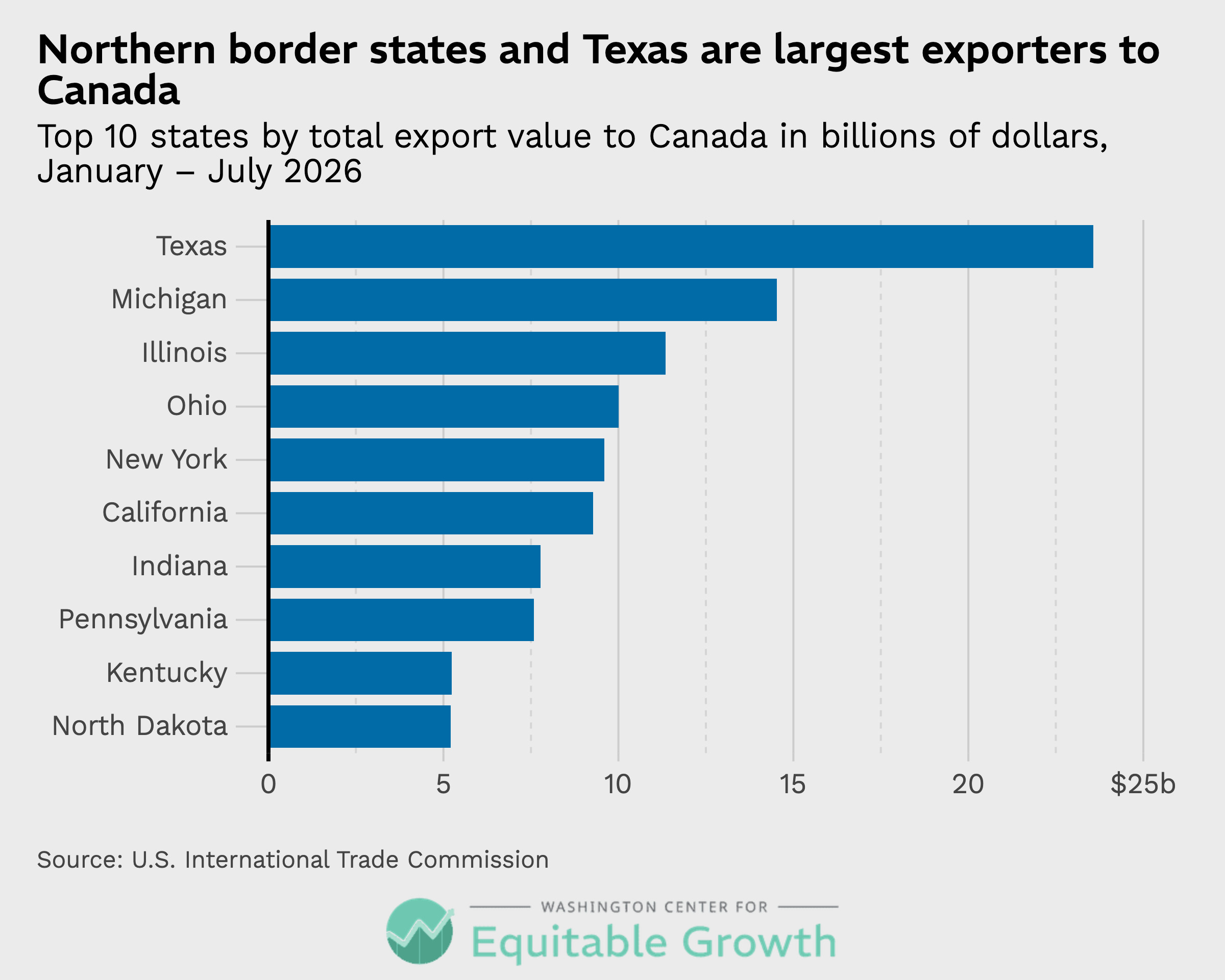
Top 10 states by total export value to Canada in billions of dollars, January – July 2026
Canada has more to lose in the near-term in a trade war with the United States given the relative sizes of the two economies. But the U.S. economy does not exist in a vacuum. Any economic harm to Canada will eventually impact the United States in the form of reduced demand for U.S. exports, higher consumer prices for key imports, and a weakened relationship with a vital geopolitical ally that supplies the nation with much of the energy and raw materials it needs to grow and defend itself.
The reputational harm among other allies and trading partners also carries costs. Framed against the Trump administration’s missions of containing domestic inflation and sparking a manufacturing renaissance, a trade war with Canada is nothing short of self-sabotage.
 Did you find this content informative and engaging?
Get Updates
Did you find this content informative and engaging?
Get Updates
Essays JUL 14, 2026
By: Christopher Bangert-Drowns
Essays MAR 4, 2026
By: Christopher Bangert-Drowns
Essays NOV 4, 2025
By: Christopher Bangert-Drowns
Get updates on our latest research, event announcements, and policy insights delivered straight to your inbox. Stay connected with the leading voices on equitable growth.


