
What happens to U.S. workers without access to Unemployment Insurance amid economic downturns or disruptions related to AI?
Essays SEP 2, 2026
By: Megan Rivera
SEP 11, 2025
Once on the political fringes, far-right parties have become established actors in many democracies. The European Parliament election in 2024, for example, resulted in far-right parties receiving more than 20 percent of the vote, and far-right parties are now represented in nearly all national parliaments in Europe. Outside of Europe, the far right has been in government in countries such as India, Israel, and Brazil. The current Trump administration in the United States also is dominated by far-right actors.
For a long time, one main research question on the political success of far-right parties was why is the far right successful in some countries but not in others? Some countries, such as Germany, were even considered immune to the contemporary far-right threat due to their particular national history.
It has now become clear that no country should be considered immune to the appeal of the far right. A mix of factors that is common to all post-industrial democracies has created a fertile ground for their political successes. Cases such as in Germany or Portugal show how quickly far-right parties can become established actors in national politics and receive a significant share of the vote.
It is thus not surprising that the rise of the far right has sparked considerable interest among researchers, commentators, and the broader public. Explanations for its success have often either focused on economic or cultural explanations. These explanations were often pitted against each other. But it is becoming increasingly clear that economic and cultural concerns are deeply intertwined among the supporters of far-right parties and across the broader electorate.
People do not necessarily separate these issues in their everyday lives—they see them as part of the same story about what is happening in the world around them. Rural resentment against urban elites has underpinnings of economic inequalities but, at the same time, is fueled by racial stereotypes and White identity politics.37 Competition in housing markets or underfunded schools can be regarded as the result of neoliberal economic policies, but they can be rhetorically connected to immigration, too.
A core idea for understanding how economic and cultural concerns are intertwined is as threats to social status.38 Social status as a concept dates back to the classic work of the early 20th century German sociologist Max Weber. It can be understood as peoples’ sense of value based on their position in society. While concepts such as class and socioeconomic status often refer to “objective” material values, such as levels of income and wealth, social status goes beyond material concerns and is based on a shared form of recognition across a society.39
Importantly, social status is not something that just exists in peoples’ heads: People experience tangible benefits or harms based on their social status. Social status determines how you are treated by others, how you can perform in certain contexts, and your access to different networks and social circles.
Typical sources of social status include education and occupation.40 Education and occupation do not only matter because they generate more or less income. They also come with different levels of prestige and power in society. Gender, race, and sexual identity similarly come with different levels of social status in society.
A growing body of research now suggests that when people see their social status threatened, they become more likely to support the far right. Importantly, the core group of supporters for the far right are not necessarily those who see themselves at the bottom of social hierarchies already but are those that perceive that they have something to lose.
Threats to social status can be both economic and cultural. They include developments that challenge a position in society that people value. These can be material economic risks that make it more likely that one’s standard of living will become significantly worse.41 But they also include transformations of roles in society.
Gender (being a man) and race (being White) were historically important sources of status in society. These roles as a source of status have been challenged in recent decades, and White men see their social status as threatened. Research by Princeton University’s Noam Gidron and Peter Hall at Harvard University, for example, demonstrates that compared to the early 1990s, the subjective social-status perceptions of men without a college degree have strongly declined in many countries in Europe and in the United States.42
In this essay, my focus is on economic sources of threats to status, focusing not on the effects of material hardships leading to more support for the far right, but rather on how economic changes and risks can contribute to a sense of potential loss of roles and routines that provide people with value, meaning, and identity. I focus on two economic threats to status: unemployment risk and rental market risks. Both a higher risk of unemployment and rising local rents contain a threat to (disposable) income and wealth. But these threats go beyond that, because people potentially will have to give up things that create a sense of value in their lives: their job, the areas in which they live, and the social circles in which they interact.
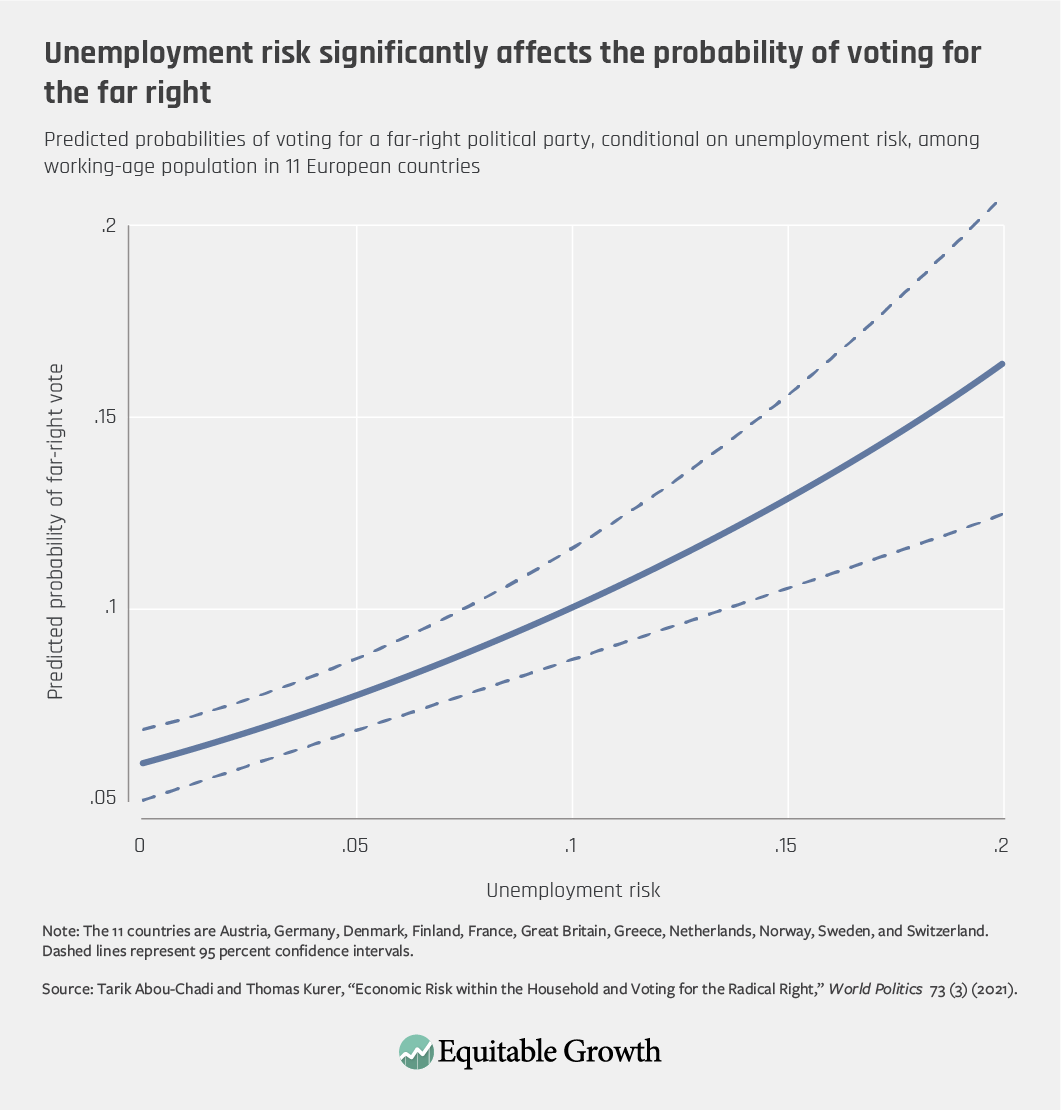
This essay summarizes my research on how economic threats to social status in the form of unemployment risk and rental market risk affects support for the far right in Europe.43 My work with collaborators shows that when people face a higher risk of unemployment, they become more likely to support far-right political parties. Within a household, one member at a high risk of unemployment is enough to increase support for the far right among both members of the household. Similarly, when people face increasing local rent prices—independent of the rent that they actually pay—they also become more likely to support the far right.
A focus on threats to social status helps answer one central question in the current ascent of the far right: Why do people who face adverse economic conditions vote for a party of the far right instead of a party of the left? Put differently: Why do people in these circumstances not support parties that would arguably provide better policy solutions for them? Why do they not support parties that promise labor market and rental market protections, better unemployment benefits, and rental controls?
There are many answers to these questions, and some are certainly related to social democratic and other center-left parties losing credibility on actually providing solutions to these issues.44 But beyond this, social status as a concept allows us to understand why far-right appeals resonate so well with people facing economic risks.
What can we learn from the relationship between threats to social status and far-right support for current developments in European and U.S. politics? In particular, what are the lessons for those who are interested in crafting economically and socially progressive policy agendas and who want to defend liberal democracy against the threat from the far right?
First, our findings show that the economy certainly matters for understanding support for the far right. But those findings also should caution against a reductionist and materialist understanding of far-right support. Economic hardship is not a necessary condition for someone to support the far right: Far-right support does not disappear in economically good times.
Indeed, racism, sexism, antisemitism, and anti-LGBTQ+ attitudes remain at the core of far-right support.51 We can find these sentiments across all class groups and across all levels of education. The far right as a political, cultural, and social project has successfully linked perceptions of threats to economic well-being with hostility toward minority groups. But this does not mean that if progressive policymakers reduce economic uncertainty, people will necessarily reduce their hostility toward these groups. Racism, sexism, and transphobia have become essential building blocks of some voters’ political identities and have become normalized as elements of political discourse.
Economic and social policies will not be enough to reverse these dynamics. Yet economic policies do matter. The erosion of a social safety net, the decline in public services, and the deterioration of government-provided health care that have resulted from austerity policies have significantly contributed to creating grievances that the far right can exploit.52 Continuing these policies means creating a steady or growing reservoir of far-right voters. Shifting away from these policies is a necessary part of a strategy to reduce far-right support.
At the same time, it should be clear that this is a long-term, not a short-term, strategy and that it is a necessary but not a sufficient condition to contain the far right. As Columbia University’s Alexander Hertel-Fernandez and Shayna Strom, the president and CEO of the Washington Center for Equitable Growth, have argued in this series, “thin deliverism” will not work.53 The sources of far-right support are too structural. Too many politicians still believe that solving problems will immediately reduce the appeal of the far right. This won’t happen.
The far right is here to stay for the foreseeable future. Politicians and activists need to embrace the long-term challenge. In the short term, questions of politics and polity will be more important to protect liberal democracy from the far right. But economic and social policies will play an important role in shaping the conditions for far-right party support in the long run.
Essays SEP 2, 2026
By: Megan Rivera
Essays AUG 31, 2026
By: Christopher Bangert-Drowns
Essays AUG 14, 2026
By: Carlos Fernando Avenancio-Leon
Get updates on our latest research, event announcements, and policy insights delivered straight to your inbox. Stay connected with the leading voices on equitable growth.
SEP 11, 2025