
What happens to U.S. workers without access to Unemployment Insurance amid economic downturns or disruptions related to AI?
Essays SEP 2, 2026
By: Megan Rivera
JUL 14, 2026
The first 4 months of 2026 saw continued seismic changes in U.S. trade policy. In late February, the U.S. Supreme Court struck down (opens in a new tab) the Trump administration’s use of the International Emergency Economic Powers Act to impose broad, country-specific tariffs under the guise of a national economic emergency, triggering a process requiring the federal government to refund (opens in a new tab) to U.S. importers as much as $175 billion (opens in a new tab). The administration responded by declaring a blanket 10 percent tariff (opens in a new tab) under a different legal authority, Section 232 (opens in a new tab) of the Trade Expansion Act of 1962, and by launching dozens of new investigations (opens in a new tab) into alleged unfair trading practices by U.S. trading partners under Section 301 of the Trade Act of 1974, with promises of new sectoral tariffs. Also beginning in late February, the war with Iran has added to general economic uncertainty and compounded tariff costs as shipping (opens in a new tab) and energy (opens in a new tab) costs have risen.
As a result of all this broad uncertainty, U.S. firms face increasing constraints that are likely to slow growth-driving investments and hiring. While the U.S. labor market has been surprisingly resilient (opens in a new tab) in response to these developments thus far, persistently above-target inflation (opens in a new tab) means the Federal Reserve could be forced to raise interest rates (opens in a new tab) at some point this year or in 2027, imposing a further drag on the capital investments that drive job and productivity growth.
Let’s now turn to a discussion of how the Trump administration’s tariff and trade policies have changed in the aftermath of the U.S. Supreme Court decision to overrule the Trump administration’s tariff authority under the International Emergency Economic Powers Act.
The U.S. Supreme Court’s IEEPA ruling resulted in two predictable, related outcomes. Data show (opens in a new tab) the average tariff rate paid on imports to the United States fell, while the total value of imports increased.
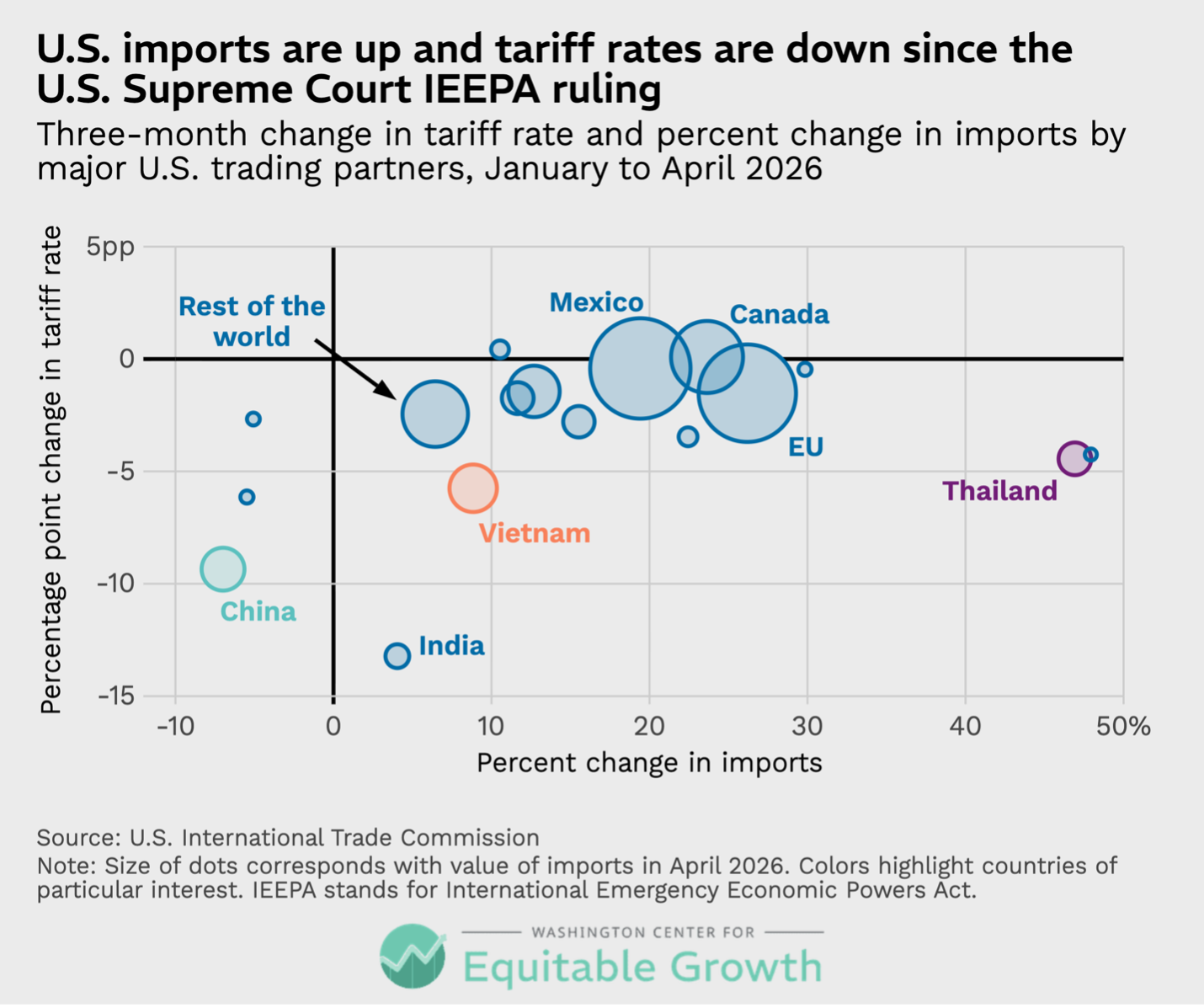
Since January 2026, the last full month prior to the ruling, nearly every major U.S. trading partner has seen their average tariff rate fall—considerably, in some cases. India’s tariff rate, for example, dropped more than 13 percentage points to 7.4 percent after the Supreme Court ruling. Still, the average tariff on all U.S. imports remains nearly 4.4 percentage points above its pre-2025 level.
As tariff rates fell, U.S. demand for imported goods increased. Since January, U.S. importers have increased purchases from all but three major trading partners, pushing total U.S. imports up (opens in a new tab) by more than 15 percent, to a little more than $300 billion in April 2026 (opens in a new tab)—the highest level since the April 2025 “Liberation Day (opens in a new tab)” tariff announcement. (See Figure 1.)

Three-month change in tariff rate and percent change in imports by major U.S. trading partners, January to April 2026
As Figure 1 shows, import growth was particularly high for Thailand, one of a few countries bucking the tariff trend and increasing trade with the United States since last year. Meanwhile, China was the major exception to the rule in the first 4 months of 2026, as its average tariff rate declined by 9.3 percentage points but total import values also fell. The large decline in China’s average tariff rate belied a still-large average rate of nearly 23 percent in April 2026, sustaining incentives for U.S. importers to seek production sources (opens in a new tab) in other countries for economic reasons and to hedge (opens in a new tab) geopolitical supply chain risks.
The continued decline in imports from China also could be attributed to export controls (opens in a new tab) set by China on critical minerals and devices shipped to the United States. These products include high-performance magnets and the technologies used to produce them.
In the near term, Sino-American geopolitical and trading relations are likely to move forward under conditions of managed instability (opens in a new tab). U.S. businesses tapping global supply chains will need to learn to live with that instability and strike a geographic balance relevant to their core business interests.
Underscoring this point, much ink has been spilled on the question (opens in a new tab) of (opens in a new tab) transshipments (opens in a new tab), or when goods are routed through a third country, sometimes to avoid import restrictions on the country of origin. Global supply chains routinely (and legally) involve the movement of partially completed goods from one country to another for modifications or packaging before arriving at a destination market. Determining an imported product’s country of origin for customs purposes involves wrangling over whether a “substantial transformation (opens in a new tab)” occurred in an intermediary country. Illicit transshipment is punishable (opens in a new tab) under U.S. law, and a July 2025 Executive Order (opens in a new tab) announced a new 40 percent punitive tariff intended to crack down on the practice.
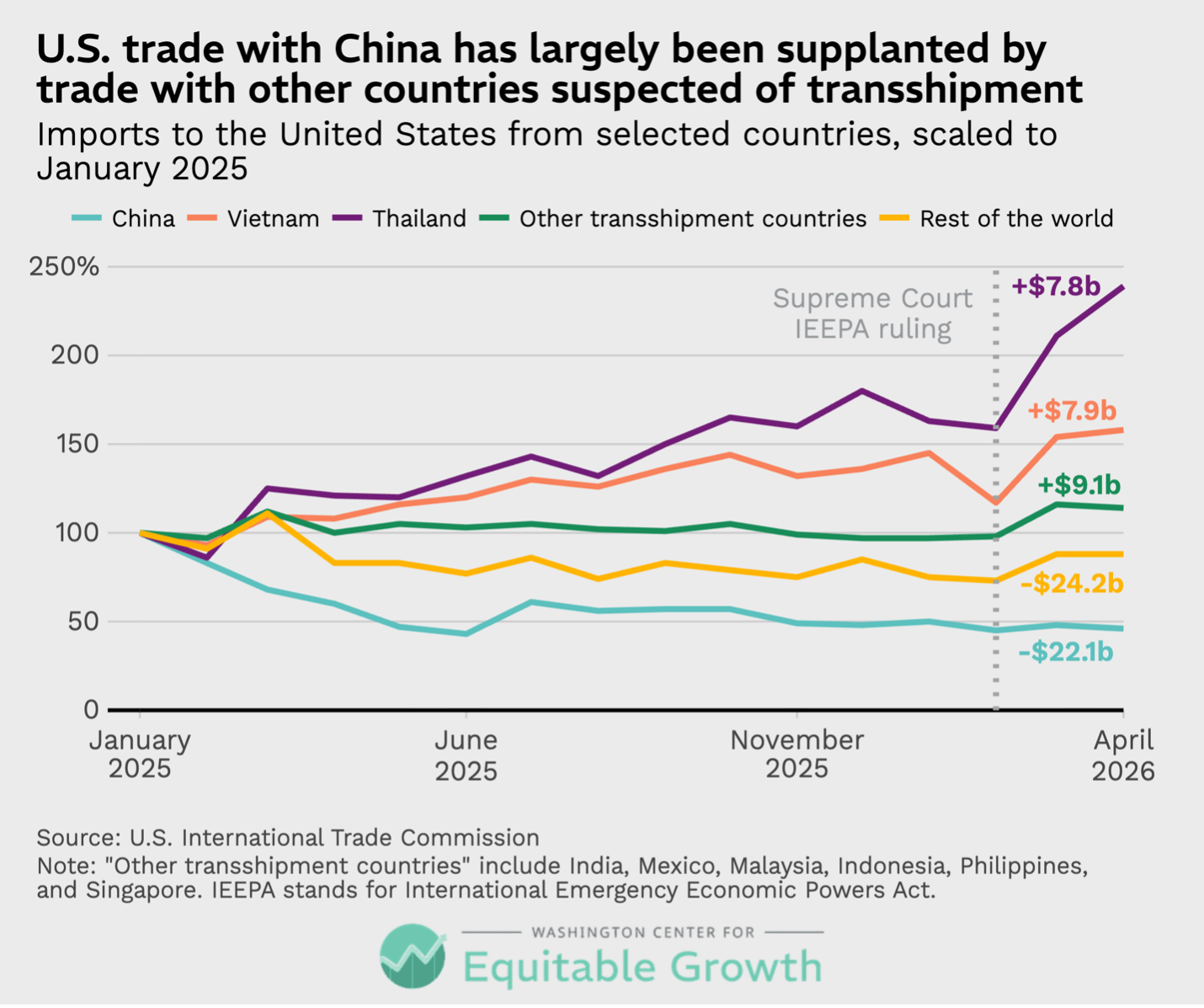
Yet evasive transshipment isn’t new. In the 1990s, for example, U.S. quotas on imported textiles were evaded when Chinese exports were re-routed (opens in a new tab) through Hong Kong. In the more recent U.S.-China trade war in 2018, researchers identified countries, including Vietnam (opens in a new tab) and Mexico (opens in a new tab), as possible routes for transshipment of goods from China, with import values from both countries increasing substantially as tariffs on China rose. Over the past year, other Southeast Asian countries, including Thailand (opens in a new tab), have been suspected (opens in a new tab) of engaging in transshipment. (See Figure 2.)

Imports to the United States from selected countries, scaled to January 2025
Concretely proving transshipment is difficult, but examining aggregate trade data can reveal broad trends that hint at transshipment. Figure 2 shows that the decline in trade with China since January 2025, for example, has been more than offset by an increase in trade with countries suspected of transshipment, primarily Vietnam and Thailand.
To be sure, at least some of the increase in trade with these potential transshipment countries is legitimate—they, on average, present a more reliable and lower-cost option for many U.S. importers compared to China. But the overall trend is impossible to ignore, and Southeast Asian and other potential transshipment countries could expect additional scrutiny (opens in a new tab) from the U.S. government in the coming months.
Previous analyses from Equitable Growth estimated the impact of tariffs on U.S. domestic industries, finding that key sectors impacting both economic growth and affordability in the United States face disproportionately higher input costs due to the increase in tariffs since January 2025. Data from the first 4 months of 2026 show continued divergence between tariff-impacted sectors and the rest of the economy.
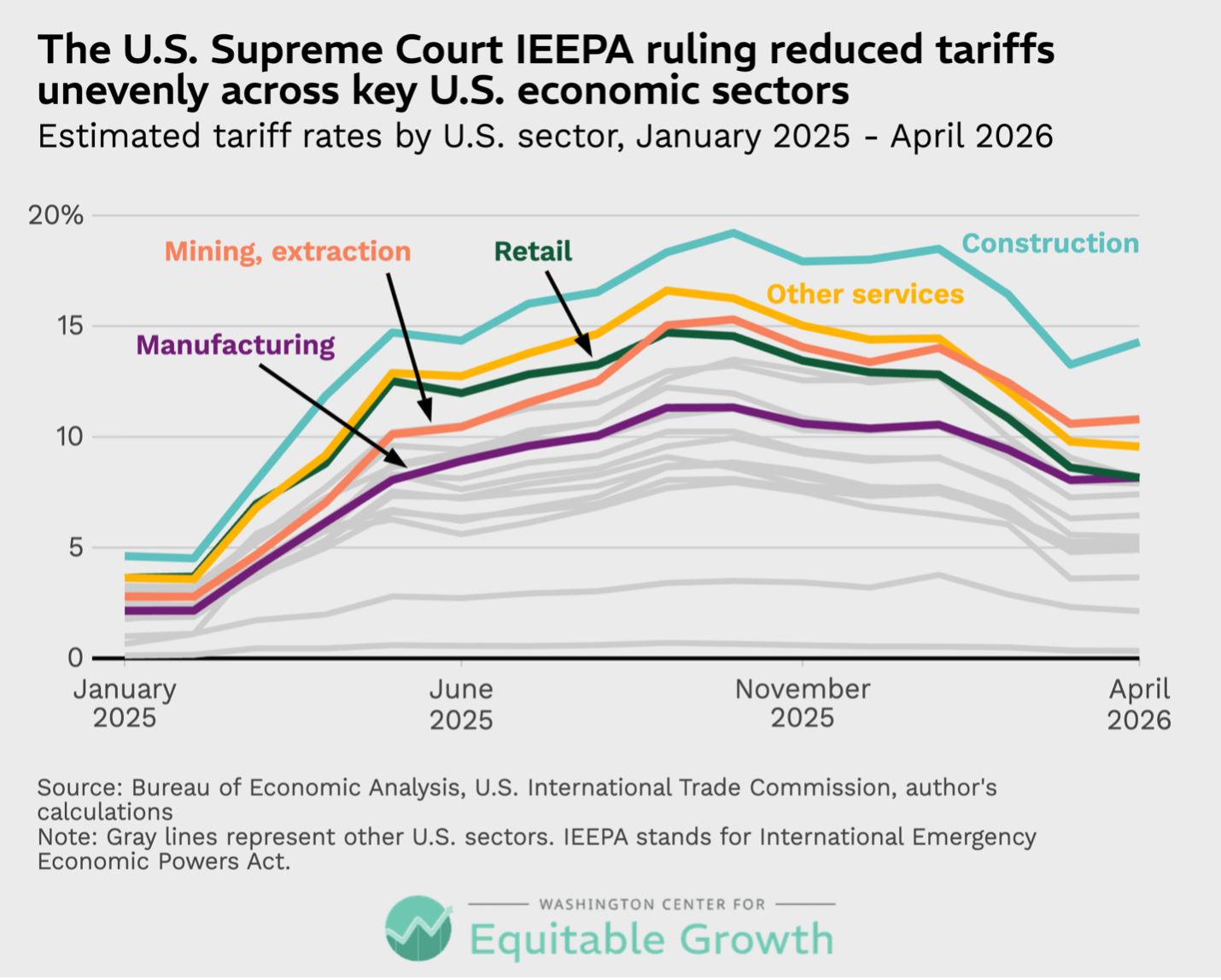
While estimated sector-level tariff rates declined following the Supreme Court’s IEEPA decision, some areas of the U.S. economy probably benefited more than others from lower tariffs. Estimated average tariff rates paid by the domestic manufacturing sector, for example, have declined since January 2026 but not as rapidly as tariffs paid by the retail sector. Retail importers had been paying a higher estimated tariff rate than manufacturing importers throughout 2025, but these rates began converging in 2026 and were effectively equal in April. Other sectors—notably, construction and mining—even saw estimated tariff rates increase from March to April 2026, as the average national rate began to plateau. (See Figure 3.)

Estimated tariff rates by U.S. sector, January 2025 – April 2026
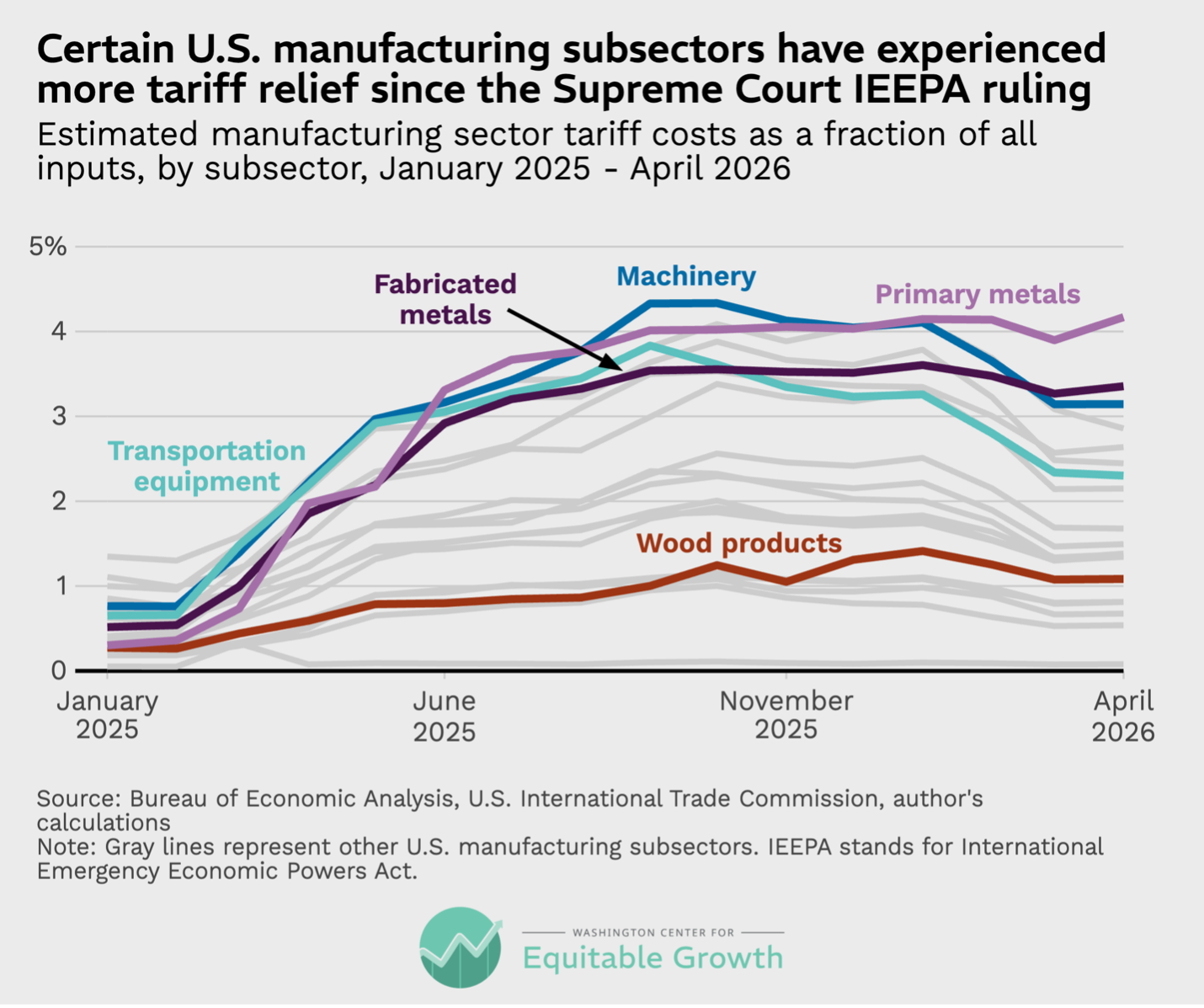
Decomposing the manufacturing sector into its constituent subsectors reveals important nuance in the varied effects of how the Supreme Court IEEPA decision impacted different industries. Throughout much of 2025, tariff costs were highest for heavy manufacturing firms, including those in the machinery, metals, and transportation equipment subsectors. Estimated rates within the group of the most impacted manufacturing industries began to diverge following the Supreme Court ruling in February 2026, with tariff rates for machinery, transportation equipment, and other groups declining as rates for primary and fabricated metals remained elevated. (See Figure 4.)

Estimated manufacturing sector tariff costs as a fraction of all inputs, by subsector, January 2025 – April 2026
This divergence in tariff exposure across industries can be attributed to the broader array of import measures and trade restrictions applied to primary and fabricated metals, compared to other products. When the Supreme Court struck down President Trump’s IEEPA tariff authority, U.S. sectors burdened primarily by those country-specific tariffs experienced immediate relief, while sectors facing tariffs imposed under different authority, such as Section 232 (opens in a new tab) of the Trade Expansion Act of 1962, did not.
The metals manufacturing subsectors—some of which import a majority of their raw metal inputs—face non-IEEPA-based tariffs mostly on imports of steel, aluminum, copper, and other materials. Wood product (opens in a new tab) manufacturers also saw only minor relief following the IEEPA ruling because the bulk of that industry’s imports fall under Section 232 authority.
This suggests the Trump administration’s strategy of using non-IEEPA alternative legal authorities to impose tariffs could bear fruit. Indeed, in early June, the office of the U.S. Trade Representative recommended (opens in a new tab) additional Section 301 tariffs of at least 10 percent on a group of 60 countries.
U.S. trade policy is likely to continue to burden the U.S. economy through direct costs in the form of tariffed inputs and other restrictions, as well as through heightened uncertainty as the administration seeks new tariff authorities. The U.S. legal system will have its hands full overseeing the distribution of tariff refunds from the defunct IEEPA authority at the same time that it fields challenges (opens in a new tab) to new tariff authorities. Lengthy and contentious court disputes are sure to compound the effects of policy uncertainty, forcing firms to hold off on growth-driving investment and hiring decisions.
Rising tariff costs and policy uncertainty also create incentives for U.S. importers and trading partners to evade tariffs, despite a push by the federal government to crack down on suspected “tariff fraud (opens in a new tab)” that could complicate those efforts.
Altogether, elevated input costs and policy uncertainty could push U.S. firms to reshore or build out their domestic supply chains and reinvest in U.S. workers. But such a reorientation requires the resources and compliance expertise available only to some well-positioned firms, as well as significant industrial (opens in a new tab) policy investments by the federal government. Time will tell which firms survive and which fall victim to a volatile trade war. Early (opens in a new tab) evidence (opens in a new tab) suggests (opens in a new tab) small (opens in a new tab) businesses (opens in a new tab)—a key source of economic dynamism and employment growth in the United States—will suffer the most.
Essays SEP 2, 2026
By: Megan Rivera
Essays AUG 14, 2026
By: Carlos Fernando Avenancio-Leon
Working Papers AUG 14, 2026
By: Carlos F. Avenancio-León, Yutao He, Michael Reher
Get updates on our latest research, event announcements, and policy insights delivered straight to your inbox. Stay connected with the leading voices on equitable growth.