




Policy
What Work Does Generative AI Do?
Essays SEP 8, 2026
By: Alexander Bick, Adam Blandin, David Deming, Tyler Schumacher
AI, Tech & Energy
Labor, Wages & Worker Power
 Browse All Resources
NOV 20, 2024
The Washington Center for Equitable Growth seeks to support research that will generate actionable insights for policymakers and inform policies that lead to strong, stable, and broad-based economic growth.
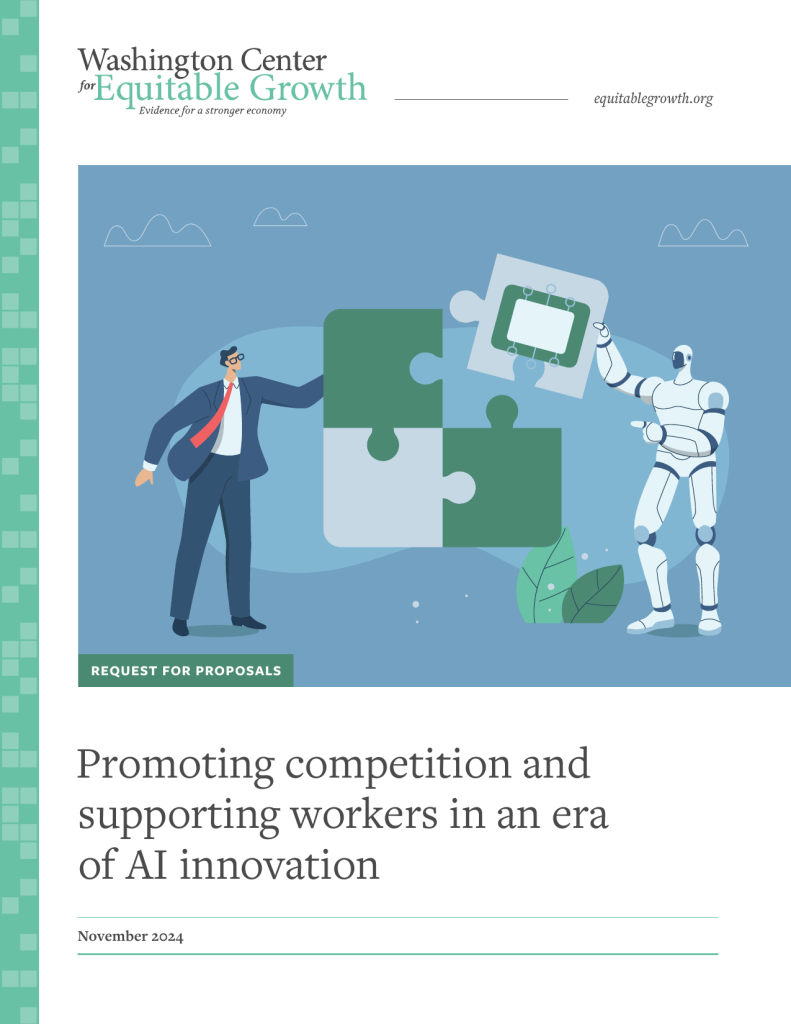
How can we encourage use of artificial intelligence technologies that is more beneficial for U.S. workers and society? We are currently requesting proposals for research that will inform policies that would harness the potential of generative AI and other emerging technologies to boost growth, innovation, and productivity while ensuring robust competition and making sure that productivity gains are broad-based and lead to improved job quality. We are open to research on a range of technologies, such as generative AI and large language models, but also algorithms, electronic surveillance, and various forms of automation. For the sake of concision, we use AI throughout this Request for Proposals to refer to all of the various forms of technologies.
Designing effective policy responses to govern the rapid development and deployment of new technologies poses serious challenges. We support research inquiry using many different types of evidence, relying on a variety of methodological approaches and cutting across academic disciplines, including research on designing new technologies and algorithms. Research can take a macro perspective and focus on aggregate outcomes, or a micro perspective and focus on outcomes for individuals or businesses. Case studies or other qualitative or descriptive designs that can shed light on how and to what extent technologies are currently being deployed and experienced are of interest, as is research using quasi-experimental methods or other rigorous statistical approaches. Historical analysis of policy regimes that led to equitable economic growth are of interest if lessons learned are applicable to the current policy landscape and to the potential disruption new technologies pose.
Preference will be given to scholars who are willing to engage with policymakers on their research. Social scientists and research can play a powerful role in shaping policy. Grantees will have the opportunity to participate in trainings and receive assistance in translating research findings for nonacademic audiences.
We recognize there are a range of other important implications for the use of AI that are relevant to inequality and growth, such as copyright, access to credit, and health care applications, just to name a few. However, this Request for Proposals is only interested in research that is directly relevant to workers and market structure. Research that is only tangentially related to the questions below falls outside of Equitable Growth’s funding priorities and is unlikely to advance, given our limited funding.
Our funding priorities fall within the following two broad areas of interest: workers, work, and workplace organization, and market structure, supply chains, and competition.
Policymakers need more information to ensure that AI develops in a way that increases jobs, wages, and worker productivity. How can AI be a complement to workers and center them in the production process?
For all questions, we’re interested in differences across industries, occupations, wage levels, business types, and demographic groups.
How do current AI technologies affect workers and wages?
How does the use of AI affect how work and workers are organized?
How can we best prepare the workforce for the potential disruption AI presents?
Policymakers need more information to effectively govern the development and application of AI. How can firms be incentivized to develop and use AI tools as a complement to workers, augmenting work and productivity while reducing inequality?
For all questions, we’re interested in the implications for regulatory and/or enforcement approaches, as well as alternative incentive structures and nondisciplinary tools.
How is the AI market structured?
How (un)competitive are markets up and down the tech stack?
Daron Acemoglu, Equitable Growth Steering Committee member; Institute Professor, Massachusetts Institute of Technology
Sorelle Friedler, Shibulal Family Professor of Computer Science, Haverford College
Jason Furman, Equitable Growth Steering Committee member; Professor of the Practice of Economic Policy, Harvard University
Alex Hertel-Fernandez, Visiting Fellow at Equitable Growth; Associate Professor of International and Public Affairs, Columbia University
Ioana Marinescu, Associate Professor, University of Pennsylvania School of Social Policy & Practice
This Request for Proposals is open to researchers affiliated with a U.S. college or university and graduate students currently enrolled in a Ph.D. program at a U.S. college or university in the dissertation stage of their career. The affiliated university must administer the grant.
Researchers not affiliated with a college or university, or with non-U.S. colleges and universities, can be part of a research team and can receive support via a grant. However, the Principal Investigator must be affiliated with a U.S. college or university, which must administer the grant.
Researchers who are the Principal Investigator for an open Equitable Growth grant with an end date beyond July 1, 2025 are not eligible to apply. Co-Principal Investigators/Collaborators with open grants are eligible to apply.
The deadline to apply is 11:59 p.m. EST on Monday, February 10, 2025.
Funding decisions will be announced in June 2025 to allow funding to be dispersed at the start of the 2025–26 academic year.
Grants awarded in response to this request are expected to fall in the $25,000 to $80,000 range. Slightly larger grants may be considered if the budget is well-justified. Grant timelines should be limited to 2 years.
Equitable Growth is willing to fund a wide range of activities, including researcher salary and benefits, research assistance, data purchase, and costs associated with conducting experiments or research-related travel. Our grants cannot cover indirect overhead.
Summer salary is capped at $20,000 per year per Principal Investigator, not including fringe.
Fringe/benefit costs are allowable up to a maximum rate of 35 percent.
Tuition and related fees are an allowable cost if student research assistants are included in the budget request.
To apply for a grant, use the online application portal (opens in a new tab) to submit a six-page proposal, a two-page abbreviated curriculum vitae, and a draft budget using Equitable Growth’s budget template (opens in a new tab). Applicants are encouraged to use this template (opens in a new tab) for the six-page proposal.
Proposals must include:
If tables, graphs, or other images are helpful in explaining your project, they can be included. While they will not count against the page limit, we encourage you to limit the use of images to one or two.
Citations can be included as endnotes and do not count against the page limit.
We frequently partner with other foundations to support projects jointly or to share proposals that are not a fit for our grant program but which may be of interest to other funders.
Grants made in response to this request must be approved by the Advisory Committee. Proposals will be evaluated by Equitable Growth staff and external reviewers. External reviewers consist of subject-matter and methodological experts and are selected with a commitment to diversity of race, gender, discipline, area of study, and university affiliation.
All applications will be evaluated on the following criteria:
Equitable Growth cannot provide feedback on a written proposal prior to the application deadline, but staff are available to respond to questions. Email grants@equitablegrowth.org (opens in a new tab) with questions.
You can also complete this form (opens in a new tab) if you would like to schedule a time with a staff member to discuss your project or application. You will receive an email from grants@equitablegrowth.org (opens in a new tab) to schedule a brief Zoom call.
Submit your application by creating an account and completing the submission form using our online application portal (opens in a new tab).
If you have questions or are having trouble with the application portal, please email grants@equitablegrowth.org (opens in a new tab) or call 202-276-3368.
Essays SEP 8, 2026
By: Alexander Bick, Adam Blandin, David Deming, Tyler Schumacher
Working Papers SEP 8, 2026
By: Alexander Bick, Adam Blandin, David Deming, Tyler Schumacher

Essays SEP 2, 2026
By: Megan Rivera
Get updates on our latest research, event announcements, and policy insights delivered straight to your inbox. Stay connected with the leading voices on equitable growth.


