Temperature, workplace safety, and labor market inequality
Working Papers JUL 19, 2021
By: R. Jisung Park, Nora Pankratz, A. Patrick Behrer
AUG 1, 2024
U.S. workers are more vulnerable than ever to the ill effects of high and rising temperatures as the world continues to shatter heat records (opens in a new tab) this year. Climate-related deaths and injuries are on the rise (opens in a new tab), yet only a handful of U.S. states have heat protections in place for workers, while Texas and Florida recently passed laws barring local governments from requiring employers to offer water and rest breaks for workers.
In early July, the federal Occupational Safety and Health Administration announced (opens in a new tab) a proposed rule that would protect (opens in a new tab) workers from the direct and indirect impacts of extreme heat, a first-of-its-kind proposal responding to a Biden administration effort (opens in a new tab) to combat the effects of climate change on workers. It would require (opens in a new tab) employers to offer water and as-needed work breaks when the heat index, which combines temperature and humidity, reaches 80 degrees Fahrenheit. The proposed rule also stipulates that if the heat index reaches 90 degrees, more stringent rules, including mandatory 15-minute breaks every 2 hours, would go into effect.
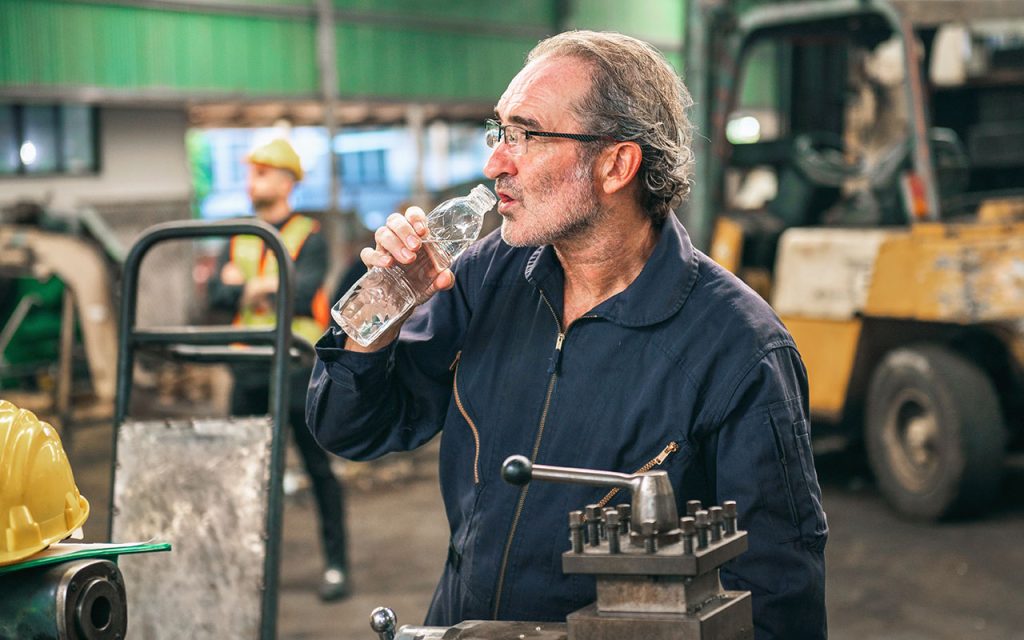
If finalized, the rule would add protections for 35 million workers around the country who labor both indoors and outside. Though it’s easy to imagine how outdoor workers, such as agricultural or construction workers, experience the effects of extreme heat directly, studies show that indoor workers, including warehouse and kitchen workers and factory employees, also are impacted by heat. Hot weather can impair cognitive ability (opens in a new tab) and decision-making (opens in a new tab), leading to accidents seemingly unrelated to heat, such as falling from heights or mishandling machinery.
Indeed, high heat has repeatedly been shown to lead to more injuries and deaths in the workplace. One study, by the University of Pennsylvania’s R. Jisung Park, University of California, Los Angeles’ Nora Pankratz, and Stanford University’s A. Patrick Behrer, finds that hot weather dramatically increases reported injuries. Using confidential data from California’s worker compensation system, the authors find that days with high temperatures of 90 degrees result in an increase in workplace injuries of between 6 percent and 9 percent, and days with highs of 100 degrees see injuries increasing by 10 percent to 15 percent.
Overall, the co-authors estimate that extreme heat causes around 20,000 injuries per year, with the effects persisting across indoor and outdoor settings. And that’s just in California.
High temperatures not only have clear adverse effects on individual workers but also affect the broader U.S. economy, costing billions of dollars in lost wages and lower productivity. Data compiled (opens in a new tab) by The Lancet finds that more than 2.5 billion hours of labor were lost in 2021 due to heat exposure in the agriculture, construction, manufacturing, and service sectors of the U.S. economy. Another study (opens in a new tab) finds that extreme heat costs the economy $100 billion in lost labor in 2020—a figure they expect to increase to $500 billion per year in 2050.
Heat also exacerbates existing income and health inequality across the economy. Lower-wage workers and less-educated workers are more likely to work in precarious jobs and to live and work in places with more heat exposure. This means these already marginalized workers face a higher risk of heat-related injury or death, compared to better-off or more educated workers.
Heat will continue to wreak havoc (opens in a new tab) on the U.S. labor market and the economy due to intensifying climate change (opens in a new tab), which makes heat waves hotter, more frequent, and more prolonged, according to the U.S. Environmental Protection Agency. Indeed, between 1960 and 2020, the United States went from experiencing an average of two heat waves per year to six, with the average 2020s heat wave lasting a full day longer than in the 1960s.
At the same time, another recent study (opens in a new tab) by UPenn’s Park finds that even moderately elevated temperatures—what he defines as days in the 80s and 90s—cause just as many excess deaths as record-breaking temperatures in the triple digits. Worse, he finds these same subtle consequences (opens in a new tab) for wildfires, hurricanes, and other natural disasters—meaning that even noncatastrophic storms and weather trends have a serious effect on workers’ health and well-being and on broader economic activity and growth.
That’s why interventions such as the new OSHA heat rule are essential to protect U.S. workers from the damaging consequences of extreme—and even moderate—heat, as well as to bolster the broader economy so it can weather these effects. By protecting both indoor and outdoor workers, it stands to make a big impact—not just for those individual workers who would be protected, but also for their employers’ bottom lines and the sustainability of local U.S. economies. The federal government should adopt the rule and ensure it is enforced effectively across the United States so that all workers can benefit and none are left behind.
Working Papers JUL 19, 2021
By: R. Jisung Park, Nora Pankratz, A. Patrick Behrer
Blog JUL 15, 2021
By: Equitable Growth
Get updates on our latest research, event announcements, and policy insights delivered straight to your inbox. Stay connected with the leading voices on equitable growth.