


Policy
Assessing the economic effects of the Tax Cuts and Jobs Act
Issue Briefs APR 17, 2018
By: Greg Leiserson
Taxation
 Browse All Resources
AUG 22, 2024
By: Rakeen Mabud, Janelle Jones and Michael Linden

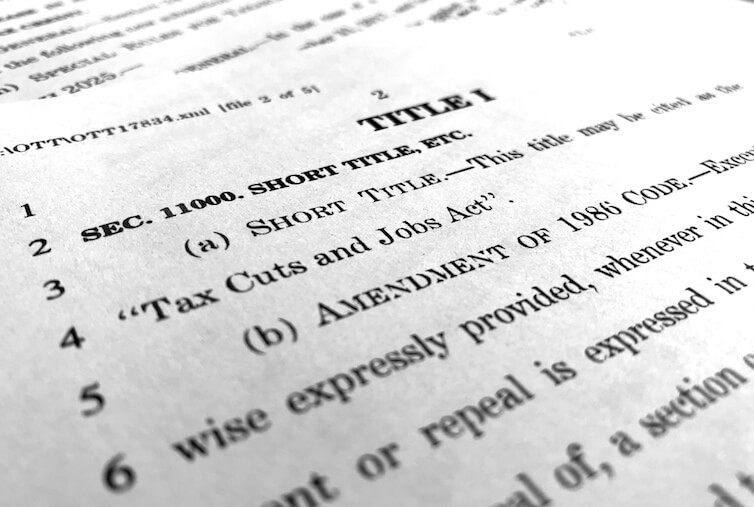
Former President Donald Trump’s hallmark economic policy was a swathe of tax cuts for the wealthy and big corporations in 2017. His Tax Cuts and Jobs Act, or TCJA, supercharged the wealth of billionaires (opens in a new tab) and shifted more power and wealth to big corporations. Republican legislators in Congress savvily made the corporate tax cuts permanent due to their deep unpopularity, but sunset the individual provisions of the bill to help with the budgetary math.
That sunset is coming up at the end of 2025, teeing up an epic tax policy fight that has the potential to change the way money and power are distributed throughout the U.S. economy. While only some of the provisions are expiring, it’s widely anticipated that all the provisions—individual and corporate—will be up for debate.
In the run up to that policy fight, many academics are reevaluating the claims that TCJA proponents made in 2017 about the tax cuts’ potential to boost growth, wages, and investment. One such paper (opens in a new tab), published earlier this year, explores the claims made by the bill’s advocates that the Trump tax cuts would boost (opens in a new tab) aggregate investment.
The four co-authors of the paper—economists Gabriel Chodorow-Reich at Harvard University, Matthew Smith at the U.S. Department of the Treasury, Owen Zidar at Princeton University, and Eric Zwick at the University of Chicago’s Booth School of Business—employ sophisticated statistical techniques and an extensive proprietary firm-level dataset. They find that businesses that received a larger tax cut invested relatively more than businesses that received a smaller tax cut. The four co-authors then use a standard macroeconomic model to estimate aggregate investment effects of the tax law and find that such effects are positive.
But the paper also presents an interesting puzzle. Because it is hard to discern economywide investment effects in the actual aggregate data, could it be possible that the tax cut led individual firms to invest more yet those investments had little or no impact on the economy as a whole?
A new technical brief (opens in a new tab) from the Institute for Macroeconomic and Policy Analysis at American University sheds some light on this puzzle. The IMPA economists—Ignacio González, Juan Montecino, and Vasudeva Ramaswamy—explain that the firm-level findings by Chodorow-Reich and his co-authors are consistent with existing economic theory: If Firm A gets a big tax cut and Firm B doesn’t, then Firm A would invest relatively more than Firm B. Yet the IMPA team also points out that there are several reasons why this doesn’t necessarily imply more investment on aggregateacross the U.S. economy.
Consider the following scenarios, all of which are consistent with the finding that, at the firm level, companies with larger tax cuts invest relatively more than those with smaller tax cuts:
All of these scenarios are plausible. Unfortunately, the study by Chodrow-Reich and his co-authors does not parse out which of these scenarios is playing out. The problem is that, when it comes to taking firm-level findings and translating those to the economy as a whole, economists need to make a lot of assumptions about how the economy works. Those assumptions underpin any macroeconomic model, and, in this case, their findings on aggregate investment depend on two key—but highly debatable—assumptions:
In addition to discussing how these two important assumptions could be driving the results, the new IMPA technical brief discusses another concern with the macroeconomic model used by Chodorow-Reich and his co-authors. Their model essentially assumes that labor supply is also infinite, so an increase in demand for labor results in a large wage increase but no employment increase. The modest wage increase implied by their model has not shown up in empirical data.
With the impending expiration next year of major elements of the Tax Cuts and Jobs Act, it is important to understand what that law did and did not accomplish. We know it did not have anywhere close to the kind of impact that many of its proponents claimed it would. Chodorow-Reich, Smith, Zidar, and Zwick make an important contribution to the effort to more precisely understand what it did and did not do. And their firm-level findings are certainly consistent with other scholarship.
It is only when they run those findings through their standard macroeconomic model that they encounter a finding that does not match the observed, empirical, aggregate data that does not suggest any significant investment impact. The three economists at the Institute for Macroeconomic and Policy Analysis have helpfully laid out a few ways we might untangle this knot.
—Rakeen Mabud is the chief economist and a senior fellow at Groundwork Collaborative. Janelle Jones is the vice president for policy and advocacy at the Washington Center for Equitable Growth. Michael Linden is a senior policy fellow at Equitable Growth.
 Did you find this content informative and engaging?
Get Updates
Did you find this content informative and engaging?
Get Updates
Issue Briefs APR 17, 2018
By: Greg Leiserson

Blog NOV 21, 2023

Blog FEB 18, 2020
By: Owen Zidar, Eric Zwick
Get updates on our latest research, event announcements, and policy insights delivered straight to your inbox. Stay connected with the leading voices on equitable growth.


