
What happens to U.S. workers without access to Unemployment Insurance amid economic downturns or disruptions related to AI?
Essays SEP 2, 2026
By: Megan Rivera
JUL 20, 2015
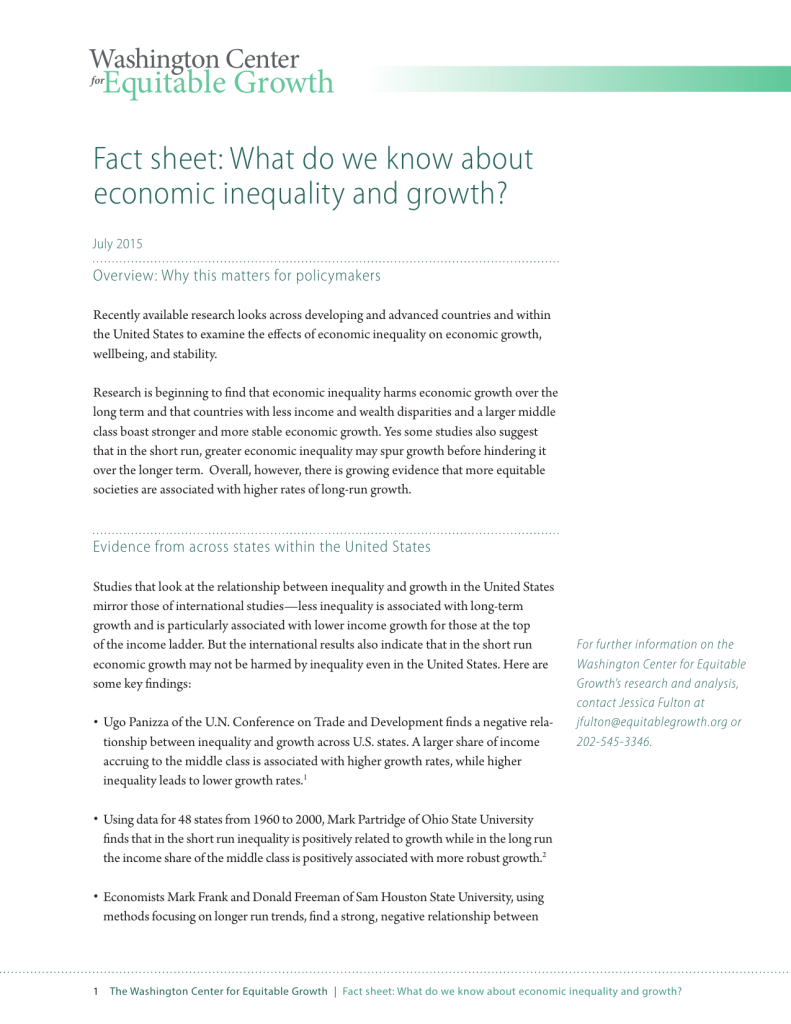
Recently available research looks across developing and advanced countries and within the United States to examine the effects of economic inequality on economic growth, well-being, and stability.
Research is beginning to find that economic inequality harms economic growth over the long term and that countries with less income and wealth disparities and a larger middle class boast stronger and more stable economic growth. Yes some studies also suggest that in the short run, greater economic inequality may spur growth before hindering it over the longer term. Overall, however, there is growing evidence that more equitable societies are associated with higher rates of long-run growth.
View full fact sheet here alongside all endnotes (opens in a new tab)
Studies that look at the relationship between inequality and growth in the United States mirror those of international studies—less inequality is associated with long-term growth and is particularly associated with lower income growth for those at the top of the income ladder. But the international results also indicate that in the short run economic growth may not be harmed by inequality even in the United States. Here are some key findings:
In the most recent literature of international comparisons, a new, somewhat nuanced theme is emerging that high inequality is bad for economic growth over long time horizons and that high inequality is particularly bad for those on the bottom of the income spectrum. But in the short run, most of the research agrees that high inequality can be associated with faster economic growth, but the benefits tend to flow to the top for that short period of time. Some of the key findings in this research arena include:
Economic theory supports conflicting narratives about the potential impact of economic inequality on economic growth. There are some ways that inequality could boost growth and other ways that it could retard growth. Furthermore, there are numerous possible mechanisms that could relate inequality to growth and many of these channels would have conflicting outcomes. Because theory cannot provide strong guidance, it is imperative to use data and analysis to understand the relationships.
Studies that look at the longer-term growth implications of economic inequality find that inequality adversely affects growth rates and the duration of periods of growth, while those that focus on short-term growth find that inequality is not harmful and may be associated with faster growth. Furthermore, studies that look at the impact of inequality on different levels of the income distribution find that inequality is particularly bad for the income growth of those not at the top.
Research on inequality and growth may be approaching a new consensus on the general implications of inequality on economic growth, but more work is needed to fully understand the specifics of how inequality affects growth. In particular, now that the United States is approaching a level of inequality that is very rare among developed economies and more closely resembles a developing economy, which mechanisms apply? These are questions that will require continued updates to the data and methods.
View full fact sheet here alongside all endnotes (opens in a new tab)
[i] OECD, In It Together: Why Less Inequality Benefits All (Paris: OECD Publishing, 2015).
[ii] Andrew Berg and Jonathan Ostry, Inequality and Unsustainable Growth (Washington, DC: International Monetary Fund, 2011).
[iii] Jonathan D. Ostry, Andrew Berg, and Charalambos G. Tsangarides, Redistribution, Inequality, and Growth, Discussion Note, IMF Staff Discussion Note (Washington, D.C.: International Monetary Fund, February 2014), http://www.imf.org/external/pubs/ft/sdn/2014/ sdn1402.pdf.
[iv] Diego F. Grijalva, Inequality and Economic Growth: Bridging the Short-Run and the Long-Run, November 29, 2011, http://escholarship.org/uc/item/4kf1t5pb.
[v] Daniel Halter, Manuel Oechslin, and Josef Zweimüller, “Inequality and Growth: The Neglected Time Dimension,” Journal of Economic Growth 19, no. 1 (March 1, 2014): 81–104, doi:10.1007/s10887-013-9099-8.
[vi] Dan Andrews, Christopher Jencks, and Andrew Leigh, “Do Rising Top Incomes Lift All Boats?,” The BE Journal of Economic Analysis & Policy 11, no. 1 (2011), http:// www.degruyter.com/view/j/bejeap.2011.11.issue-1/ bejeap.2011.11.1.2617/bejeap.2011.11.1.2617.xml.
[i] Ugo Panizza, “Income Inequality and Economic Growth: Evidence from American Data,” Journal of Economic Growth 7, no. 1 (2002): 25–41.
[ii] Mark Partridge, “Does Income Distribution Affect U.S. State Economic Growth,” Journal of Regional Science 45 (2005): 363–94.
[iii] Mark W. Frank and Donald Freeman, “Relationship of Inequality to Economic Growth: Evidence from U.S. StateLevel Data,” Pennsylvania Economic Review 11 (2002): 24–36.
[iv] Mark W. Frank, “Inequality and Growth in the United States: Evidence from a New State-Level Panel of Income and Inequality Measures.” Economic Inquiry 47, no. 1 (January 2009): 55–68.
[v] Chris Benner and Manuel Pastor, Just Growth: Inclusion and Prosperity in America’s Metropolitan Regions (New York: Routledge, 2012).
[vi] Van der Weide, Roy, and Branko Milanovic. “Inequality Is Bad for Growth of the Poor (But Not for That of the Rich).” World Bank Policy Research Working Paper 6963 (July 2014). http://www-wds.worldbank.org/servlet/ WDSContentServer/WDSP/IB/2014/07/02/000158349_2 0140702092235/Rendered/PDF/WPS6963.pdf.
[vii] Ibid.
[viii] Jeffrey Thompson and Elias Leight, Searching for the Supposed Benefits of Higher Inequality: Impacts of Rising Top Shares on the Standard of Living of Low and MiddleIncome Families (Amherst: Political Economy Research Institute – University of Massachusetts, Amherst, 2011), http://www.peri.umass.edu/fileadmin/pdf/working_papers/working_papers_251-30 (opens in a new tab).
Essays SEP 2, 2026
By: Megan Rivera
Essays AUG 31, 2026
By: Christopher Bangert-Drowns
Essays AUG 14, 2026
By: Carlos Fernando Avenancio-Leon
Get updates on our latest research, event announcements, and policy insights delivered straight to your inbox. Stay connected with the leading voices on equitable growth.