


Resources
From peer-reviewed research to accessible policy briefs, explore the scholarship that’s shaping debates and driving change.

58 Results

The Macroeconomic Effects of Tariffs: Evidence From U.S. Historical Data (opens in a new tab)
Working Papers MAR 4, 2026
We study the macroeconomic effects of tariff policy using U.S. historical data from 1840–2024. We construct a narrative series of plausibly exogenous tariff changes–based on major legislative actions, multilateral negotiations,…
By: Tamar den Besten (opens in a new tab), Diego Känzig (opens in a new tab)
Why Financial Crises Recur (opens in a new tab)
Working Papers AUG 5, 2025
Financial crises have occurred around the world for over two centuries. These crises have been so costly and frequent that one wonders why governments cannot prevent them from recurring despite…
By: Gary B. Gorton (opens in a new tab), Jeffery Y. Zhang (opens in a new tab)
Optimal Monetary Policy Under Menu Costs (opens in a new tab)
Working Papers JUL 1, 2025
We analytically characterize optimal monetary policy in a multisector economy with menu costs and contrast it with the textbook New Keynesian model based on Calvo pricing. Following a sectoral productivity…
By: Daniele Caratelli (opens in a new tab), Basil Halperin (opens in a new tab)

Americans Informed About the Distributional Effects of Republicans’ Budget Bill Overwhelmingly Oppose It (opens in a new tab)
Working Papers JUN 25, 2025
Republicans in the Senate are currently considering the One Big Beautiful Bill Act, which, if enacted, would be the most regressive U.S. tax and budget law in at least the…
By: Jacob S. Hacker, Patrick Sullivan (opens in a new tab)

Request for Proposals: The economic effects of the Inflation Reduction Act (opens in a new tab)
RFPs APR 2, 2025
By: Equitable Growth (opens in a new tab)
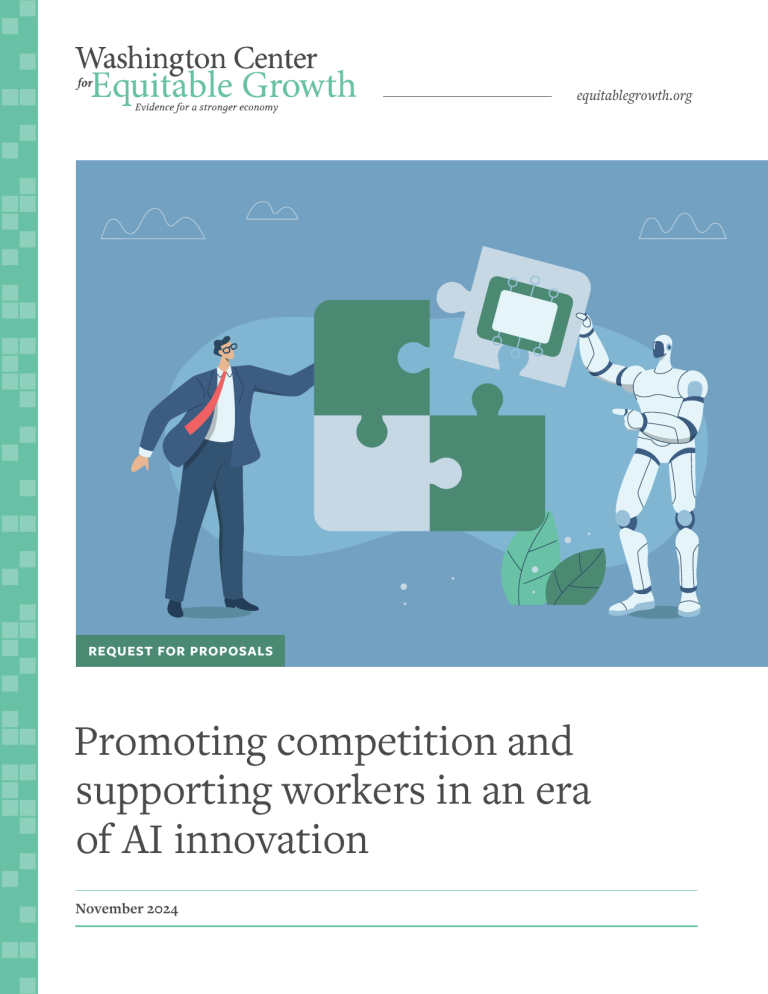
Request for Proposals: Promoting competition and supporting workers in an era of AI innovation (opens in a new tab)
RFPs NOV 20, 2024
By: Equitable Growth (opens in a new tab)

Request for proposals: Research grants for early career scholars (opens in a new tab)
RFPs OCT 30, 2024
By: Equitable Growth (opens in a new tab)
Asymmetric Effects of Monetary Policy on Firms (opens in a new tab)
Working Papers SEP 16, 2024
This paper documents firm-level evidence on the asymmetric effects of monetary policy in the US. Focusing on the 1980q3-2019q4 period, I find that monetary tightenings show larger effects on firms’…
By: Ezgi Kurt (opens in a new tab)

Request for Proposals: How effective was the fiscal response to the COVID-19 recession for workers? (opens in a new tab)
RFPs MAR 18, 2024
By: Equitable Growth (opens in a new tab)
Request for proposals: Research grants for early career scholars (opens in a new tab)
RFPs NOV 30, 2023
By: Equitable Growth (opens in a new tab)
The New Economics of Industrial Policy (opens in a new tab)
Working Papers SEP 19, 2023
We discuss the considerable literature that has developed in recent years providing rigorous evidence on how industrial policies work. This literature is a significant improvement over the earlier generation of…
By: Réka Juhász (opens in a new tab), Nathan Lane, Dani Rodrik (opens in a new tab)
Money Demand and Income Inequality: International Evidence using a Century of Data (opens in a new tab)
Working Papers MAR 14, 2023
Transactions and precautionary theories of money demand imply that aggregate money demand declines as income becomes more unequally distributed. In this paper I test this prediction using money demand regressions…
By: Guillermo Gallacher (opens in a new tab)
Heterogeneous Spending, Heterogeneous Multipliers (opens in a new tab)
Working Papers MAR 9, 2023
Do local fiscal multipliers depend on what the government purchases? We find that government purchases of services have larger effects on employment than spending on goods. Industries producing services are…
By: Umberto Muratori (opens in a new tab), Pedro Juarros (opens in a new tab), Daniel Valderrama (opens in a new tab)
Monetary Policy, Labor Income Redistribution and the Credit Channel: Evidence from Matched Employer-Employee and Credit Registers (opens in a new tab)
Working Papers NOV 17, 2022
We document the redistributive effects of monetary policy on labor market outcomes via the credit channel. For identification, we exploit matched administrative datasets in Portugal – employee-employer and credit registers…
By: Martina Jasova (opens in a new tab), Caterina Mendicino (opens in a new tab), Ettore Panetti (opens in a new tab), José-Luis Peydró (opens in a new tab), Dominik Supera (opens in a new tab)

In Conversation with Lenore Palladino (opens in a new tab)
In Conversation NOV 16, 2022
Equitable Growth in Conversation is a recurring series where we talk with economists and other academics to help us better understand whether and how economic inequality affects economic growth and…
By: Kate Bahn (opens in a new tab)
Taxing the Rich: How Incentives and Embeddedness Shape Millionaire Tax Flight (opens in a new tab)
Working Papers JUL 28, 2022
Taxing the rich is one of the central debates in this era of rising inequality. Elite taxation can alleviate income disparities and fund public investments. Yet, if top earners engage…
By: Cristobal Young (opens in a new tab), Ithai Lurie (opens in a new tab)
A Goldilocks Theory of Fiscal Deficits (opens in a new tab)
Working Papers JUN 30, 2022
This paper proposes a tractable framework to analyze fiscal space and the dynamics of government debt, with a possibly binding zero lower bound (ZLB) constraint. Without the ZLB, a greater…
By: Atif Mian (opens in a new tab), Ludwig Straub (opens in a new tab), Amir Sufi
Understanding Climate Damages: Consumption versus Investment (opens in a new tab)
Working Papers APR 22, 2022
Existing climate-economy models use aggregate damage functions to model the effects of climate change. This approach assumes climate change has equal impacts on the productivity of firms that produce consumption…
By: Gregory P. Casey (opens in a new tab), Stephie Fried (opens in a new tab), Matthew Gibson (opens in a new tab)
Cyclical Demand Shifts and Cost of Living Inequality (opens in a new tab)
Working Papers JAN 11, 2022
This paper examines the cyclical behavior of low-income versus high-income household price indices and documents two new facts: (1) during recessions prices rise more for products purchased relatively more by…
By: Jacob Orchard (opens in a new tab)
Falling Rates and Rising Superstars (opens in a new tab)
Working Papers JAN 7, 2022
Do low interest rates contribute to the rise in market concentration? Using data on firm financials and high frequency monetary policy shocks, we find that falling interest rates disproportionately benefit…
By: Thomas Kroen (opens in a new tab), Ernest Liu (opens in a new tab), Atif Mian (opens in a new tab), Amir Sufi (opens in a new tab)
What explains the decline in r*? Rising income inequality versus demographic shifts (opens in a new tab)
Working Papers JAN 7, 2022
Downward pressure on the natural rate of interest (r*) is often attributed to an increase in saving. This study uses microeconomic data from the SCF+ to explore the relative importance…
By: Atif Mian (opens in a new tab), Ludwig Straub (opens in a new tab), Amir Sufi (opens in a new tab)

In Conversation with Jonathan Fisher (opens in a new tab)
In Conversation DEC 16, 2021
Equitable Growth in Conversation is a recurring series where we talk with economists and other academics to help us better understand whether and how economic inequality affects economic growth and…
By: Kate Bahn (opens in a new tab), Jonathan Fisher (opens in a new tab)

In Conversation with Erica Groshen (opens in a new tab)
In Conversation OCT 25, 2021
Equitable Growth in Conversation is a recurring series where we talk with economists and other academics to help us better understand whether and how economic inequality affects economic growth and…
By: Austin Clemens (opens in a new tab)
Diverse Policy Committees Can Reach Underrepresented Groups (opens in a new tab)
Working Papers SEP 16, 2021
In a randomized control trial that varies the salience of female and minority representation on the Federal Reserve’s monetary policy committee, the FOMC, we test whether diversity affects how Fed…
By: Francesco D’Acunto (opens in a new tab), Andreas Fuster (opens in a new tab), Michael Weber (opens in a new tab)
Tax Refund Uncertainty: Evidence and Welfare Implications (opens in a new tab)
Working Papers APR 8, 2021
Transfers paid through annual tax refunds are a large but uncertain source of income for poor households. We document that low-income tax-filers have substantial subjective uncertainty about these refunds. We…
By: Sydnee Caldwell (opens in a new tab), Scott Nelson (opens in a new tab), Daniel Waldinger (opens in a new tab)
The Matching Multiplier and the Amplification of Recessions (opens in a new tab)
Working Papers APR 8, 2020
This paper shows that the unequal incidence of recessions in the labor market amplifies aggregate shocks. I define the Matching Multiplier as the increase in the output multiplier stemming from…
By: Christina Patterson (opens in a new tab)
Baltimore Study: Credit Scores (opens in a new tab)
Working Papers MAR 4, 2020
The Baltimore Project Phase II This report builds upon the original Baltimore study by including credit score questions to the survey instrument conducted on the Phase I sample. In Phase…
By: Mónica García-Pérez (opens in a new tab), Sarah Gaither, William Darity Jr. (opens in a new tab)
Whose News? Class-Biased Economic Reporting in the United States (opens in a new tab)
Working Papers MAR 3, 2020
There is substantial evidence that voters’ choices are shaped by assessments of the state of the economy and that these assessments, in turn, are influenced by the news. But how…
By: Alan M. Jacobs (opens in a new tab), J. Scott Matthews (opens in a new tab), Timothy Hicks (opens in a new tab), Eric Merkley (opens in a new tab)
Targeted Debt Relief and the Origins of Financial Distress: Experimental Evidence from Distressed Credit Card Borrowers (opens in a new tab)
Working Papers DEC 4, 2019
We study the drivers of financial distress using a large-scale field experiment that offered randomly selected borrowers a combination of (i) immediate payment reductions to target short-run liquidity constraints and…
By: Will Dobbie (opens in a new tab), Jae Song (opens in a new tab)
Heterogeneity and Persistence in Returns to Wealth (opens in a new tab)
Working Papers NOV 19, 2019
We provide a systematic analysis of the properties of individual returns to wealth using twelve years of population data from Norway’s administrative tax records. We document a number of novel…
By: Andreas Fagereng (opens in a new tab), Luigi Guiso (opens in a new tab), Davide Malacrino (opens in a new tab), Luigi Pistaferri (opens in a new tab)

In Conversation with Fabian Pfeffer (opens in a new tab)
In Conversation NOV 13, 2019
“Equitable Growth in Conversation” is a recurring series where we talk with economists and other academics to help us better understand whether and how economic inequality affects economic growth and…
By: Liz Hipple (opens in a new tab)

In Conversation with Gabriel Zucman (opens in a new tab)
In Conversation AUG 7, 2019
“Equitable Growth in Conversation” is a recurring series where we talk with economists and other academics to help us better understand whether and how economic inequality affects economic growth and…
By: Heather Boushey (opens in a new tab)
Disability and distress: The effect of disability programs on financial outcomes (opens in a new tab)
Working Papers MAR 26, 2019
We provide the first evidence on the relationship between disability programs and markers of financial distress: bankruptcy, foreclosure, eviction, and home sale. Rates of these adverse financial events peak around…
By: Manasi Deshpande (opens in a new tab), Tal Gross (opens in a new tab), Yalun Su (opens in a new tab)
Simplified distributional national accounts (opens in a new tab)
Working Papers JAN 28, 2019
This paper develops a simplified methodology that starts from the fiscal income top income share series and makes very basic assumptions on how each income component from national income that…
By: Thomas Piketty (opens in a new tab), Emmanuel Saez (opens in a new tab), Gabriel Zucman (opens in a new tab)

In Conversation with Atif Mian (opens in a new tab)
In Conversation JAN 14, 2019
“Equitable Growth in Conversation” is a recurring series where we talk with economists and other academics to help us better understand whether and how economic inequality affects economic growth and…
By: Heather Boushey (opens in a new tab)

In Conversation with Karen Dynan (opens in a new tab)
In Conversation DEC 12, 2018
Equitable Growth Executive Director and Chief Economist Heather Boushey talks with Equitable Growth Steering Committee member Karen Dynan, a professor of the practice of economics at Harvard University.
By: Heather Boushey (opens in a new tab)


Your Direct Line to Cutting Edge Research
Be the first to know about our latest events, research releases, and expert insights. Get exclusive updates delivered right to your inbox and never miss an opportunity to engage with our community.