


Issue Areas
The Washington Center for Equitable Growth is engaged in an array of issues to advance evidence-based ideas and policies that promote strong, stable, and broad-based economic growth.

0 Results
No results match your criteria. Try clearing the search or adjusting your filters.

AI, Tech & Energy
Equitable Growth supports research and policy analysis on how artificial intelligence, emerging technologies, and the energy transition affect workers, inequality, and broad-based economic growth.
Macroeconomics & Economic Measurement
Equitable Growth supports research and policy analysis on how macroeconomic policies and better economic measurement can promote stable and broad-based economic growth.

Political Economy & Democracy
Equitable Growth supports research and policy analysis on how economic inequality shapes political power and democratic institutions, and how that in turn affects broad-based economic growth.

Taxation
Equitable Growth supports research and policy analysis on how tax policies can promote stable and broad-based economic growth.

Competition & Economic Dynamism
Equitable Growth supports research and policy analysis on how strong competition among U.S. businesses affects inequality and broad-based economic growth.

Household Economic Security
Equitable Growth supports research and policy analysis on how unequal access to care, 21st century work-life policies, and education undermines stable, broad-based economic growth.

Economic Equity & Opportunity
Equitable Growth supports research and policy analysis on how trends in economic inequality and mobility and changes in the economy have affected the concentration of wealth, income, and earnings, and how these distributional shifts have affected the promise of economic security and opportunity.

Labor, Wages & Worker Power
Equitable Growth supports research and policy analysis on how inequalities in wages, bargaining power, and the evolving labor market affect workers’ economic security and opportunity as well as broad-based economic growth.
779 Results
 (opens in a new tab)

What happens to U.S. workers without access to Unemployment Insurance amid economic downturns or disruptions related to AI? (opens in a new tab)
Essays Sep 2, 2026
The adoption of artificial intelligence in the workplace has led to predictions of U.S. labor market disruptions. In response, policymakers have increased attention on the fitness of the nation’s social…
(opens in a new tab)

Defining extreme wealth is more complicated than it looks (opens in a new tab)
Videos Aug 13, 2026
Facing high levels of income and wealth inequality and shrinking tax revenues, U.S. policymakers are showing increased interest in proposals to tax the richest households. Yet determining which households fall into that category is complex and changes based…
(opens in a new tab)

Estimating AI exposure is useful for research but cannot yet tell policymakers the whole story of AI’s impact on the labor market (opens in a new tab)
Essays Aug 7, 2026
Artificial intelligence has the potential to substantially change the nature and availability of work. To effectively manage the transitions this technology might bring to the U.S. economy, policymakers need information…
(opens in a new tab)
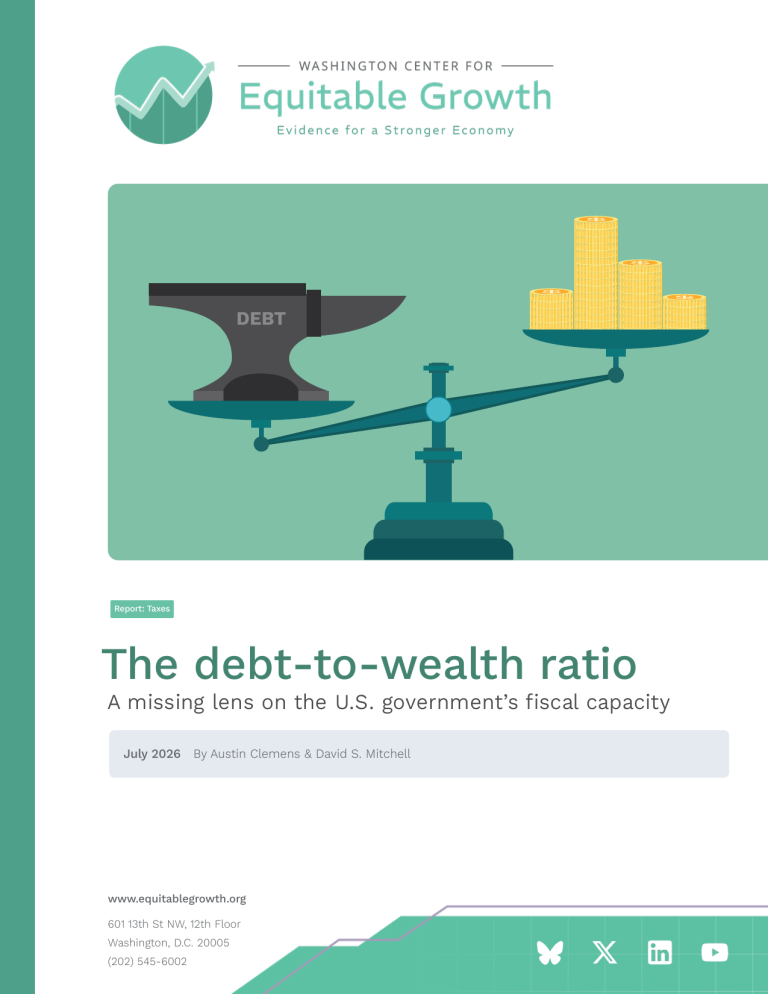
The debt-to-wealth ratio: A missing lens on the U.S. government’s fiscal capacity (opens in a new tab)
Reports Jul 30, 2026
Few statistics shape the fiscal debate in the United States as powerfully as the ratio of federal debt-to-Gross Domestic Product. Debt held by the public recently surpassed 100 percent of…
(opens in a new tab)
 View Chart
(opens in a new tab)
View Chart
(opens in a new tab)
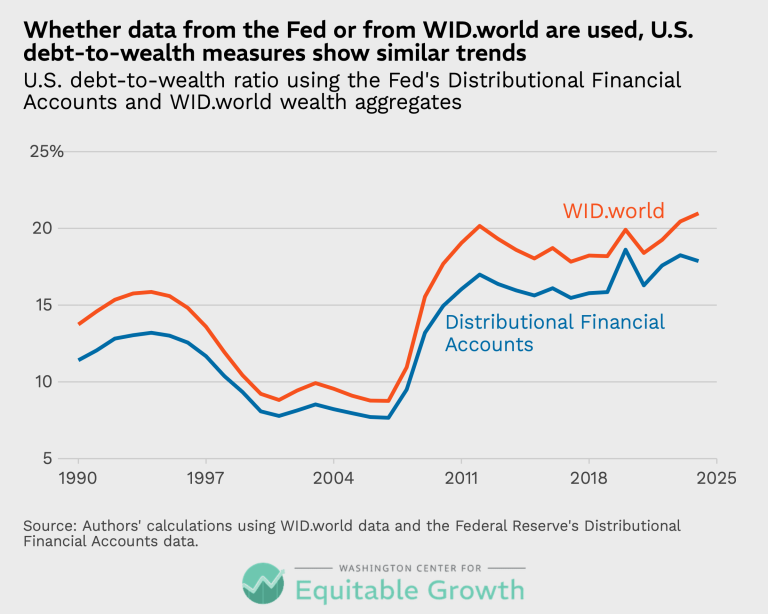
Whether data from the Fed or from WID.world are used, U.S. debt-to-wealth measures show similar trends (opens in a new tab)
Visualizations Jul 22, 2026
(opens in a new tab)
 View Chart
(opens in a new tab)
View Chart
(opens in a new tab)
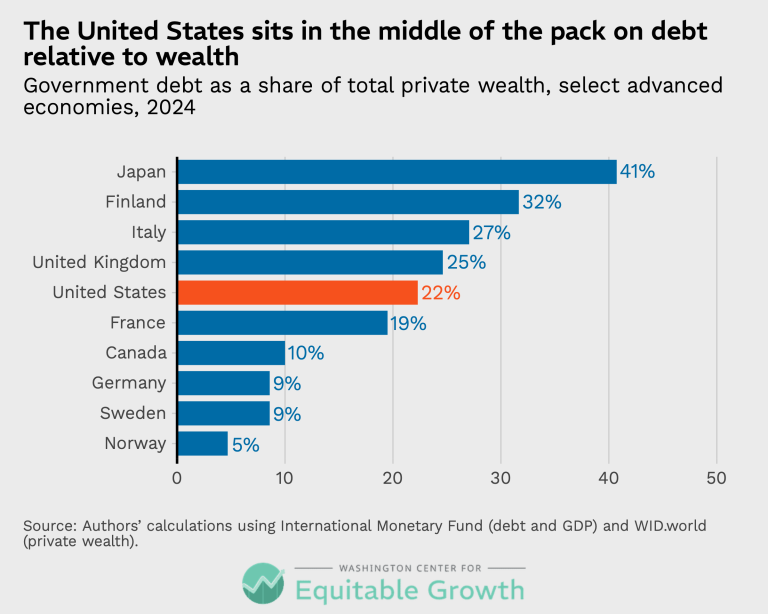
The United States sits in the middle of the pack on debt relative to wealth (opens in a new tab)
Visualizations Jul 22, 2026
92 Results
-
 Daniel Reck (opens in a new tab)
Assistant Professor of Economics
Daniel Reck (opens in a new tab)
Assistant Professor of Economics
University of Maryland
-
 Javier Cravino (opens in a new tab)
Associate Professor
Javier Cravino (opens in a new tab)
Associate Professor
University of Michigan, Ann Arbor
-
 Andrei Levchenko (opens in a new tab)
Professor of Economics
Andrei Levchenko (opens in a new tab)
Professor of Economics
University of Michigan, Ann Arbor
-
 Samir Sonti (opens in a new tab)
Assistant Professor of Urban Studies
Samir Sonti (opens in a new tab)
Assistant Professor of Urban Studies
CUNY School of Labor and Urban Studies
-
 Susan Yackee (opens in a new tab)
Director and Professor at the La Follette School of Public Affairs
Susan Yackee (opens in a new tab)
Director and Professor at the La Follette School of Public Affairs
University of Wisconsin-Madison
-
 Scott Nelson (opens in a new tab)
Assistant Professor of Finance
Scott Nelson (opens in a new tab)
Assistant Professor of Finance
University of Chicago
-
 Emi Nakamura (opens in a new tab)
Chancellor’s Professor of Economics
Emi Nakamura (opens in a new tab)
Chancellor’s Professor of Economics
University of California, Berkeley
-
 Jon Steinsson (opens in a new tab)
Chancellor's Professor of Economics
Jon Steinsson (opens in a new tab)
Chancellor's Professor of Economics
University of California, Berkeley
-
 Will Dobbie (opens in a new tab)
Professor of Public Policy
Will Dobbie (opens in a new tab)
Professor of Public Policy
Harvard University
-
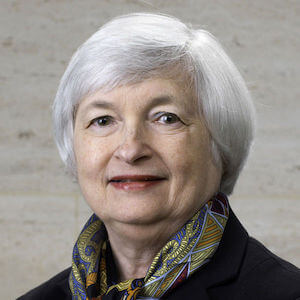 Janet L. Yellen (opens in a new tab)
Secretary of the Treasury
Janet L. Yellen (opens in a new tab)
Secretary of the Treasury
U.S. Department of the Treasury
-
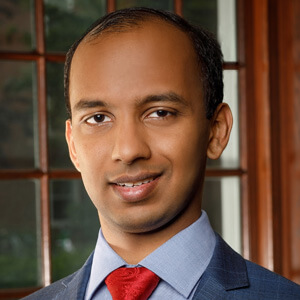 Ravi Jagadeesan (opens in a new tab)
Assistant Professor
Ravi Jagadeesan (opens in a new tab)
Assistant Professor
Stanford University
-
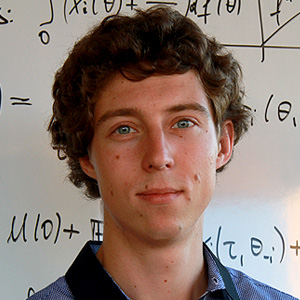 Piotr Dworczak (opens in a new tab)
Assistant Professor of Economics
Piotr Dworczak (opens in a new tab)
Assistant Professor of Economics
Northwestern University
-
 Mohammad Akbarpour (opens in a new tab)
Associate Professor of Economics
Mohammad Akbarpour (opens in a new tab)
Associate Professor of Economics
Stanford University
-
 Jacob Orchard (opens in a new tab)
Ph.D. Candidate in Economics
Jacob Orchard (opens in a new tab)
Ph.D. Candidate in Economics
University of California, San Diego
-
 Christian Wolf (opens in a new tab)
Ph.D. Candidate in Economics
Christian Wolf (opens in a new tab)
Ph.D. Candidate in Economics
Princeton University
-
 John Sabelhaus (opens in a new tab)
Nonresident Senior Fellow
John Sabelhaus (opens in a new tab)
Nonresident Senior Fellow
Brookings Institution
-
 Umberto Muratori (opens in a new tab)
Max Weber Post-doctoral Fellow
Umberto Muratori (opens in a new tab)
Max Weber Post-doctoral Fellow
European University Institute
-
David Kamin (opens in a new tab) Deputy Director
National Economic Council
-
 David Johnson (opens in a new tab)
Senior Program Officer
David Johnson (opens in a new tab)
Senior Program Officer
National Academies of Sciences, Engineering, and Medicine
-
Gauti Eggertsson (opens in a new tab) Professor of Economics
Brown University
-
 Gabriel Zucman (opens in a new tab)
Associate Professor of Economics and Director of the Stone Center on Wealth and Income Inequality
Gabriel Zucman (opens in a new tab)
Associate Professor of Economics and Director of the Stone Center on Wealth and Income Inequality
University of California, Berkeley
-
Ethan Kaplan (opens in a new tab) Associate Professor of Economics
University of Maryland
-
 Gabriel Chodorow-Reich (opens in a new tab)
Professor of Economics
Gabriel Chodorow-Reich (opens in a new tab)
Professor of Economics
Harvard University








Your Source for the Latest Insights
Get updates on our latest research, event announcements, and policy insights delivered straight to your inbox. Stay connected with the leading voices on equitable growth.