



Policy
What Work Does Generative AI Do?
Essays SEP 8, 2026
By: Alexander Bick, Adam Blandin, David Deming, Tyler Schumacher
AI, Tech & Energy
Labor, Wages & Worker Power
 Browse All Resources
FEB 23, 2016
By: Matt Markezich
Skill-biased technological change is a prominent explanation for the rise in income inequality over the past few decades, but it is not clear how this theory can explain the differential rise in very top incomes across countries. The theory, argued by Harvard’s Lawrence Katz and the University of Chicago’s Kevin Murphy (opens in a new tab) and recently overhauled by MIT’s Daron Acemoglu and David Autor (opens in a new tab), states that changes in technology drive increased demand for workers whose skills best complement new production processes. But as Ian Dew-Becker and Robert Gordon explain (opens in a new tab), “it is difficult to think of what particular skill set would account for the meteoric rise of incomes in the top 1 and 0.1 percentiles.”
A purely technological explanation cannot explain all of the variance in the change in top incomes across rich countries. Figure 1 shows the share of national income accruing to the top 1 percent of earners (excluding capital gains) over time for a selection of highly developed countries, from Thomas Piketty’s Capital in the Twenty-First Century (opens in a new tab).
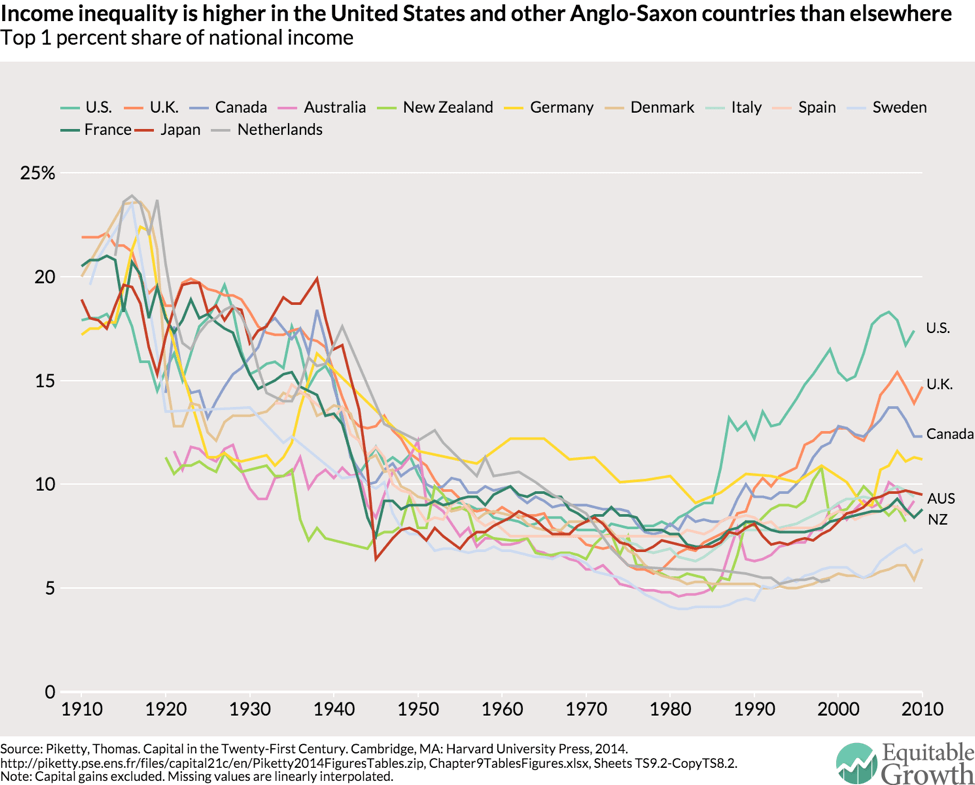
The chart provides a history lesson in its own right. You can see the sky-high inequality of the early 1900s, the remarkable collapse in top incomes following World War II, and the long moderation of income inequality during a period of high growth in the succeeding three decades. After that, we can see the recent explosion in top-end inequality starting during the mid-1980s.
Notably, the pace of growth in that inequality is strikingly different among developed countries. Anglo-Saxon countries, such as the United States, the United Kingdom, and Canada, saw their rich run away from the rest of their populations. In the United States, the top 1 percent of earners went from claiming 8 percent of national income in 1980 to nearly 18 percent of national income in 2010. The United Kingdom saw a similar increase over the same time period (from 6 percent to 15 percent), as did Canada (from 8 percent to 12 percent).
These gains contrast sharply with much more modest changes in other countries over that time period:
Given this new understanding of top-end incomes, can we point to some additional explanations? While some countries do have some technological advantages over others, all advanced Western economies are broadly on the same level in terms of development. Modern information technology is pervasive in all major sectors of the economy, and they all have high-performing education systems. So why is similar tech driving dissimilar returns to skill across the developed world? Are the United States and the United Kingdom exceptional in how talented their high performers are? Or is it a matter of institutional disparities between countries—that is, the degrees to which collective bargaining, high marginal income tax rates, and intellectual property regimes rein in the bargaining power of the top 1 percent?
These are still open questions, and it’s beyond the scope of this blog post to give a full answer. Suffice it to say, although inequality is increasing in many rich countries, the severity to which it’s increasing varies dramatically depending on where you look.
Essays SEP 8, 2026
By: Alexander Bick, Adam Blandin, David Deming, Tyler Schumacher
Working Papers SEP 8, 2026
By: Alexander Bick, Adam Blandin, David Deming, Tyler Schumacher

Essays SEP 2, 2026
By: Megan Rivera
Get updates on our latest research, event announcements, and policy insights delivered straight to your inbox. Stay connected with the leading voices on equitable growth.


