
What happens to U.S. workers without access to Unemployment Insurance amid economic downturns or disruptions related to AI?
Essays SEP 2, 2026
By: Megan Rivera
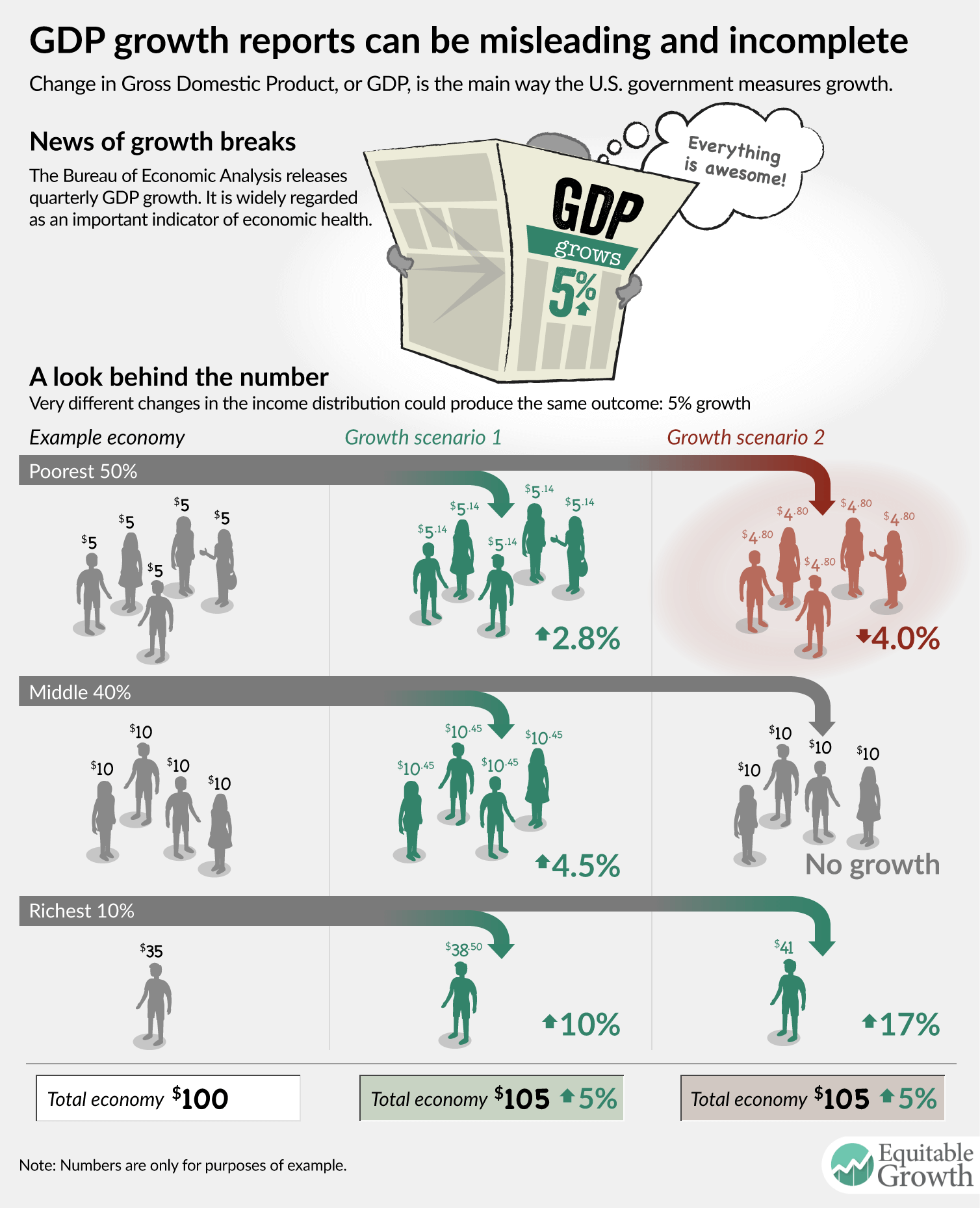
Each quarter, the U.S. Bureau of Economic Analysis releases its Gross Domestic Product report, which measures the value of goods and services produced in the United States. These numbers drive our national conversation about economic growth, yet they provide precious little information about the well-being of most Americans. The solution is to add a distributional component to our System of National Accounts that would tell policymakers and the general public not only the average growth of the economy, but would also report income growth for the rich, poor, and middle class.
In recent decades, income inequality in the United States has been rising, and larger shares of economic growth have flowed to the very top of the income distribution—the most wealthy. From 1980 to 2014, pretax income growth for the top 1 percent of all earners was 204 percent in the United States, far above the national average of 61 percent. Over the same time period, pretax incomes for the bottom 50 percent of individuals grew by just 1 percent.298
Therefore, the official GDP growth statistic may bear little resemblance to the experience of most Americans. Because it is a report of average growth across everyone in the United States, as incomes at the very top skyrocket, they drag the average up with them, making GDP growth less and less representative. (See Figure 1.)

Better understanding how economic growth in the United States is shared among income groups, geographic regions, and demographic groups will have a significant and lasting impact on how policymakers and economists alike gauge economic progress and evaluate policy.
“Disaggregating growth: Who prospers when the economy grows (opens in a new tab)”
By Heather Boushey and Austin Clemens
March 2018
“What if we took equity into account when measuring economic growth? (opens in a new tab)”
By Heather Boushey and Austin Clemens
November 2017
“Here’s why you should interpret tomorrow’s GDP growth estimate skeptically (opens in a new tab)”
By Austin Clemens
October 2017
“Improving the measurement and understanding of economic equality in the United States (opens in a new tab)”
By Robert Solow
July 2017
“Americans’ feelings about the U.S. economy make sense (opens in a new tab)”
By Heather Boushey
February 2017
“The once and future measurement of economic inequality in the United States (opens in a new tab)”
By Austin Clemens
March 2017
“Distributional National Accounts and measuring 21st century growth (opens in a new tab)”
By Heather Boushey
December 2016
Essays SEP 2, 2026
By: Megan Rivera
Essays AUG 31, 2026
By: Christopher Bangert-Drowns
Essays AUG 14, 2026
By: Carlos Fernando Avenancio-Leon
Get updates on our latest research, event announcements, and policy insights delivered straight to your inbox. Stay connected with the leading voices on equitable growth.