
What happens to U.S. workers without access to Unemployment Insurance amid economic downturns or disruptions related to AI?
Essays SEP 2, 2026
By: Megan Rivera
MAY 18, 2020
By: Leah Stokes and Matto Mildenberger
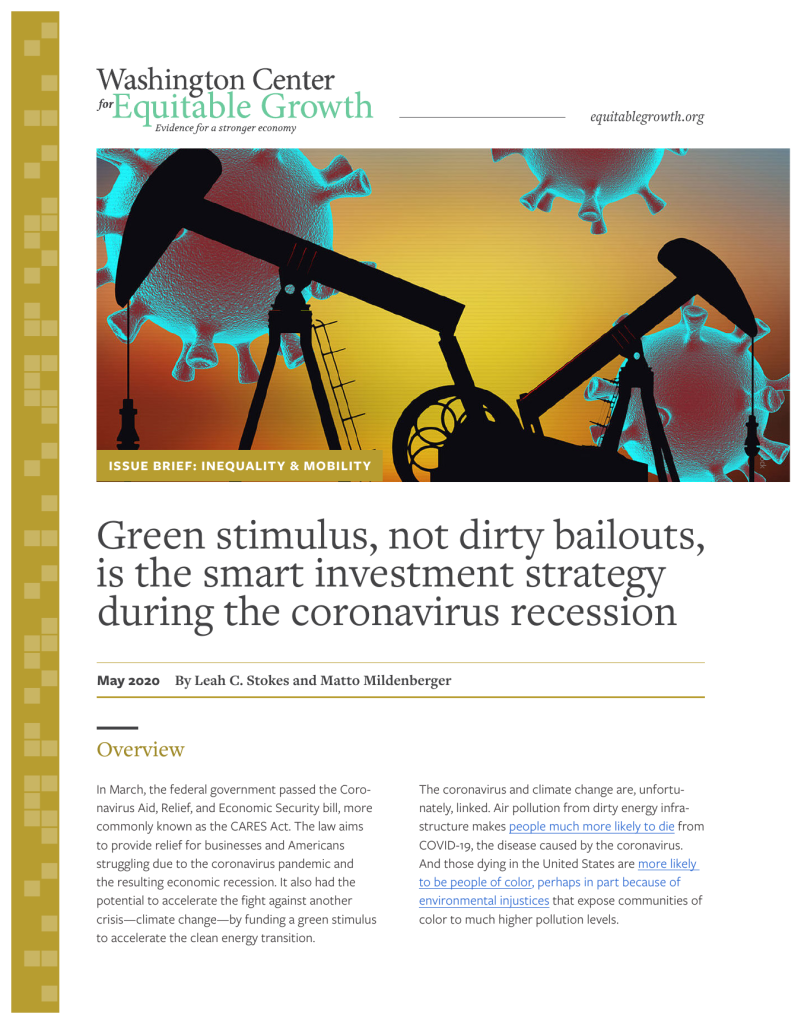
In March, the federal government passed the Coronavirus Aid, Relief, and Economic Security bill, more commonly known as the CARES Act. The law aims to provide relief for businesses and Americans struggling due to the coronavirus pandemic and the resulting economic recession. It also had the potential to accelerate the fight against another crisis—climate change—by funding a green stimulus to accelerate the clean energy transition.
The coronavirus and climate change are, unfortunately, linked. Air pollution from dirty energy infrastructure makes people much more likely to die (opens in a new tab) from COVID-19, the disease caused by the coronavirus. And those dying in the United States are more likely to be people of color, perhaps in part because of environmental injustices that expose communities of color to much higher pollution levels.
We do not have to use dirty energy that damages peoples’ lungs to power our societies. The CARES Act could have helped protect Americans’ health during this pandemic by moving us away from polluting fossil fuels. Yet rather than supporting clean energy, the law is being used to bail out the dirty fossil fuel sector.
If we continue along this terrible path, the accelerating climate crisis will disrupt employment, cause property damage, and destabilize the financial system. Why use the rescue programs from the current crisis to subsidize the industry most likely to cause the next one?
This issue brief examines how the CARES Act was deliberately misapplied to the fossil fuel industry, which was already on the ropes before the coronavirus recession. We also examine how future stimulus funds could be targeted toward clean energy, which would create more and better-paying jobs to power our economic recovery. This approach would not just help us tackle the coronavirus recession, but the climate crisis as well.
Every dollar spent propping up a dying industry is a dollar that can’t be invested into new careers, training, opportunity, and equitable growth in the clean energy sector. Increasingly, even banks recognize this, as more and more are pulling out of fossil fuel investments that are yielding poor returns.
According to recent research (opens in a new tab) from Heidi Garrett-Peltier, an assistant professor at the University of Massachusetts Amherst, for every $1 million invested in renewable energy or energy efficiency, almost three times as many jobs are created than if the same money were invested in fossil fuels. Investing more money in the fossil fuel industry will not address high and growing unemployment rates. Indeed, the Federal Reserve is not even requiring companies to keep workers as a condition for getting loans.
The seeds of an even more pernicious (opens in a new tab) argument (opens in a new tab) are already sprouting. Some conservative members of Congress are raising concerns about rising federal debt levels and threatening to stop further spending on relief amid the still-deepening recession. This would be the worst of both worlds. With $1.8 trillion in direct spending, the CARES Act is larger than Vice President Joe Biden’s 10-year climate plan (opens in a new tab). Clearly, the United States is able to spend more money addressing climate change if we treat it as the crisis it is.
We need green stimulus investments because it’s a smart way to spend money. Investments in the clean economy will provide significant returns. As Nobel prize-winning economist Joseph Stiglitz argues (opens in a new tab), alongside other colleagues, renewable energy and energy efficiency investments typically have high multipliers, delivering even greater returns over time. They also create more jobs, including ones that can’t be taken offshore, such as those in home energy retrofits.
At the end of 2019, Congress had an opportunity to put extensions for basic supports of the green energy sector into place, among them the Investment Tax Credit and the Production Tax Credit, in the year-end budget bill. But Congress decided against it. Congress then could have put these extensions in the CARES Act, but both President Trump and Senate Majority Leader Mitch McConnell (R-KY) opposed it (opens in a new tab).
This lack of support immediately before and during the coronavirus recession leaves the the renewable energy sector struggling. This quarter, for example, residential solar installations are likely to fall by half (opens in a new tab). In March alone, the clean energy industry lost more than 100,000 jobs (opens in a new tab). In wind energy alone, $43 billion (opens in a new tab) in investments are at risk. Despite the terrible state the industry finds itself in, Congress is doing very little to support clean energy jobs.
Despite a complete economic shutdown, global carbon pollution has only declined (opens in a new tab) 5.5 percent so far this year. It may fall as much as 8 percent by year end (opens in a new tab), marking the largest annual decline on record. But to limit global warming to 1.5 °C (2.7°F), emissions must fall by that amount every year for the next decade. This will not happen without concerted government policy.
Instead, U.S. policymakers could power an economic rebound and prepare to meaningfully address climate change by investing stimulus funds in the renewable energy sector. If the Great Recession of 2007–2009 is any indication, temporary emissions reductions from economic contractions quickly reverse themselves (opens in a new tab). We should learn a lesson from the previous recession and the current one—ignoring a crisis does not make it go away, be it the coronavirus pandemic or the growing climate threat.
Leah C. Stokes is an assistant professor at the University of California, Santa Barbara. Her recent book, Short Circuiting Policy (opens in a new tab), examines the clean energy transition.
Matto Mildenberger is an assistant professor at the University of California, Santa Barbara. His recent book, Carbon Captured (opens in a new tab), examines carbon pricing and climate policy.
Essays SEP 2, 2026
By: Megan Rivera
Essays AUG 31, 2026
By: Christopher Bangert-Drowns
Essays AUG 14, 2026
By: Carlos Fernando Avenancio-Leon
Get updates on our latest research, event announcements, and policy insights delivered straight to your inbox. Stay connected with the leading voices on equitable growth.