
What happens to U.S. workers without access to Unemployment Insurance amid economic downturns or disruptions related to AI?
Essays SEP 2, 2026
By: Megan Rivera
JUL 30, 2014
By: Nick Bunker
Five years removed from the end of the Great Recession, economists, policymakers, investors, business leaders, and everyday Americans from all walks of life remain concerned about the future of economic growth in the United States. The severity of that two-year recession and the lackluster recovery ever since sparks fear among economists and policymakers that the U.S. economy is in for a perhaps new and long period of slow growth. Economist Tyler Cowen of George Mason University raised this concern in his book “The Great Stagnation.” And Harvard University economist and former Treasury Secretary Larry Summers recently warned about secular stagnation where the economy suffers from a prolonged period of inadequate demand.
Read a PDF of the full document with all citations (opens in a new tab)
While these fears are surfacing today, the anemic economic conditions that prevail at present and from which these concerns spring may be the result of structural changes in the U.S. economy over the past 40 years. Since the mid-1970s, the U.S. economy has undergone a variety of changes that may help or hinder economic growth over the long-term, among them:
The mission of the Washington Center for Equitable Growth is to understand whether and how these structural changes, particularly the rise in inequality, affect economic growth and stability. But before we can understand how these forces may affect economic growth, we need a baseline understanding of how the U.S. economy grew in the past.
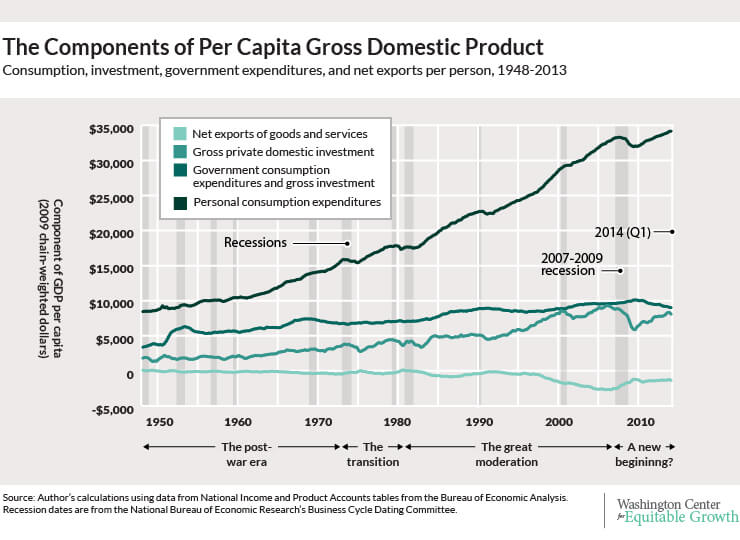
This report helps in that endeavor by looking at the past 65 years of economic growth in the United States—measured by examining our country’s Gross Domestic Product, both its rate of growth and sources of growth, from 1948 to 2014. The starting point, of course, is what this oft-cited statistic GDP actually measures. GDP is comprised of aggregate statistics based upon four major components: consumption, investment, government expenditures, and net exports.
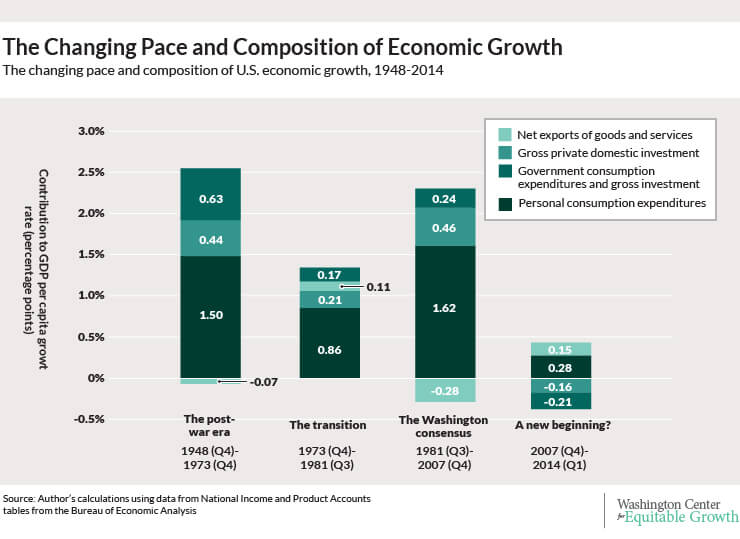
The report then looks at the overall growth of real (inflation adjusted) per capita GDP as well as the contributions of each component to growth over time, specifically over business cycles, or patterns of economic recessions and expansions. (See graph.)
Based on the overall trends, we divide the post-World War II into three eras of growth—the booming post-war period to the early 1970s (the fourth quarter of 1948 to the fourth quarter of 1973), the transition period to the early-1980s characterized by a series of economic shocks and high inflation (the fourth quarter of 1973 to the third quarter of 1981), and the ensuing period of low economic volatility and heightened growth known as the Great Moderation up until the start of the Great Recession in 2007 (the third quarter of 1981 to the fourth quarter of 2007).(See graph.)
Specifically, economic growth in the third period, leading up to the Great Recession, was:
The current business cycle, starting with the beginning of the Great Recession, appears to be the beginning of a new era—one tentatively defined by tepid consumer demand, stagnant real-wage gains, and growing economic inequality.
This report will have achieved its purpose if it spurs new thinking about how exactly we can and should promote economic growth in the United States.
Essays SEP 2, 2026
By: Megan Rivera
Essays AUG 31, 2026
By: Christopher Bangert-Drowns
Essays AUG 14, 2026
By: Carlos Fernando Avenancio-Leon
Get updates on our latest research, event announcements, and policy insights delivered straight to your inbox. Stay connected with the leading voices on equitable growth.