The consequences of political inequality and voter suppression for U.S. economic inequality and growth
Reports FEB 3, 2021
By: David S. Mitchell, Austin Clemens, Shanteal Lake
FEB 28, 2022
By: Kate Bahn and Carmen Sanchez Cumming
Different manifestations of inequality are among the most persistent features of the U.S. economy, yet mainstream economics traditionally explains disparities between groups solely as they relate to differences in either so-called human capital or a lack of economic competition. A subfield within the broader economics discipline, called stratification economics, instead studies and explains inequality as a process in which the outcomes of different groups are shaped by social relationships, power dynamics, and public policies.
Stratification economics is an empirically grounded approach to study disparities (opens in a new tab) across the lines of race, ethnicity, gender, class, caste, sexuality, nationality, and other social markers. This framework also incorporates the importance of social hierarchies and structures in shaping economic outcomes.
William “Sandy” Darity, Jr. is one of the founders of stratification economics. He is the director (opens in a new tab) of the Samuel DuBois Cook Center on Social Equity at Duke University and also a member of the Washington Center for Equitable Growth’s Research Advisory Board. Darity puts forth (opens in a new tab) that stratification economists hold certain assumptions about the processes by which economic and social disparities are created and maintained, as well as about the mechanisms through which they can be addressed. Specifically, these assumptions are that:
In this issue brief, we examine each of these insights in turn.
Under the stratification economics framework, the structures and processes that affect groups’ ability to transfer resources from one generation to the next are essential factors explaining persistent disparities between groups. Wealth inequality, for example, is understood as the result of a long-term process in which exclusionary social policies, property dispossession, and disparities in access to opportunities all have an effect on groups’ ability to pass on resources across generations. Further, stratification economics highlights the feedback loop associated with the generation, accumulation, and transfer of resources.
Darrick Hamilton, professor of economics and urban policy at the New School for Social Research and co-founder of stratification economics, for instance, explains (opens in a new tab) wealth generation this way:
We often think of wealth as an outcome, but its true essence is functional. Wealth empowers individuals to consume and invest in different ways. And wealth is iterative: Wealth often generates more wealth, both within and across generations. Wealthier families are better positioned to finance elite educations, access capital to start a business, finance expensive medical procedures, reside in higher amenity neighborhoods, exert political influence, purchase better counsel if confronted with an expensive legal system, leave a bequest, and withstand financial hardship resulting from any number of emergencies, including a global pandemic.
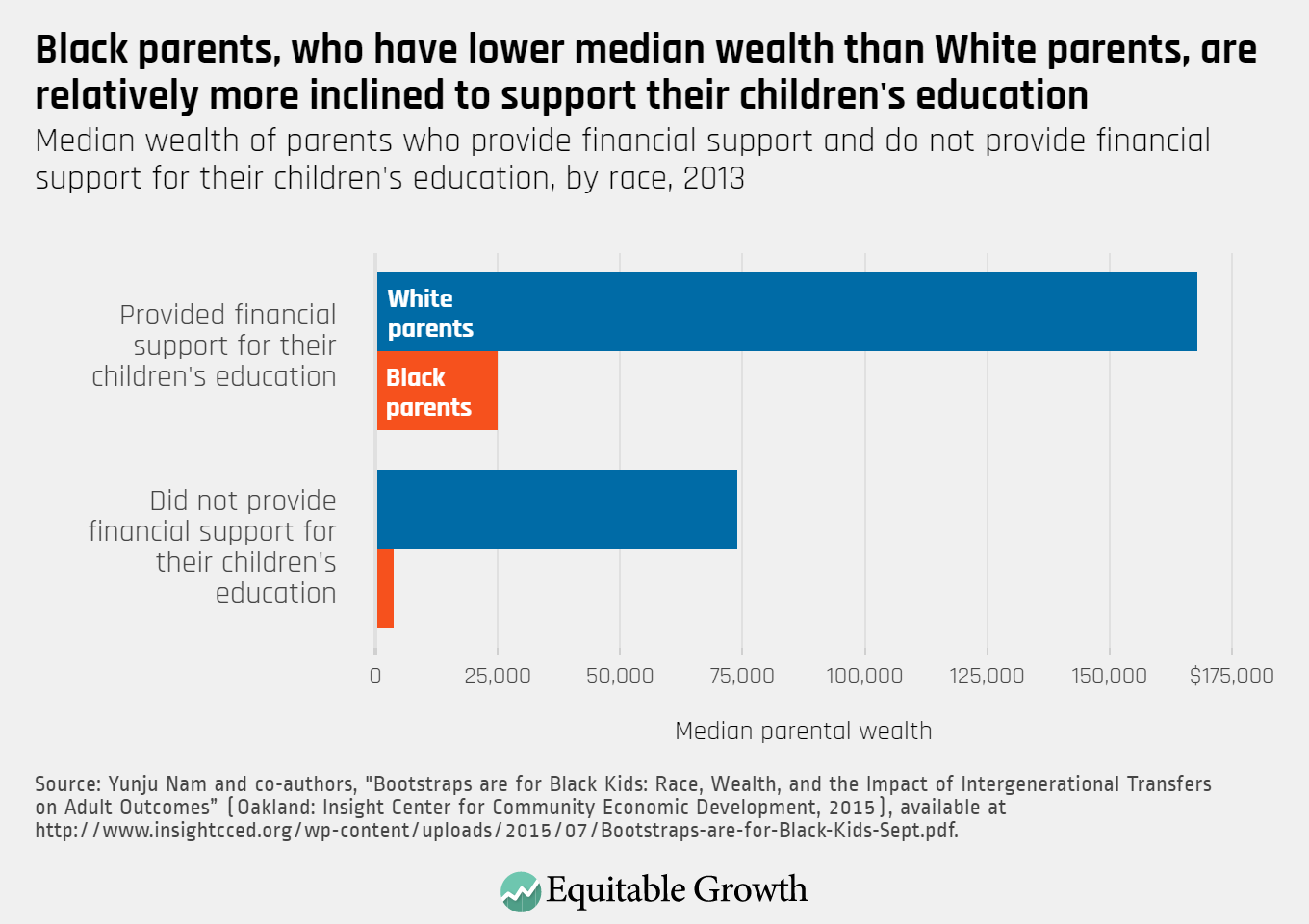
Several empirical studies support this view. Research shows that wealth and income divides between groups are important drivers of health (opens in a new tab), earnings, and educational (opens in a new tab) gaps. A study analyzing (opens in a new tab) the relationship between race and intergenerational transfers, for example, finds that disparities in families’ abilities to pass on resources have deep implications for long-term life outcomes. It shows that 34 percent of adult White children receive financial support from their parents to pay for higher education and 12 percent receive financial support for homeownership, while only 14 percent of Black adult children receive parental support for higher education and 2 percent receive it for homeownership.
The authors of this study also show that this divide is driven by disparities in economic resources rather than by preferences. This is because Black parents who do provide financial support for their children’s education do so at far lower levels of wealth than their White counterparts. (See Figure 1.)

Median wealth of parents who provide financial support and do not provide financial support for their children’s education, by race, 2013
Fewer resources to support higher education (opens in a new tab) create a number of knock-on effects that limit people’s abilities to achieve economic security. The wealth divide (opens in a new tab), for example, is one of the most important contributors to the higher levels of student debt (opens in a new tab) that Black students face. Higher levels of student debt are, in turn, associated with lower academic performance and degree completion (opens in a new tab), lower levels of wealth accumulation (opens in a new tab) over a lifetime, and lower financial well-being (opens in a new tab). As such, wealth and income divides also create barriers for the economic advancement of less privileged groups.
Or take unequal access to employment opportunities. Matthew Staiger at Opportunity Insights finds that by providing access to networks and better-paying jobs, the intergenerational transmission of employers—where a worker finds their first stable job at the same employer as a parent—gives those workers a large earnings boost that persists over time. Non-Black men with higher-earning parents, Staiger finds, benefit most from this intergenerational transmission of employers.
A similar dynamic is at play in housing. A study by Rachel Atkins at New York University’s Stern School of Business shows, for instance, that Black-White differences in housing wealth contribute to Black-White differences in the likelihood of starting a business (opens in a new tab). Atkins also finds that Black homeowners are less able to leverage their housing assets as collateral to fund entrepreneurial endeavors.
Scholars also study how policies and institutions create disparities in groups’ abilities to pass on resources across generations. For instance, the forced relocation of American Indians and Alaska Natives and other harmful federal government policies create big barriers (opens in a new tab) for members of these communities to own property and access affordable and high-quality financial institutions. Other examples include research on:
These are just a few of the lines of stratification economics research examining the consequences of unequal access to resources in the U.S. economy.
One of the most important insights of stratification economics is that privileged groups’ material interest in maintaining existing social hierarchies is a key driver of inequality. Segregation, discrimination, and exploitation, for example, are all understood as mechanisms by which more powerful groups keep and protect their higher position in a social hierarchy.
In recognizing that groups have a collective self-interest in maintaining or improving their relative standing, stratification economists understand and study efforts by dominant groups to uphold inequality as unjust, intentional, and rational.
To this point, several studies document how outsized political and economic influence in conjunction with structural racism and other forms of oppression create and entrench economic inequities. A number of scholars point out, for example, that despite the race-neutral language embedded in the New Deal legislation of the 1930s, the exclusion of domestic workers and farm workers from the National Labor Relations Act (opens in a new tab) of 1935 and the Fair Labor Standards Act (opens in a new tab) of 1938 reflect deliberately racist and sexist efforts by southern Democrats to preserve the cheap labor and social privileges. These exclusions were designed to preserve (opens in a new tab) the “quasi-plantation style of agriculture that pervaded the still-segregated Jim Crow South,” writes Juan Perea at the Loyola University of Chicago School of Law.
These findings are echoed in rhetoric about and around economic policy. In recent research, Chris Becker at Stanford University analyzed speeches from the Congressional Record and found (opens in a new tab) the pro-segregationist language of the Jim Crow era embedded in economic policy speeches of conservative politicians in the late 20th and the early 21st centuries. Becker proposes that even though the precise language is less explicitly racist, conservative political rhetoric around issues, such as government spending, taxes, and anti-poverty policy, maintain so-called dog whistles that lead to the racialization of economic issues, expand support for a right-wing economic agenda, and ultimately create barriers for the implementation of redistributive economic policies.
Other examples of dominant groups protecting their privileged positions include opposition to affordable housing projects (opens in a new tab) and voter suppression and income- and race-based barriers to voting. In the case of barriers to political participation and its relationship with economic inequality, research (opens in a new tab) by M. Keith Chen of the University of California, Los Angeles and his co-authors shows that voter wait times are significantly longer in areas where a higher proportion of residents are Black than in areas where residents are predominantly White, increasing costs associated with political participation for Black Americans. This disparity in voting wait times, the authors suggest, is likely a result of the systematic underresourcing (opens in a new tab) of Black neighborhoods.
Barriers to political participation, in turn, shape economic policy priorities when certain groups are disenfranchised. Research by Abhay Aneja of the University of California, Berkeley and Carlos Avenancio-León of the University of California, San Diego finds, for example, that the invalidation of the core provisions of the Voting Rights Act (opens in a new tab) in the Shelby County v. Holder Supreme Court decision of 2013 contributed to increases in income inequality. The authors propose that removing voting rights protections, such as oversight by federal election monitors in counties that had been found to engage in voting discrimination, seem to have had knock-on effects by hindering disadvantaged groups’ political power and widening wage divides in public-sector employment.
Stratification economics centers the role of policies and institutions in alleviating—as well as perpetuating—social and economic disparities between different groups. For instance, the standard view of mainstream economics is that discrimination declines over time (opens in a new tab) as competition progressively makes discriminatory firms inefficient and unprofitable, ultimately driving them out of business. While research does show that robust competition can lead to more equitable outcomes, stratification economists recognize that structural inequities, such as systemic racism and sexism, are long-lasting, persistent, and unlikely to disappear in the absence of effective public policies.
Empirical research shows that deep-rooted inequities, such as racial income divides, have only substantially narrowed because of proactive government efforts. The enforcement of anti-discrimination protections (opens in a new tab) by the U.S. Equal Employment Opportunity Commission, for example, shapes the processes of racial desegregation in the workplace, with more resources and political will channeled toward enforcement fostering integration and lax enforcement reducing integration or stalling it altogether.
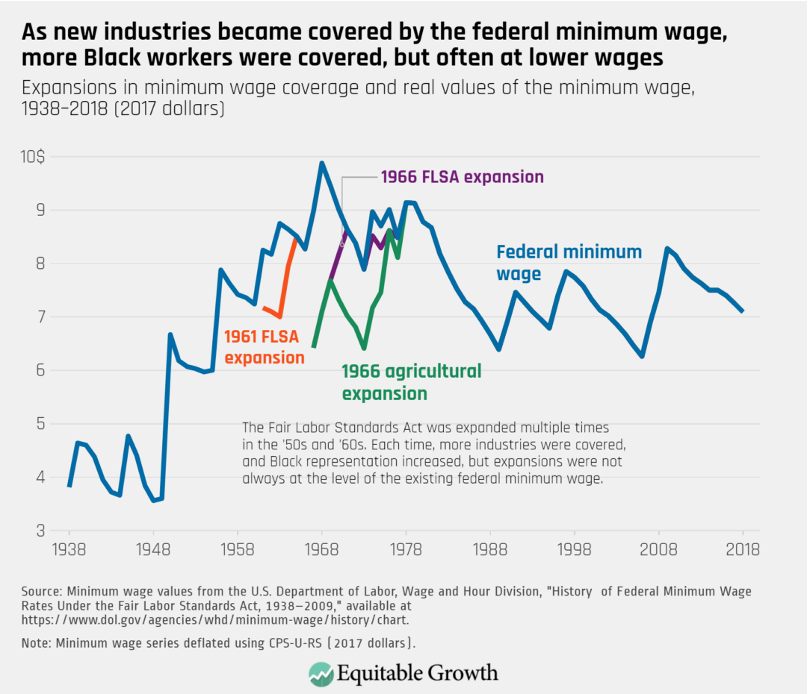
Similarly, research by Ellora Derenoncourt at Princeton University and Claire Montialoux at the University of California, Berkeley, finds that the Black-White income divide narrowed substantially as minimum wage protections under the Fair Labor Standards Act were extended in the 1960s to industries in which Black workers where overrepresented, such as restaurants and hospitality. Yet the authors also find that the real value of the minimum wage has declined after it was expanded to cover more Black workers. (See Figure 2.)

Expansions in minimum wage coverage and real values of the minimum wage, 1938-2018 (2017 dollars)
Other studies find that effective public policies to alleviate discrimination also include the enactment of Civil Rights era legislation and government agencies, such as the Equal Employment Opportunity Commission (opens in a new tab), and the launch of federal affirmative action programs (opens in a new tab). These efforts are all associated with a decline in economic inequality along the lines of race.
Stratification economists are not only concerned with explaining the consequences of social and economic inequality but also study, propose, and design policies to address them. Dania Francis at the University of Massachusetts, for example, examines how a reparations program in the United States can be designed to effectively address the legacy of slavery, the state-sanctioned discrimination that followed the Civil War, and the systemic racism that continues to hinder the ability of descendants of enslaved people in the United States from building wealth and achieving economic security.
Other such examples include the creation of a so-called baby bonds program that would establish a public trust account for children at birth. Naomi Zewde of the City University of New York, for example, estimates that a baby bonds program (opens in a new tab) inversely tied to family wealth up to a maximum $50,000 investment would reduce the wealth disparity between young White Americans and young Black Americans. Zewde’s estimates show that while young White Americans currently hold about 16 times the wealth of their Black counterparts, a baby bonds program would reduce that number to less than 2 times after about 25 years. These programs thus demonstrate the transformative potential of public policy designed to address the economic impact of structural racism.
Stratification economists analyze inequality and discrimination as phenomena that are not mitigated through an individual’s acquisition of educational credentials. For instance, wage divides between different groups of workers are often explained and understood solely in terms of differences in the acquisition of human capital—disparities in the possession of skills, knowledge, and formal education that are associated with greater or lesser economic rewards. Yet empirical studies reveal that even when comparing individuals with similar backgrounds and human capital characteristics, race, ethnicity, gender, nationality, and the interaction between these social markers often result in economic premiums and penalties (opens in a new tab) that cannot be accounted for by the factors economists traditionally associate with productivity.
Research shows, for instance, that even when accounting for a variety of factors—such as formal educational attainment, years of work experience, geography, family formation, occupation, and years of work—racial and gender pay divides among workers persist. What scholars call “unexplained pay penalties,” moreover, are strikingly persistent features of the U.S. labor market, hurting women (opens in a new tab), workers of color (opens in a new tab), foreign-born workers, and LGBTQ workers (opens in a new tab) and harming the labor market outcomes of those who possess multiple marginalized identities at once, as is the case of Black women.
In addition, there is evidence that higher levels of human capital are sometimes associated with even greater pay disadvantages. An analysis (opens in a new tab) by Elsie Gould and Teresa Kroeger at the Economic Policy Institute finds that women workers are not only paid less than men at every level of formal education, but also that the gender pay divide actually widens as workers acquire more educational credentials. Specifically, Gould and Kroeger find that while women with a high school degree are paid about 80 percent of what men with a high school degree are paid, women with an advanced degree are paid 73 percent of what men with the same level of education are paid.
Negative stereotyping against discriminated groups, as well as individualistic economic frameworks, are often used to conclude that disparities in outcomes are primarily, if not solely, the result of either individual behaviors or cultural practices, with the implication that policies are most effective when designed to nudge individual behaviors without interfering in the functioning of the market. The debate over income supports in the United States, for example, is often laden with racial stereotyping (opens in a new tab) that is neither reflective of the reality of low-income Americans nor conducive to fostering upward economic mobility.
Ann Cammett of the City University of New York School of Law writes about how racialized stereotypes (opens in a new tab) of dysfunctional parents—such as so-called deadbeat dads or welfare queens—reduce support for policies, such as cash assistance programs, and shape these and other poverty alleviation measures. Such stereotypes eroded the size and efficiency of income support systems. This, in turn, hinders their ability to support economic security. Research shows how income supports increase earnings for low-wage workers by alleviating poverty as a foundation for upward mobility.
Then, there’s the bias evident in explanations of inequality based on individual responsibility or cultural practices. Research demonstrates how the legacy of slavery (opens in a new tab) contributes to persistent racial economic inequality in the United States today, yet policies that emphasize “financial literacy” to address wealth inequality reorient the solution toward individual responsibility based on the premise that current outcomes are reflective of group-based characteristics. As Darity and Hamilton have noted (opens in a new tab), despite a widespread belief that Black households have less financial acumen, Black households save at similar rates (opens in a new tab) as White households when controlling for income. Furthermore, this is the case despite low-income Americans facing significant barriers to banking access (opens in a new tab).
Stratification economics shifts away from explanations that center personal responsibility and cultural practices as key drivers of inequality. Instead—and using the empirically grounded tools of the economics discipline—it highlights the role of structures, institutions, exploitation, and public policy in upholding the conditions that generate inequality between groups. Stratification economics contributes to the scholarly understanding of the causes and consequences of intergroup inequality and how to address longstanding inequities to inform public policy design so that the country can reach more equitable outcomes.
Reports FEB 3, 2021
By: David S. Mitchell, Austin Clemens, Shanteal Lake
Blog AUG 7, 2018
By: Mark Paul, Darrick Hamilton, William Darity Jr.
Issue Briefs MAY 28, 2021
By: Kate Bahn, Carmen Sanchez Cumming
Get updates on our latest research, event announcements, and policy insights delivered straight to your inbox. Stay connected with the leading voices on equitable growth.