



Policy
What Work Does Generative AI Do?
Essays SEP 8, 2026
By: Alexander Bick, Adam Blandin, David Deming, Tyler Schumacher
AI, Tech & Energy
Labor, Wages & Worker Power
 Browse All Resources
FEB 13, 2025
By: Kevin Rinz
After the tumultuous swings of the early COVID-19 pandemic period and years of normalization since then, economic data from the past several months suggest that the U.S. labor market may have stabilized. While certain measures point to some cooling since the hottest post-pandemic period—in April 2023, for example, the unemployment rate was as low as 3.4 percent—they also indicate that the labor market remains strong by historical standards. (See Figure 1.)
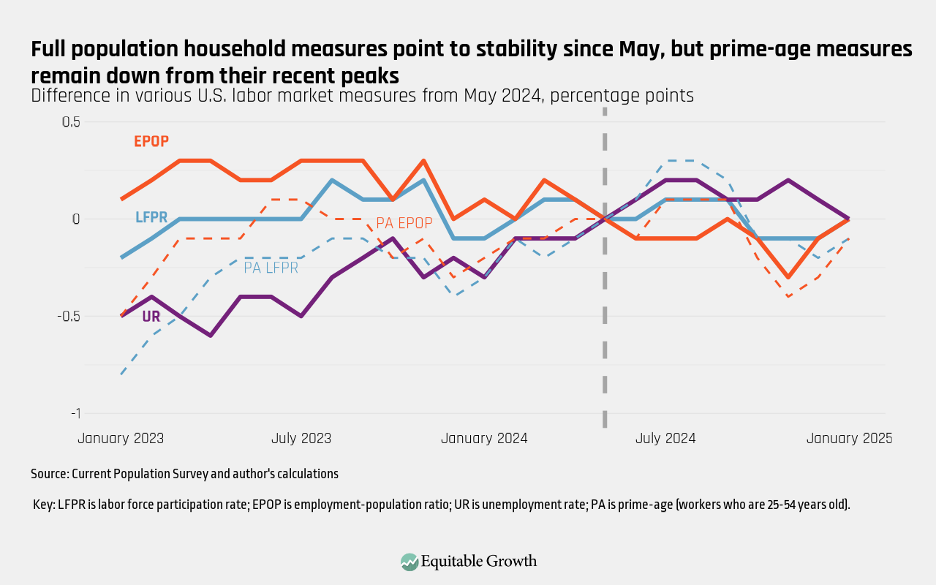
Difference in various U.S. labor market measure from May 2024, percentage points
Data from the Job Openings and Labor Turnover Survey, which measures monthly employment dynamics, have generally been weaker than one would expect based on data from the jobs report (that is, the JOLTS data are more in line with values seen when the unemployment rate was meaningfully higher in 2013–2014). Yet even these data have shown some potential stabilization in measures of labor demand since last summer: The hires and quits rates are the same as they were in July 2024, and the job openings rate, while more volatile, is down only slightly. Each of those measures had trended down consistently since early 2022. (See Figure 2.)
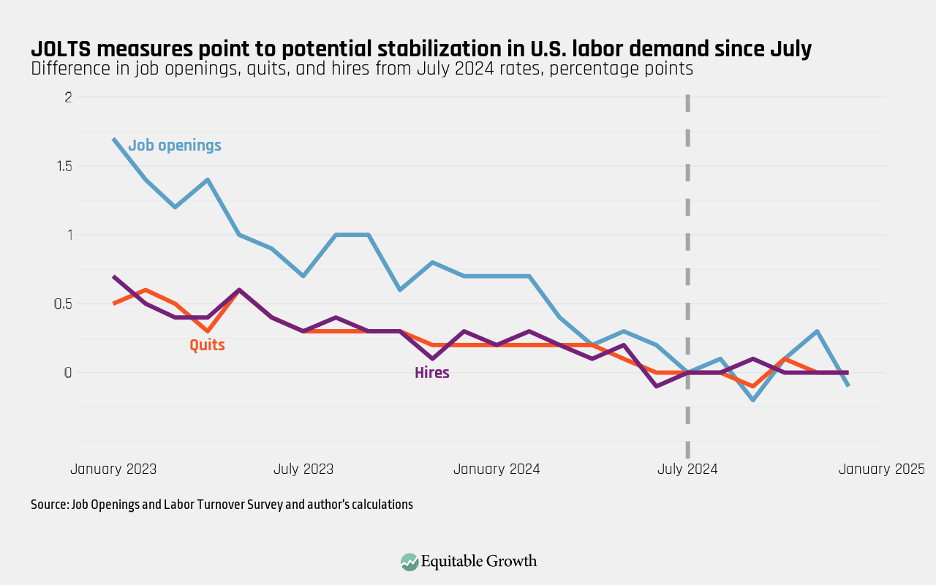
Difference in job openings, quits, and hires from July 2024 rates, percentage points
Alongside this stabilization of employment dynamics, nominal wage growth (opens in a new tab) also has been relatively stable, on balance, since mid-2024. Depending on the measure being used, annual nominal wage growth over that period has declined by 0.4 percentage points or more (according to the Employment Cost Index (opens in a new tab) based on wages and salaries of private industry workers or on the Atlanta Fed’s wage growth tracker (opens in a new tab)), while other data indicate that annual nominal wage growth has been virtually unchanged (based on average hourly earnings of production and nonsupervisory workers (opens in a new tab)) or has increased by about 0.15 percentage points (per the average hourly earnings of all workers (opens in a new tab) or median usual weekly earnings (opens in a new tab) of workers employed full-time). At the end of 2024, annual wage growth ranged from 3.6 percent to 4.2 percent across these measures. (See Figure 3.)
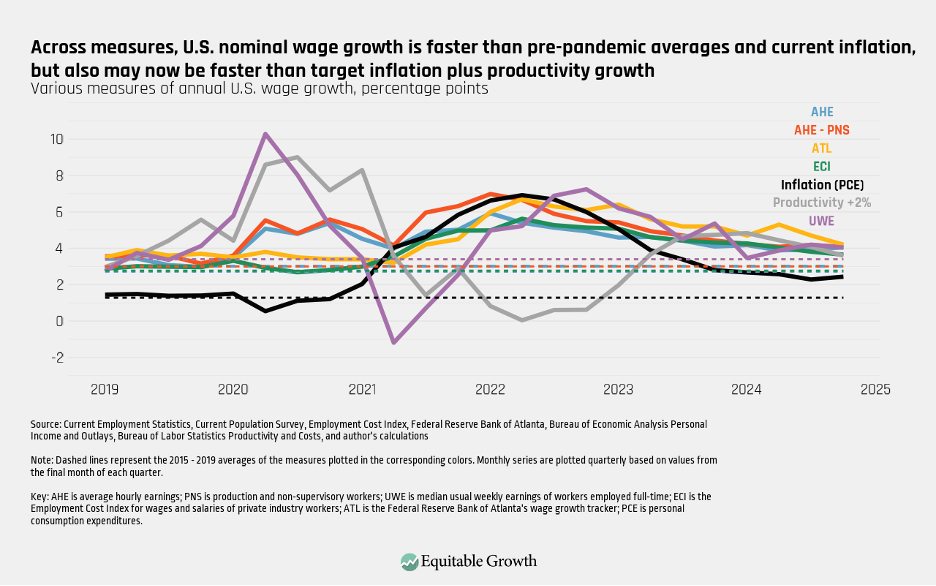
Various measures of annual U.S. wage growth, percentage points
Six months ago, prior to this stabilization, weak and weakening JOLTS data suggested that the then-ongoing slowdown in nominal wage growth could continue to the point at which real wage gains would evaporate, threatening the labor market’s ability to deliver material gains for workers. With employment rates, wage growth, and inflation having held approximately steady since then, though, it is worth reassessing how these data figure into U.S. workers’ bottom lines going forward.
To that end, there are three important facts about nominal wage growth to keep in mind:
Faster nominal wage growth is good for workers to the extent that it exceeds inflation. Because annual PCE inflation is also running a little more than 1.1 percentage points above its 2015–2019 average, current real wage gains are not meaningfully larger than the gains experienced before the pandemic, despite faster nominal growth.
Those real wage gains could become more vulnerable if productivity growth continues to decline and nominal wage growth starts to put more upward pressure on prices. Higher inflation directly threatens workers’ ability to take advantage of real wage gains, but so could the remedy for it—following interest rate hikes over the course of 2022, employment growth in interest-rate-sensitive sectors has declined (opens in a new tab) relative to the rest of the U.S. economy.
Consumers want interest rates to be lower (opens in a new tab), but inflation remains above the Fed’s target. Consumer price data for January 2025 highlighted (opens in a new tab) this persistent elevation: On an annual basis, inflation increased to 3 percent, and on a monthly basis, inflation was higher than the previous month for the sixth time in the past 7 months. Progress toward the 2 percent target seems to have stalled.
Both productivity and wage growth measures can be noisy, so it is far from certain that nominal wage growth is putting or will continue to put upward pressure on prices. The productivity growth buffer between nominal wage growth and inflation, however, seems to have shrunk. Further moderation in wage growth could help inflation progress back toward 2 percent without necessitating higher interest rates, even if productivity growth does not reaccelerate or returns to the lower levels seen during the previous business cycle.
 Did you find this content informative and engaging?
Get Updates
Did you find this content informative and engaging?
Get Updates
Essays SEP 8, 2026
By: Alexander Bick, Adam Blandin, David Deming, Tyler Schumacher
Working Papers SEP 8, 2026
By: Alexander Bick, Adam Blandin, David Deming, Tyler Schumacher

Essays SEP 2, 2026
By: Megan Rivera
Get updates on our latest research, event announcements, and policy insights delivered straight to your inbox. Stay connected with the leading voices on equitable growth.


