





Policy
What Work Does Generative AI Do?
Essays SEP 8, 2026
By: Alexander Bick, Adam Blandin, David Deming, Tyler Schumacher
AI, Tech & Energy
Labor, Wages & Worker Power
 Browse All Resources
OCT 31, 2016
By: Bradley Hardy
About the author: Bradley L. Hardy is an assistant professor in the Department of Public Administration and Policy at American University
Many low-income individuals and families also have highly unstable incomes between weeks, months, and years.151 This “income volatility” is an economic phenomenon driven largely by earnings, with a tendency to rise during recessions,152 and is attributed to short-term economic shocks such as job loss as well as larger, permanent structural changes throughout the economy,153 including the decline of blue-collar manufacturing jobs and the emergence of part-time and contingent work arrangements.154
Survey-based data suggest that volatility has been on the rise for most families, and I argue that this warrants concern for three reasons related to imperfections in the economy and social welfare policy:
This essay examines these three issues and then offers several different policy solutions to the problems.

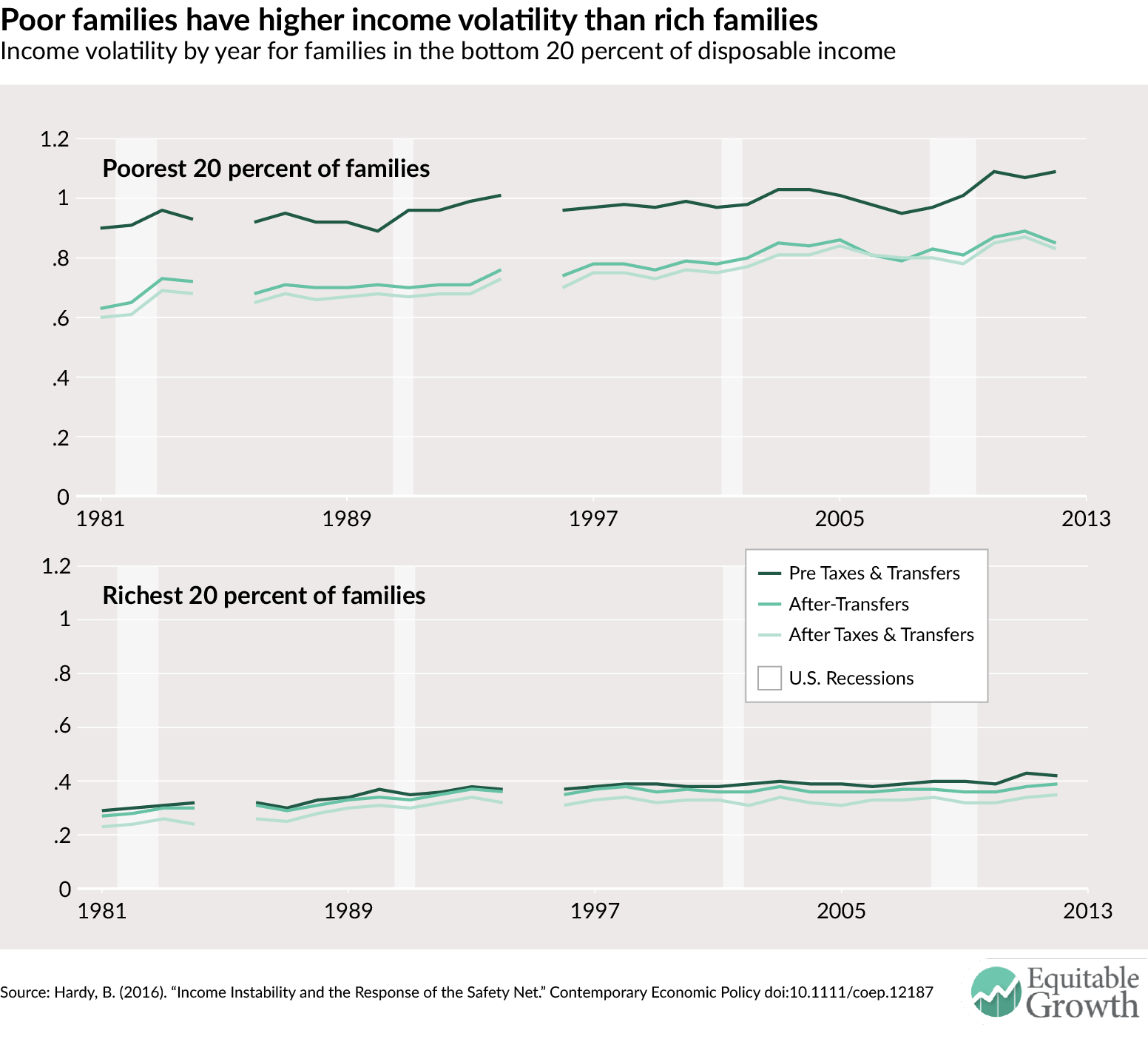
Over the past 30 years, income volatility155 is highest among the nation’s poorest families. Tabulations in Figure 1 using the U.S. Census Bureau’s 1980-2013 Current Population Survey show that income volatility is highest for low-income families—those in the bottom 20 percent of the income distribution. Higher income households, in the top 20 percent of the income distribution, in turn have the lowest levels of volatility. Thus, poor families are effectively stuck with the worst possible financial portfolio—one with a low mean and high variability. While transfer policies could perform better, they do benefit low-income families by reducing income volatility, whereas higher income families are buffered from income volatility by the tax system. (See Figure 1.)
Previous article: The tipped minimum wage (opens in a new tab), Sylvia A. Allegretto
Next article: Early childhood development, Ariel Kalil
Many low-wage workers and their families lack access to savings and also face imperfect capital markets and limited access to loanable funds.156 Such families may be denied loans or credit cards that allow for consumption smoothing against negative income shocks—perhaps the first solution many households pursue when faced with an unanticipated expense or income shortfall. Whether due to displacement from employment altogether or unpredictable hours, credit and loan denials can lead to far costlier alternatives such as payday lenders. Such financial streams provide financial assistance for low-income families facing liquidity constraints, but they do so at interest rates that can exceed 100 percent and cause longer-term damage to borrowers.157
This stands in contrast to the predictions derived from standard economic models which perhaps better characterize the circumstances of higher income families in a position to save more and then draw upon those same savings in the event of an unanticipated negative income shock. Similarly, higher income families possess greater access to credit markets that can serve the same purpose in response to temporarily low income.
Low-income workers with children face higher income volatility on average, and are less likely to have affordable access to credit markets. These families are increasingly underserved by the nation’s welfare program—Temporary Assistance for Needy Families, or TANF. This program could be altered to be more responsive for low-income workers with volatile income. Returning to Figure 1, the after-transfer reduction of income volatility from safety net programs is somewhat diminished in the post-1996 years, coincident with the new welfare reform law enacted at the time. This appears to be the case as well for female-headed families, and black families.158
This is consistent with the dramatic fall in TANF caseloads since the middle 1990s. The program today provides less in cash assistance per case than in the 1980s and 1990s, and appeared to be unresponsive during the Great Recession of 2007-2009.159 The welfare reform law that created TANF occurred amid a large economic expansion, and the program should be adjusted to reflect new realities.
Income volatility is driven by a combination of aggregate macroeconomic shifts alongside individual-level events such as job losses and gains. Especially for low-income and less-educated workers, this volatility is indicative of a riskier labor market. With these conditions in mind, the first set of solutions presented below are the most ambitious and call for reforms to TANF and the Supplemental Nutrition Assistance Program, or SNAP. The reforms would enhance job training in sectors of high local-labor demand, providing both financial and employment support, suspend time limits on TANF assistance, create minimum state requirements for the provision of TANF cash assistance, and increase SNAP generosity.
The remaining solutions presented below would provide families with greater liquidity to buffer against economic risk and uncertainty through an expanded Unemployment Insurance system. These reforms also would reconsider program recertification periods and re-introduce advance Earned Income Tax Credits (as an elective option for tax filers. Below, I summarize each of these policy solutions.
As a share of gross domestic product, the United States lags several other developed countries’ investments in job training.160 I recommend expanding allowable work-related activities to include education and job training with cash assistance during the training period, up to 3 years.161
Following the spirit of recent reform proposals by Georgetown University public policy professor Harry J. Holzer related to community colleges,162 such training programs would include community college career training, and would be coordinated with Workforce Innovation and Opportunity Act providers and, as a result, be deemed by WIOA providers as subject-training areas of high local-labor demand to ensure trainees have strong employment prospects.163 States would be encouraged to include non-custodial parents in such training programs, and job-seekers within TANF would be eligible for public-sector employment and infrastructure jobs as they become available.164 Due to years of under-investment, there are labor shortages and opportunities to train workers in local sectors with high demand, including healthcare as well as elements of the nation’s aging transportation, water, and electricity infrastructure-related trades.
Income volatility is a reflection of an increasingly competitive, dynamic, and at times unpredictable employment situation in the United States, particularly among low-income and less-educated workers. The Temporary Assistance for Needy Families program can help buffer against this risk by suspending time limits under qualifying circumstances while maintaining work requirements. Approved education and training would be permitted to occur full time and without work/job search, and would not count against the 5-year federal time limit—stopping the clock. Adults who satisfactorily complete TANF- and WIOA-approved education and training and/or engage in continuous job search efforts would receive assistance, even if they breach the time limit.
Next, states would be required to allow qualifying recipients to remain on welfare for the entire 5-year federal time limit—the current policy sets five years effectively as a maximum with a state option to provide extended benefits, but this would now be a minimum standard. Finally, following the recommendations of Marianne Bitler at the University of California-Davis and Hilary Hoynes at the University of California-Berkeley,165 time limits would be suspended during periods of high local unemployment or joblessness, much like the allowable suspension for high local unemployment in the Supplemental Nutrition Assistance Program for able-bodied adults.
Importantly, work requirements would remain in place, and TANF participants would still be subject to sanctions and removal via administrative rules and/or rules violations. This modified version of TANF—with its work requirements and rules—retains a design promoting temporary participation relative to the predecessor policy, whereas time limits in their current form in some states potentially undermine the capacity of the program to respond to changing economic circumstances.
Welfare reform had unintended consequences, one of which was the dramatic decline in cash benefits. While there is fairly broad consensus that the program rightly emphasizes employment, many states have done so at the expense of maintaining a cash safety net for vulnerable families with children. In some instances, states are merely responding to financial incentives from the block-grant design of TANF to plug a variety of budgetary holes where available, and spending has moved from cash assistance to non-assistance in the post-welfare reform era.166
Following the recommendations of Bitler and Hoynes, I recommend that states be required to spend at least 25 percent of their TANF funds on cash assistance.167 Increasing cash assistance will help to ensure that the nation’s most vulnerable families are better protected against negative income shocks.
Workers with low, volatile income are increasingly reliant on programs such as SNAP and the Earned Income Tax Credit. Recent evidence suggests that caseload declines throughout 2016 are being driven in part by states that are implementing the 3-month SNAP time limit for so-called ABAWDs—able bodied adults without dependents.168 I and my co-authors in a 2015 working paper show that SNAP participation is increasingly predicted by structural economic variables such low wages and the decline of full-time employment.169 To account for this, the work requirement for ABAWDs could be lowered to 10 hours per week, from 20 hours. These low-wage workers are also more likely to face long, costly commutes that preclude the most time consuming, cost efficient forms of food preparation. With this in mind, I follow the recommendations of University of Kentucky economist James P. Ziliak for SNAP benefits to be increased to account for higher food preparation costs and transportation costs.170
The Earned Income Tax Credit is the largest cash transfer for the working poor. While the EITC program has well-documented employment and anti-poverty benefits, it is not constructed to address income volatility in its current form. First, the refund occurs as a lump sum at tax time. While this benefits families as a form of precautionary savings, those that face weekly or monthly income shortfalls do not benefit from support that is backloaded until tax season.
Re-introducing an optional Advance EITC, whereby filers could elect to have the EITC distributed paycheck-to-paycheck over the entire year, would provide families with several thousand dollars of immediate income support.171 Hybridized versions similar to the Advance EITC would allow a portion of the full EITC to be made available throughout the year.172 Although participation in the Advance EITC program was low prior to being discontinued in 2011, employers and human resources professionals could more aggressively promote it as a financial tool.
The Earned Income Tax Credit is of little or no use for low-income individuals who are jobless—by design EITC receipt is predicated on labor market earnings.173 At the same time, a growing share of workers are part-time and many have work-history gaps leaving them uncovered by the current Unemployment Insurance system.
Rachel West and her co-authors at the Center for American Progress offer a range of suggested reforms to the Unemployment Insurance system that would provide financial incentives for workers who find new employment in a lower paying job—from covering part-time workers to covering workers with less than five quarters of work history.174 These workers, varying state-to-state, generally lack protection via the unemployment insurance system. Many hold more than one part-time job, and do so in the absence of access to stable, full-time employment. Such reforms can provide an important buffer in the event of earnings loss due to unemployment, and would reflect the modern growth in part-time, contingent work arrangements. In the absence of substantial Unemployment Insurance reform, the aforementioned TANF solutions loom especially large—many individuals are currently underserved by both programs.
In some states, low-income families participating in SNAP, TANF, Medicaid, and low-income housing assistance are required to provide eligibility verification, by program, throughout the year. As a consequence, many such households flow in and out of eligibility for these programs, raising the possibility that families lose out on benefits when they find themselves to be temporarily in need—or when complexity in the renewal process causes qualifying families to cycle off the program. Currently the typical program requires re-certification at a rate of every six months to one year. I recommend extending recertification periods to once per year while simplifying and aligning recertification across safety net programs.
Income volatility is highest among lower income and less-educated Americans. While the safety net provides some buffer against volatility, changes can be made to better address the reality of low and volatile income. Some firms see this need, and are introducing flexible pay plans that allow workers to withdraw their earned income on a daily basis to meet immediate consumption needs that arise between pay periods.175 Still, such private initiatives are working at the margins of a larger challenge—many workers find themselves unemployed or under-employed in sectors of the economy offering low, unpredictable earnings.
Moreover, many families lack the resources to buffer against negative and unanticipated economic shocks. To address this, the safety net can provide greater cash assistance via TANF and SNAP, including financial assistance to support families while they participate in approved job training as well as during periods of high unemployment. Such assistance would operate in part through a conditional suspension of time limits in TANF. In addition, part-time and less-experienced workers should have greater access to the unemployment insurance system, and the working poor and near poor could benefit from an optional Advance EITC that spreads the credit over the year.
Taken together, the policy recommendations put forth in this essay aim to address income volatility among low-income workers by providing greater liquidity and insurance against negative shocks while providing a wider range of job training opportunities to move workers into higher demand, stable employment opportunities. These policies retain the values of work that are embedded in the current set of programs while providing a pathway for workers to respond to economic risks that characterize today’s dynamic, globally competitive economy.
Essays SEP 8, 2026
By: Alexander Bick, Adam Blandin, David Deming, Tyler Schumacher
Working Papers SEP 8, 2026
By: Alexander Bick, Adam Blandin, David Deming, Tyler Schumacher

Essays SEP 2, 2026
By: Megan Rivera
Get updates on our latest research, event announcements, and policy insights delivered straight to your inbox. Stay connected with the leading voices on equitable growth.


