



Policy
What Work Does Generative AI Do?
Essays SEP 8, 2026
By: Alexander Bick, Adam Blandin, David Deming, Tyler Schumacher
AI, Tech & Energy
Labor, Wages & Worker Power
 Browse All Resources
AUG 26, 2021

The U.S. government expanded Unemployment Insurance and support for families with children amid the coronavirus pandemic to a degree unprecedented in recent history (opens in a new tab). Preliminary estimates of these expansions show their positive impacts on U.S. households. These income support programs are, among other things, reducing child poverty (opens in a new tab) by almost 50 percent and ensuring parents who lose their jobs through no fault of their own can keep paying for everyday necessities such as rent and groceries.
Yet the expansion of Unemployment Insurance (opens in a new tab) and the Child Tax Credit (opens in a new tab) are only temporary. Congress will soon begin debating whether to make these measures permanent. As policymakers consider the implications of permanently improving our nation’s social infrastructure, they should look at the impact of income support on wages and poverty (opens in a new tab) across the U.S. workforce.
My new working paper finds that broader accessibility to household income support leads to positive labor market outcomes for workers. Some think expanding income support will increase the likelihood of low-wage workers choosing unemployment over work (opens in a new tab). My research, however, finds the opposite: Low-wage workers in households falling into poverty who receive greater income support are more likely to not only remain employed, but also start earning higher wages.
Although 80 percent of low-wage workers are not in poverty, low-wage work and poverty are often conflated. The low-wage labor market (opens in a new tab) encompasses those workers earning less than $14 per day in 2021 dollars, using the international standard definition (opens in a new tab). This is currently about 25 percent of all workers in the United States and has remained a relatively stable share of the labor force for at least the past 50 years. (See Figure 1.)
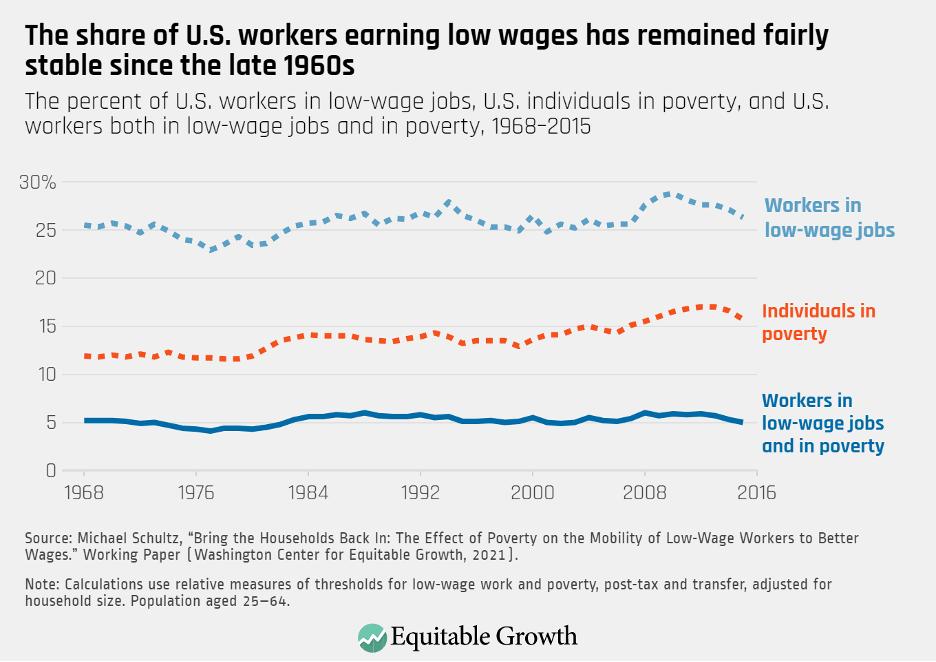
The percent of U.S. workers in low-wage jobs, U.S. individuals in poverty, and U.S. workers both in low-wage jobs and in poverty, 1968–2015
It’s important to note that poverty is a household economic situation, not a permanent status. Most households in poverty are in poverty for only a year (opens in a new tab). Consequently, low-wage workers in poverty and not in poverty are similar in terms of education, work experience, jobs, and demographic characteristics, such as age, race, and gender. This also helps explain why, as Figure 1 shows, only about 20 percent of low-wage workers are in households in poverty in any given year, using the international standard definition (opens in a new tab) of the poverty rate.129
My research sheds light on the interaction between low-wage work and poverty. I estimate what economists call “individual wage mobility”—the movement of low-wage workers up and down the lower rungs of the earnings ladder—for households in and not in poverty in the previous year.
Using a nationally representative survey called the Panel Study of Income Dynamics (opens in a new tab) that follows U.S. households and the individuals within them over time, I find that about 30 percent of low-wage workers who experienced poverty in the previous year move to better wages within 2 years, compared to 45 percent of low-wage workers who did not experience poverty in the previous year. (See Figure 2.)
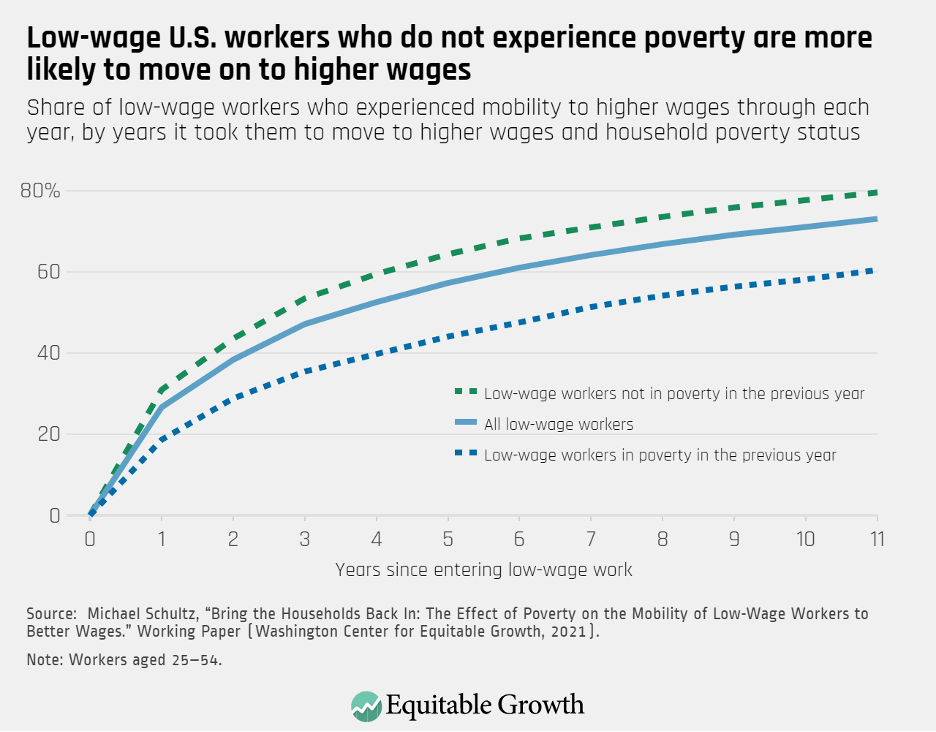
Share of low-wage workers who experienced mobility to higher wages through each year, by years it took them to move to higher wages and household poverty status
Simply put, falling into poverty disrupts households. Household disruptions make it more difficult for workers to search for alternative jobs (opens in a new tab). Finding alternative jobs is one of the primary ways workers in the U.S. labor market gain a wage increase. Disrupted households must divert more resources, such as time and money, to address the disruptions, limiting the ability to search for new jobs.
Households falling into poverty face the challenge of greater disruption with fewer resources to manage that disruption. Greater losses of household income when falling into poverty are an approximation of greater household disruption. Consistent with this explanation, I find that low-wage workers whose households lose a greater share of their household income when falling into poverty have lower rates of mobility out of low-wage work. (See Figure 3.)
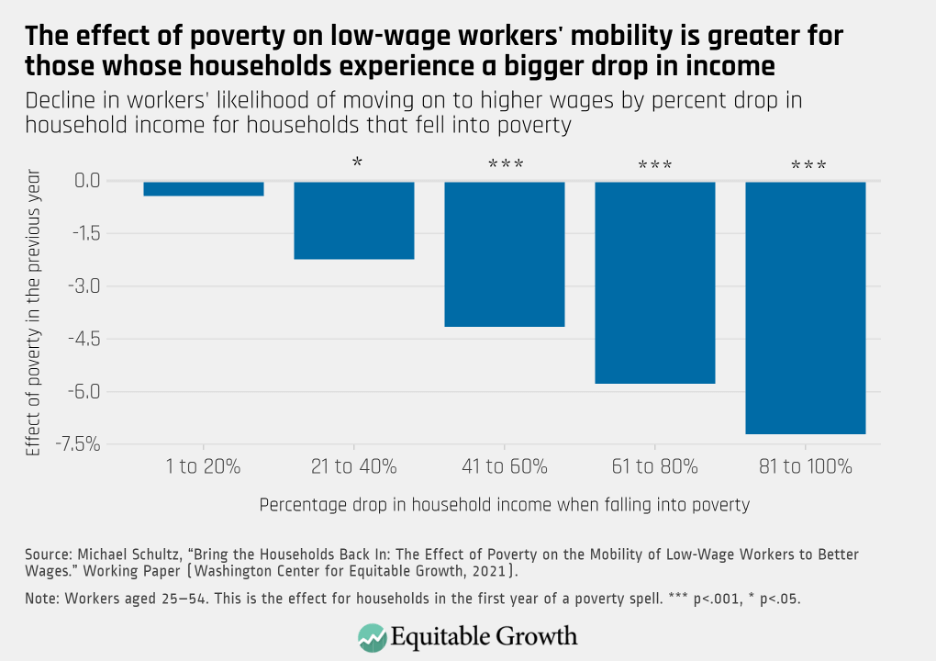
Decline in workers' likelihood of moving on to higher wages by percent drop in household income for households that fell into poverty
I also find that workers in households experiencing longer poverty spells—of 3 or more years—are much less likely to move out of low-wage work than those workers in households in the first 2 years of poverty. Income support keeps households from falling deeper into poverty and helps shorten the time a household remains in poverty.
My study then estimates how other characteristics explain why workers in poverty households are less upwardly mobile. I find that human capital factors, such as education and work experience, explain just 20 percent of the difference in mobility outcomes among workers in households either experiencing or not experiencing poverty. Much more significant is a household’s resources, such as household savings and average income across the previous 3 years, which explains 60 percent of the poverty gap in mobility.
Essays SEP 8, 2026
By: Alexander Bick, Adam Blandin, David Deming, Tyler Schumacher
Working Papers SEP 8, 2026
By: Alexander Bick, Adam Blandin, David Deming, Tyler Schumacher

Essays SEP 2, 2026
By: Megan Rivera
Get updates on our latest research, event announcements, and policy insights delivered straight to your inbox. Stay connected with the leading voices on equitable growth.


