



Policy
What Work Does Generative AI Do?
Essays SEP 8, 2026
By: Alexander Bick, Adam Blandin, David Deming, Tyler Schumacher
AI, Tech & Energy
Labor, Wages & Worker Power
 Browse All Resources
MAR 5, 2021
By: Kate Bahn and Carmen Sanchez Cumming

One year after the onset of the coronavirus recession, the U.S. labor market is still a long way from its February 2020 employment levels, but saw important job gains last month. According to the latest Employment Situation Summary by the U.S. Bureau of Labor Statistics, the U.S. economy in February added 379,000 nonfarm payroll jobs—the greatest month-over-month gain since October of last year.
Today’s release also shows that between mid-January and mid-February the overall unemployment rate fell from 6.3 to 6.2 percent, with 50,000 workers re-entering the U.S. labor force. Across sectors, last month’s job gains were concentrated in leisure and hospitality, which added 355,000 jobs. Yet data on employment changes over the entire year show that the downturn remains especially hard for this sector and for service-providing industries in general. (See Figure 1.)
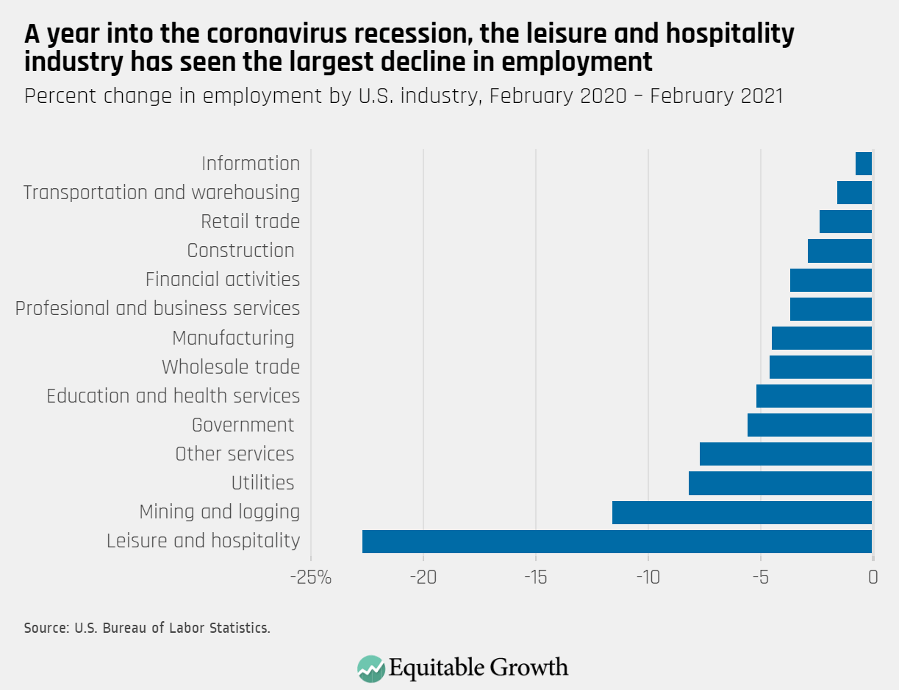
Percent change in employment by U.S. industry, February 2020–February 2021
The economic pain brought on by the downturn continues to fall heaviest on some groups. The jobless rate stands at 9.9 percent for Black workers, at 8.5percent for Latinx workers, at 5.1 percent for Asian American workers, and at 5.6 percent for White workers. Disaggregating the data further shows that over the past 12 months, net job losses have been greatest for Black and Hispanic women and men—groups for whom employment declined by 9.7 percent and 8.6 percent, respectively. (See Figure 2.)
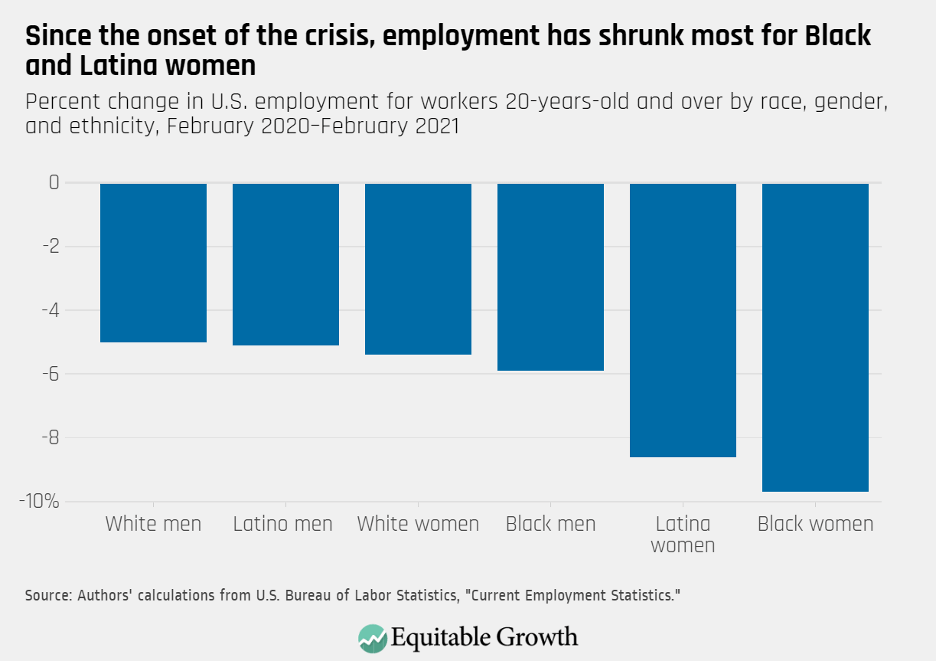
Percent change in U.S. employment for workers 20-years-old and over by race, gender, and ethnicity, February 2020–February 2021
As the U.S. economy went into a pandemic-driven tailspin one year ago, almost 21 million workers lost their jobs between mid-March and mid-April alone. In February 2021, the U.S. labor market is short 9.5 million jobs relative to February 2020. These losses remain starkest for Black and Latina women, and other vulnerable groups of marginalized workers, highlighting the importance of policy in setting the groundwork for an equitable economic recovery.
Above all, policymakers should prioritize the enforcement of existing labor law. Even though this should be a priority for policymakers during booms as well as contractions, research shows that wage theft rises and falls with the business cycle (opens in a new tab)—as recessions hit and the jobless rate rises, so does the share of workers who suffer a minimum wage violation.
Another way to tackle these U.S. labor market inequities is to lift the federal minimum wage, now frozen at $7.25 an hour for more than a decade. More than 40 percent (opens in a new tab) of U.S. workers make less than $15 dollars per hour. In the food services industry, where Latinx workers make up more than a quarter of all workers (opens in a new tab), a whopping 78 percent (opens in a new tab) of workers earn less than $15 dollars an hour. A large share of U.S. workers and an even larger share of women workers and workers of color would receive a much-needed pay boost should the federal minimum wage increase, helping drive a faster and more equitable economic recovery.
Essays SEP 8, 2026
By: Alexander Bick, Adam Blandin, David Deming, Tyler Schumacher
Working Papers SEP 8, 2026
By: Alexander Bick, Adam Blandin, David Deming, Tyler Schumacher

Essays SEP 2, 2026
By: Megan Rivera
Get updates on our latest research, event announcements, and policy insights delivered straight to your inbox. Stay connected with the leading voices on equitable growth.


