


 Browse All Events
Racial and Gender Wage Gaps: Overcoming Structural Barriers to Shared Growth
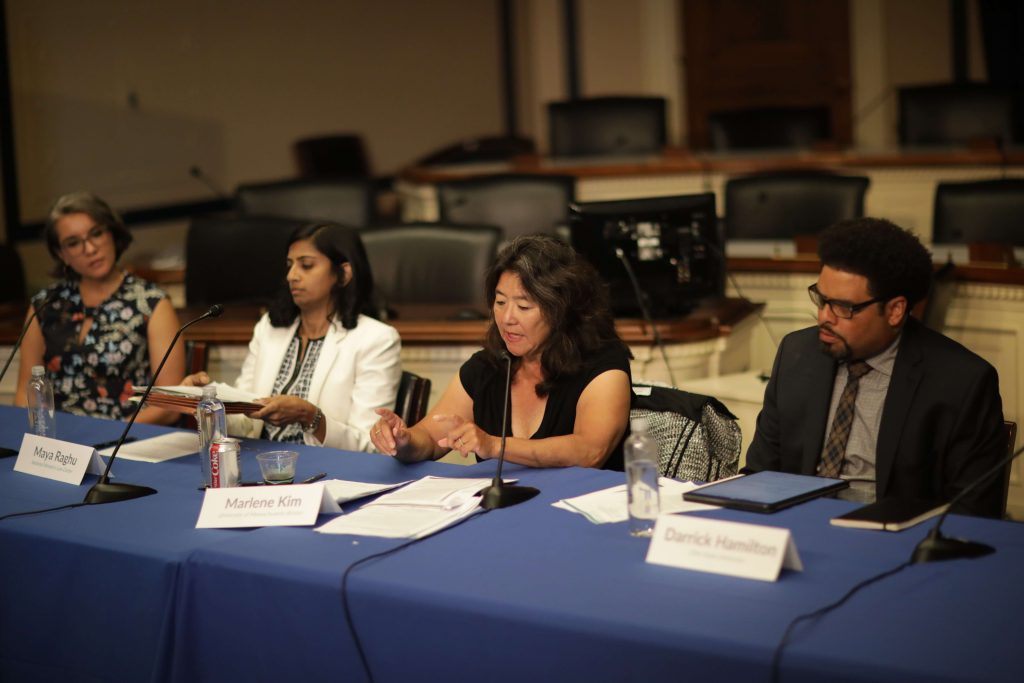
On July 9, the Washington Center for Equitable Growth hosted a conversation on wage gaps for women and people of color, and what we can do about it.
Wage stagnation and falling economic mobility are endemic economic problems in the United States. Their effects fall most severely on communities of color and women, who also face large wage gaps compared with white men. Key to solving wage stagnation and overall income inequality is a recognition that deeply ingrained structural forces keep many Americans from sharing in economic prosperity. This event will feature research and discussion from policy experts on the wage gaps in U.S. society.
Racial and Gender Wage Gaps Event (opens in a new tab)
Featured:
Heather Boushey, Executive Director, Washington Center for Equitable Growth (Welcome Remarks)
Alma Adams (opens in a new tab), Congresswoman, North Carolina’s 12th District, Chairwoman, Workforce Protections Subcommittee (Keynote)
Discussants:
Kate Bahn, Director of Labor Market Policy and Economist, Washington Center for Equitable Growth
Darrick Hamilton, Executive Director, Kirwan Institute for the Study of Race and Ethnicity; Associate Professor of Economics and Urban Policy, Ohio State University
Marlene Kim (opens in a new tab), Professor of Economics, University of Massachusetts, Boston
Maya Raghu (opens in a new tab), Director of Workplace Equality and Senior Counsel, National Women’s Law Center
Carmen Rojas (opens in a new tab), Co-Founder and CEO, The Workers’ Lab
The conversation examined intersectional wage gaps in the United States for workers of different genders, races, ethnicities, and backgrounds, and covered the following topics:
- What are the specific wage gaps experienced by different identity groups, and why is it important to look at them through an intersectional lens?
- Why has wage inequality among workers based on their identity been so persistent? How are historically disadvantaged groups of workers held back from sharing in the gains of economic growth?
- Are unions equipped to promote inclusive wage increases and strengthen worker bargaining power? What other models of worker collective action are promising for boosting wages for historically disadvantaged groups?
- What are appropriate policy responses to protect workers from harmful effects of workplace fissuring and ensure that pathways to the middle class remain accessible in the “future of work”?
For any questions, please contact events@equitablegrowth.org (opens in a new tab).


Don’t Miss Our Upcoming Events
Stay connected with Equitable Growth. Sign up for our newsletter to receive the latest research, event invitations, and expert insights delivered directly to your inbox.