


Policy
What Work Does Generative AI Do?
Essays SEP 8, 2026
By: Alexander Bick, Adam Blandin, David Deming, Tyler Schumacher
AI, Tech & Energy
Labor, Wages & Worker Power

This is a weekly post we publish on Fridays with links to articles that touch on economic inequality and growth. The first section is a round-up of what Equitable Growth has published this week and the second is work we’re highlighting from elsewhere. We won’t be the first to share these articles, but we hope by taking a look back at the whole week, we can put them in context.
Expanding access to high-quality prekindergarten and child care programs could be a huge boon to the U.S. economy. But recent studies of pre-K programs have raised concerns about the effectiveness and scalability of these programs. Looking at past research can provide a framework for building better and more expansive programs.
Research published during the past couple of years has revealed that business dynamism is on the decline in the United States. While the focus has mostly been on the declining startup rate, a new paper shows that the startups we do have in the United States are also growing slower.
Seven years of zero-interest-rate policy appears to be coming to a close. Some of the data from the U.S. Bureau of Labor Statistics’ widely covered Employment Situation report might make it look like the U.S. labor market is doing just great. But a look at the data from the Job Openings and Labor Turnover Survey—also known as JOLTS—reveals a labor market that could use more time to recover.
If you read about debates about taxing capital, more likely than not you’re reading about the influence of the tax rate on capital gains. But that debate misses other forms of capital income, such as unrealized gains. It is worth remembering that when we thinking about capital taxation.
While the U.S. economy is widely regarded as highly innovative, the distribution of innovation across the United States is far from even. What determined this distribution? In a report for Equitable Growth’s “History of Technology” series, University of California, Santa Barbara history professor John Majewski looks at the impact of slavery on economic creativity.
When it comes to Federal Reserve policy, the focus has decidedly been on when the central bank will start to raise short-term interest rates. But with that decision all but made, perhaps policymakers, both fiscal and monetary, should start thinking about how to fight the next recession, Larry Summers argues. [wa post (opens in a new tab)]
The idea of a universal basic income, or an unconditional cash payment to every resident of a jurisdiction, is one that stirs strong debate and supporters with varying views of economic policy. So when Finland seemingly announced it was shifting to a UBI, there was a bit of an uproar. But as Dylan Matthews reports, the country is merely proposing evaluations of the policy. [vox (opens in a new tab)]
The rise of the “gig economy” is supposedly the wave of the future, with companies like Uber and TaskRabbit disrupting the labor market. But the data on the extent of the phenomenon is unclear to say the least. Shane Ferro shows that we really aren’t sure how big the gig economy really is. [huff post (opens in a new tab)]
The aging of the global population is a fact, but the impact of this demographic change is uncertain. A number of economic commentators have argued that an older population will result in higher interest rates, lower inequality, and lower returns to capital. Matthew C. Klein points to Japan as a counterexample to this prediction. [ft alphaville (opens in a new tab)]
One of the many concerns about the U.S. labor market after the Great Recession was the specter of underemployment. Workers with college degrees would end up stuck in jobs that don’t require the level of education they earned. That concern might be overblown, at least in the long run, Lydia DePillis writes. [wonkblog (opens in a new tab)]
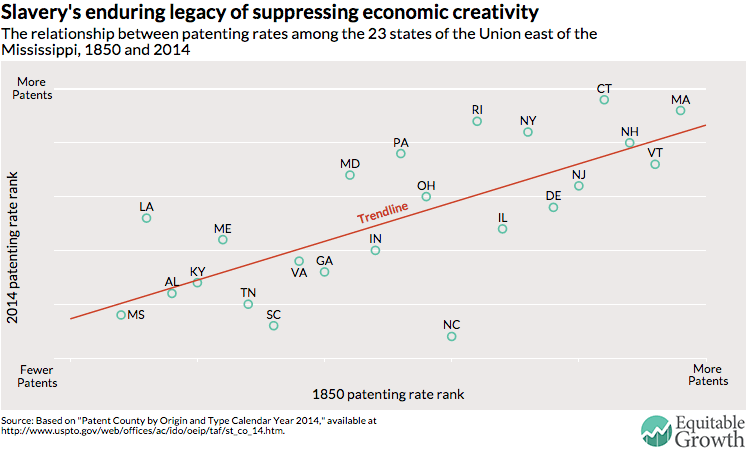
Figure from “Not all inequality is the same” by University of California, Santa Barbara’s John Majewski
Essays SEP 8, 2026
By: Alexander Bick, Adam Blandin, David Deming, Tyler Schumacher

Essays SEP 2, 2026
By: Megan Rivera

Essays AUG 31, 2026
By: Christopher Bangert-Drowns
Get updates on our latest research, event announcements, and policy insights delivered straight to your inbox. Stay connected with the leading voices on equitable growth.


