




Policy
Trump’s trade war with Canada grows increasingly costly as Section 338 tariffs harm both economies
Essays SEP 22, 2026
By: Christopher Bangert-Drowns
Macroeconomics & Economic Measurement
Taxation
 Browse All Resources
OCT 24, 2017
Read the full PDF in your browser (opens in a new tab)
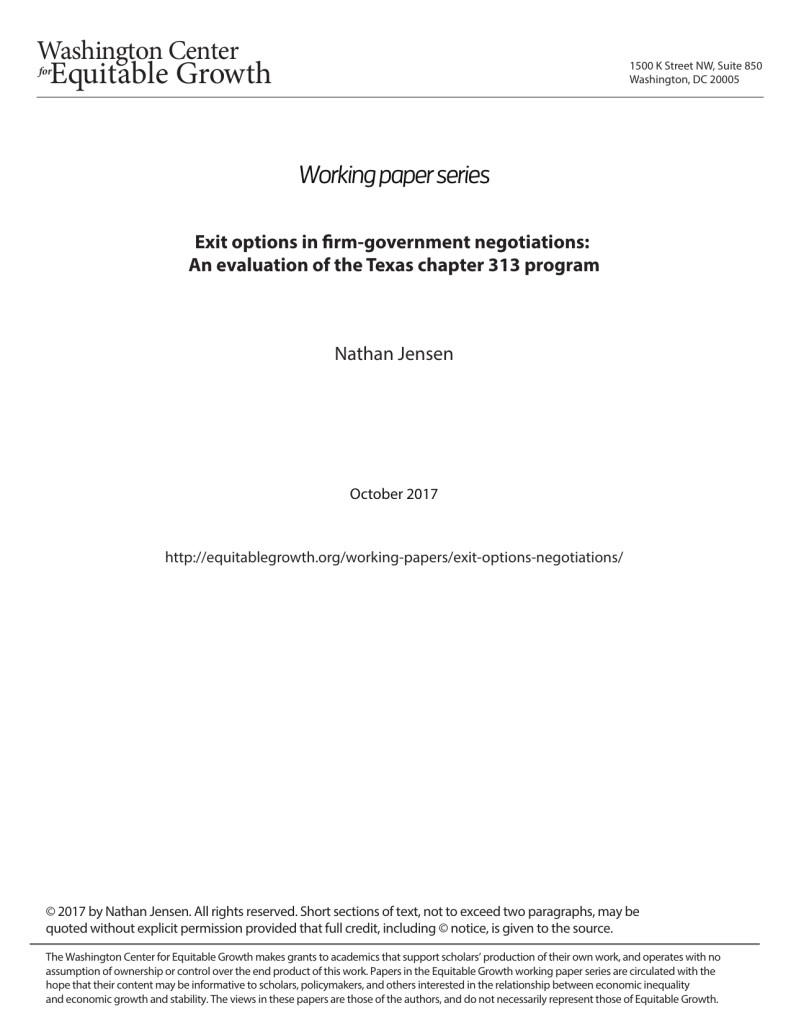
Existing research has examined how the mobility of capital shapes bargains between firms and governments. The major barriers to examining bargaining behavior include the large number of dimensions to these bargains, lack of knowledge of the utility functions of both firms and governments, and differences in capacity and strategy between firms and governments. In this paper, I examine data from a unique economic development incentive program in the state of Texas that holds almost all elements of bargaining constant, leaving only the ability of firms to walk away from a given location during the bargaining process. Using original data on the bargaining outcome as well as elite opinions, I document the extent to which firms that chose to locate in Texas made their decisions independent of this special economic development program. My findings suggest that only 15% of the firms participating in the program would have invested in another state without this incentive. The majority of these projects, and incentive dollars, were allocated to firms already committed to investing in Texas. Case studies of over 80 projects reveal that in many cases it was an open secret that companies had already committed to their investment locations prior to receiving the incentive. This implies the that structure of the program encourages the overuse of incentives.
Essays SEP 22, 2026
By: Christopher Bangert-Drowns

Essays AUG 14, 2026
By: Carlos Fernando Avenancio-Leon
Working Papers AUG 14, 2026
By: Carlos F. Avenancio-León, Yutao He, Michael Reher
Get updates on our latest research, event announcements, and policy insights delivered straight to your inbox. Stay connected with the leading voices on equitable growth.


